

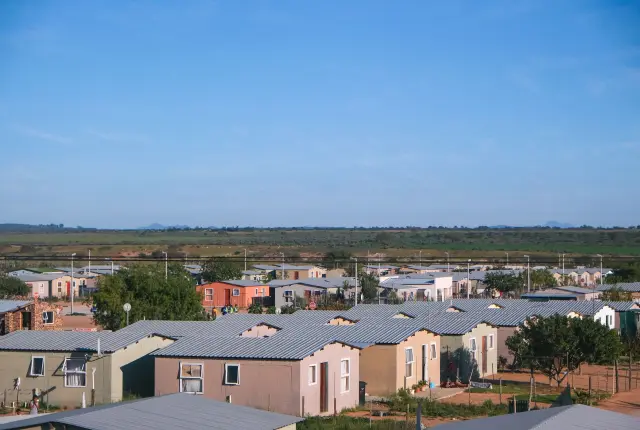
Affordable
Housing in Johannesburg: The Role of Private Developers in Meeting Demand
The lack of affordable housing is a severe problem in South Africa due to the boom of urbanization and population, along with the existing socio-economic disparities. Low- and middle-income households of millions of people have difficulties reaching safe, adequate and affordable housing.
 Although there have been the efforts by government-led housing programs like the
Reconstruction and Development Programme (RDP) and social housing projects to
provide a large number of units, these programs have not been adequate to match
the increased demand. The lack of available budgets, sluggish delivery and
urban land scarcity have raised the issue of complementary strategies.
The importance of private investment is also being appreciated as a major way of closing this housing gap. Capital, new construction methods, and market efficiencies that could speed up the delivery of housing are introduced by the investors.
Other partnership forms including
the public-private partnerships have demonstrated the potential of integrating
financial resources and government incentives in developing sustainable
affordable forms of housing.
This blog discusses how the affordable housing industry in South Africa should be supported by privately funded investment. Each of the sections analyses an important aspect, such as the benefits, challenges, ways of financing, urban planning, innovation, and long-term effects.
Through
the analysis of these points, it is discussed how the role of private
investment can be used alongside public measures to offer inclusive,
affordable, and sustainable housing to the rising urban population of South Africa.
Knowledge of the South African Affordable Housing Gap
The extent of the affordable housing shortage in South Africa is humongous. Informal settlements or overcrowded cities and cities, which contain millions of households, do not have access to basic services such as sanitation, water, and electricity. The issue is further worsened by rapid urban migration, especially in the large urban centers like Johannesburg, Cape Town, and Durban.
This increased demand makes it clear that any particular
governmental housing strategy cannot effectively serve the needs of the low-
and middle-income population without considering public housing.
Even though government interventions such as RDP and social
housing projects have achieved a lot, there are constraints. Lack of money to
fund the construction budgets, construction delays, and inadequate allocation
of land have contributed to slow delivery, which has left most households in
deplorable conditions. Additionally, the increase in urban land and
construction prices puts large-scale state-oriented projects into question.
This gap can be filled through the use of private investment to mobilize more financial resources, cost-effective ways of construction, and reduction of project timelines. With such an initiative through market efficiencies and innovative solutions, the government's efforts can be augmented by the role of private investors to affordably offer housing at scale.
It is important to know the scale, characteristics and causes of the housing deficit in South Africa in a bid to create effective investment policies that are sustainable and inclusive.
The benefits of Private Investment in Affordable Housing
The South African affordable housing industry has numerous benefits of the privately invested capital. First, investors avail capital, which can be mobilized by government programs otherwise.
This supplementary
finances enable the projects to run at quicker speeds to make sure that many
households can use affordable housing solutions. The knowledge of project
management, effective construction methods and design innovation delivered by
the private developers can also make the projects cost-effective and better.
Second, privately-owned investments promote market-oriented
solutions, which cater to the various housing demands. The developers will be
able to develop a combination of residential products, including entry-level
apartments and mid-market ones, and thereby serve a wider range of low- and
middle-income populations. This diversity makes the housing projects accommodating and demand responsive.
Another major strength is innovation. Modern construction
technologies, modular designs, and energy-saving materials are also easily
implemented by the private investors and help to save operational costs that
the residents would incur in the long run. Project management, supply chain
optimizing and maintenance monitoring digital tools are also efficient.
Generally, private investment is a supplement of the public
efforts to deliver faster, enhance the quality, and offer some scaleable
solutions. Nevertheless, these advantages should be well balanced with
regulation and societal goals so that in the name of profitability, neither
affordability nor inclusivity would be affected.
Finance models and investment strategy
Funding affordable housing needs novel methods to strike a
balance between profitability and affordability for investors and the
residents, respectively. Another framework that is prevalent in South Africa is
the use of PPP, which is a blend of government incentives, including land
allocation, tax breaks, or subsidies, and private capital. The similarity in
risk structure enables the projects to proceed with their operations and meet the affordability targets.
There are also a wide variety of financing options that are available to private investment, such as social impact funds, blended finance and long-term investment vehicles like pension funds.
These models help
investors to invest in housing projects and earn long-term returns. Creative
programs such as rent-to-own or cooperative ownership enable households with
low initial capital to access housing, which opens the possibility of wealth
acquisition and financial inclusion.
Also, phased delivery and mixed-income units can be
implemented in the project structuring to make it financially viable. The
resources are further optimized by high-density layouts, prefabrication, and
cost-sharing agreements with the local governments. The alignment of individual
interests with social goals makes the financing models not only profitable but
also affordable.
Efficient investment policies demand proper legal
frameworks, open contracts, and surveillance systems to safeguard residents as a
way of enticing the involvement of the private sector. Properly structured, the
financing models can open the door to large-scale affordable housing
developments that can relieve the backlog of housing in South Africa.
Public-Private Partnerships in Housing Development
One of the strategies that have emerged in efforts to
incorporate the element of private investment in affordable housing
projects is that of public-private partnerships (PPP). PPPs capitalize on the
advantages of the two industries: governments offer land, regulation, and
subsidies, whereas the private developers bring in capital, construction
experience, and efficiency. Such a partnership will help to speed up the
process of project execution and make housing affordable to the low- and
middle-income families.
Design, construction and financing is also enabled through PPPs. Through funding risk and responsibility, the governments can encourage the participation of private investors into projects that would otherwise be cost-prohibitive.
The PPP models frequently lead to mixed-use development projects, transit-oriented projects and integrated community plans, which avail inhabitants with the necessary services, transportation, and economic opportunities.
PPP depends heavily on monitoring and governing. Open contracts
and involvement of stakeholders minimize chances of mismanagement or
profitability concerns which may affect the well-being of the people.
Innovation and Technology in Housing Projects of the Private Sector
The introduction of new technology in affordable housing in South Africa by private investment enhances cost-efficiency, efficiency, and sustainability of housing. Modern technologies like modular construction, prefabrication, and 3D-printed housing parts reduce the time required to build and reduce the cost of materials. Long-term affordability of residents is also promoted by energy-efficient designs and environmentally friendly materials.
Solar panels, water saving appliances and insulated materials
save on utility bills, making the living conditions more sustainable. Moreover,
digital project management software and supply chain optimization systems
simplify the work process, minimize the time spent on delays, and optimize
resources.
Innovative financing and management solutions are also
supported using technology. Through internet, rent collection, maintenance
reporting and communication with residents are feasible, as transparency and
efficiency can be achieved in management of property. Digital monitoring tools
will help investors and municipalities to follow the performance of the
project, its compliance, and customer satisfaction.
With the incorporation of innovation and technology, the sole purpose of the private investment is to not just increase the supply of housing, but also enhance the quality, sustainability and livability.
These
developments enable personal involvement as one of the strategic means of
providing affordable houses to satisfy the demands of the expanding urban
population of South Africa.
Overcoming the Problems of Affordability
Although it is possible to hasten the delivery of houses
through private investment, the issue of affordability is still a significant
problem. Privatizers are inherently driven by profit motives, which can be
counterproductive to such objectives as affordable housing to the low-income
population. The risk of serving the most vulnerable groups with the least
regulation is that without proper regulation, the private projects will be
available to people with middle-income only.
This is alleviated by a number of measures. Affordable units
can be viable to the developers when the government provides subsidies and
taxation benefits and low land prices. Mixed-income developments have low,
middle, and market-rate housing, which enables investors to cross-subsidize
affordability without losing profitability.
New models of finance, including rent-to-own, cooperative ownership and social impact bonds offer homes access to gradual homeownership that avoids the initial financial obligations.
Redundancy designs with high
densities, modular construction and cost sharing with the municipalities are
used to save on the costs further allowing the cost to be lowered in terms of
rental or purchase price.
Through a thorough design of the projects and synchronization between individual incentives and the societal goals, investors are able to provide affordable housing on a large scale.
Affordability is not
only a moral and social requirement but it is also a practical approach to
assure of long term occupancy, stability of the community and the long term
returns on investments.
Urban Planning and Community Integration
The utilization of the advantages of affordable housing private investment cannot be achieved without proper urban planning. The location of the projects should be strategic, close to transport hubs, employment centers, schools, and even healthcare to increase the accessibility of economic and social opportunities to residents.
The development of poor
location poses a threat of further spatial inequality that has existed since
history and the isolation of residents who may not be able to access basic services.
There is a growing trend in which mixed-use designs
and community-oriented layouts are included in affordable housing projects by private investors. Development through the incorporation of residential
homes into commercial spaces, recreational parks, and other areas of social
services makes developments self-sustaining, lively neighborhoods. These designs
promote socialization and community building in the surrounding environment
and the economy.
It is also important to plan infrastructure. Sufficient
roads, water, electricity, sanitation and open areas make the developments
acceptable to live in the long run. The close working hand in hand with the
municipalities and urban planners enables the private developers to work in the
interest of the city at the interest of sustainable and inclusive growth of the
city.
Through integration of the private investment strategy with
proper planning of the urban areas, affordable housing schemes do not just
offer shelter but build thriving and integrated communities capable of
decreasing inequality and enhancing the lives of the people that live in them.
Success Case Studies of the Private Sector
The sector has the potential in affordable housing, as evidenced by several successful private investment projects in South Africa. The example of Cosmo City in Johannesburg, developed on the basis of public-private collaboration, could be referred to.
The project combined
affordability and market-rate residential properties with schools, medical
centers and business premises to form a mixed-income, well-serviced
neighborhood.
Social housing development by the privates companies has
shown good construction in Cape Town, which is cost effective and of good
quality as well as having innovative financing schemes, including rent to own
schemes. These projects are affordable and sustainable in the long run and they
offer the community basic infrastructure.
Lessons can also be learned using international examples.
This was the work of the private developers in Brazil, Colombia, and India
where they worked with government to provide high-density affordable housing
coupled with government services. These models put emphasis on strategic
planning, finances and community participation to make it available and
inclusive.
These case studies show that when privately invested and
supported with government, as well as in a properly managed way, housing
delivery can be fastened, better, and be inclusive. They can be used as a
prototype of scaling affordable housing solutions in South Africa and managing
social, economic, and spatial inequalities.
Policy Recommendation on Improving Private Investment
To ensure that the impact of private investment on affordable housing is achieved to the maximum, South Africa needs to introduce policies that will strike a balance between profitability and social goals.
Fast-tracked regulatory procedures, land allocation, and planning approvals
will minimize delays in the project and make investors participate. Affordable
housing can be obtained through government incentives like tax breaks,
subsidies or low cost of land.
The use of public-private partnership is encouraged whereby
the government should support it with its own expertise and funds to make it
affordable, quality, and long-lasting. Funding strategies such as blended
finance, social impact funds, and rent-to-own plans increase the access of low-
and middle-income families.
Based on the regulations of urban planning, there should be
promotion of mixed-use, transit-oriented and high-dense designs where the
developments must be integrated well with the existing urban infrastructure.
Mechanisms of monitoring, transparency and community involvement are
fundamental in ensuring a social purpose and accountability.
Through the introduction of friendly policies and regulatory frameworks, South Africa can take advantage of the infusion of private investment to deal with the shortage of housing.
Having the private incentives
aligned to the social purpose provides the fiscal soundness of the affordable
housing projects; their social inclusiveness and sustainability thrive,
resulting in benefits over both the long-term to both the residents and
investors and cities.
Conclusion
The issue of affordable housing in South Africa can be transformed through the involvement of private investment. Investors are associated with the availability of capital, new construction processes, operational efficiencies, and financial skills to supplement the efforts of the government in providing housing on a mass scale.
Mixed-income developments,
innovative mechanisms of financing, and public-private partnerships can be used
as evidence and show that the sector is capable of delivering sustainable,
inclusive, and high-quality housing solutions.
Nevertheless, the profitability goals should be set against the social requisites to make them affordable, accessible, and equitable. Government policies, incentives and control are critical in directing the investment process of the private sector to attain socially responsible results.
The city planning, integration of communities and long-term
maintenance also make sure that projects are habitable and help in minimizing
spatial and economic inequality.
Probably, properly implemented, the private investment will be able to speed up the provision of housing, enhance quality, and provide vibrant, inclusive communities that can empower the inhabitants and promote socio-economic mobility.
Through a mix of social accountability and business efficiency, the affordable housing gap can be filled in South Africa to develop sustainable and combined city spaces.
Conclusively, the aspect of the private
investment is never an independent solution but rather an important ally in the
development of equitable, resilient, and inclusive housing to every South
Africans.





-ySWGlp0vgc.jpg)










LEAVE A REPLY