

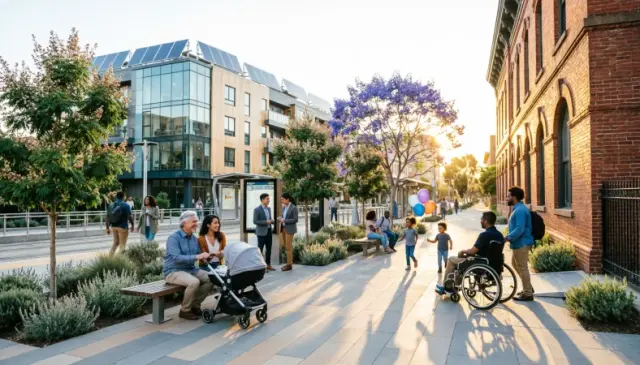
Transit-Oriented Affordable Housing: Building Near Mass Transit Without Displacement
With the process of urbanization taking place in cities all over the world, the nexus of housing affordability, transportation access, and social equity has been ranked among one of the most urgent urban developments of the 21st century.
 Compact and mixed-use development adjacent to the mass
transit facilities has long been advocated as a remedy to urban sprawl,
traffic congestion, and climate change through the concept of transit-oriented
development (TOD).
Nevertheless, despite these environmental and economic advantages that cannot be overlooked, TOD has also been related to increased rents, property speculation, and relocation of long-established communities with low incomes.
This strain has given rise to a pressing dilemma: how to
develop transit-oriented affordable housing and still not displace residents
who are so targeted by the investments?
The idea of transit-oriented affordable housing aims to match the affordability of housing with the affordability of public transport so that low- and middle-income earners do not need to meet their needs by owning a car, which is costly, but can now afford to live near employment, schools, healthcare, and other important facilities.
Under fair
distribution, it can save money on household transportation, decrease carbon
emission, and make cities inclusive. When improperly executed, it may hasten
gentrification, increase inequity, and also divide neighborhoods.
This blog discusses the way cities can both seek transit-oriented affordable housing and address displacement. It considers the principles of equitable transit-oriented development, the role of public policy, the significance of community involvement, creative financing and land use schemes, planning and zoning, and practical lessons from cities that tried to balance growth and justice.
Combined, these views suggest that
the construction of near mass transit does not necessarily need to be at the
expense of the stability of the community; equity is at the core of
planning and execution.
Understanding Transit-Oriented Development and the Roots of Displacement
Transit-oriented development relies on a very straightforward and powerful concept: focusing housing, employment, and services close to high-quality transit means that people can walk to them.
This model
minimizes car reliance, minimizes the emission of greenhouse gases, and also
makes cities efficient and habitable. Nonetheless, with these advantages, TOD
has frequently had undesirable social impacts, especially on low-income tenants
and people of color.
Transit investment is associated with displacement that usually takes place in several interrelated ways. The value of land within the environs is likely to increase at a high rate when new transit lines or stations are announced.
The investors and developers expect demand to be in the future, and thus they start purchasing property, sometimes far before it is even constructed. This speculation has the capability to push rents and property taxes high, which strains the tenants and small homeowners who might already be vulnerable financially.
With time, the long-term residents have no option but to move farther away, increasing the distance between these residents and transit, jobs, and services, which TOD is meant to offer.
The historic divide between housing policy and transportation planning is also another cause of displacement. Agencies that handle transit tend to put a very small lens on ridership, efficiency, and delivery of infrastructure, and housing affordability is considered as a different problem.
In the absence of coordinated planning, investments in
transit may inadvertently trigger the development of luxury housing instead of
affordable housing, transforming the neighborhoods so that no one can afford to
live there anymore.
One should as well note the disinvestment/segregation legacy
that defines the location of transit investments. Most of the low-income
neighborhoods lack efficient tenant protection, limited political influence,
and old houses. In transit, it may be an agent of sudden change in previously
neglected areas, as well as making inequalities worse instead of fixing them.
It is necessary to understand such dynamics to design affordable housing based on transit that does not entail any displacement. Equity is not an automatic process, but one that has to be intervened.
As a
recognition of the displacement process and those who are most vulnerable,
planners and policymakers can start to develop strategies that safeguard
residents, maintain affordability, and prioritize transit investments to
already established communities.
The Role of Public Policy in Protecting Affordability near Transit
One of the most effective tools that can be used in ensuring that transit-oriented development incorporates affordable housing and reduces displacement is public policy. Market forces will virtually always prefer higher-income development along transit in the market, where land prices are the highest, and the returns are more predictable, unless there are robust policy frameworks to the contrary.
Local governments, regional
governments, and national governments have a decisive role in the establishment of
rules that influence the outcome of development.
Proactive conservation of affordable housing around transit corridors is one of the best policy approaches. This may involve financing the purchase and renovation of already available affordable buildings, especially those that dangerously run the risk of being transformed into market-rate housing.
Public agencies and nonprofit partners can easily access
housing that will be affordable over the decades by being early enough,
sometimes even before a new transit line opens.
Another important policy lever is inclusionary zoning policies. These policies compel or encourage developers to incorporate some proportion of affordable units in new residential developments, particularly those that are close to transit stations.
Inclusionary zoning can be used to
make sure that the new development adds to the mixed-income communities and is
not an exclusive enclave when designed with due consideration. The financial
incentives or subsidies would, however, have to accompany such policies in order
to survive in the high-cost markets.
Policies that offer protection to tenants are also very significant. Rent stabilization, just-cause eviction, and right-to-return provisions can ensure short-term protection of people living near transit investments. These policies can be used to avoid cases of abrupt displacement by a hike in rent or redevelopment, as well as providing tenants with more security at times of neighborhood transition.
Lastly, there should be coordination of plans between transit agencies and housing departments. When transit expansions are planned to meet housing affordability objectives at the beginning, cities can know where affordable housing is needed the most, allocate government land to well-balanced development, and prioritize investment in a way that causes minimal harm.
With a deliberate and coordinated push of public policy,
transit-oriented development can become a source of displacement instead of inclusive
growth.
Power of Resident-led Planning and Community Engagement
Communal involvement is central to sustainable
transit-oriented affordable housing. There is a tendency to make decisions
about transit and development without the contribution of the residents who
live within the neighborhoods that are most impacted. This not only destroys
trust, but also results in the outcomes that do not satisfy the needs of the
community and aggravate the possibility of being displaced.
Resident-led planning changes this because the community
members will be at the core of decision-making. Instead of viewing engagement
as a checkbox, cities can create structures that provide residents with actual
power over land use, housing priorities, and development outcomes near transit.
This would involve community advisory boards, participatory planning, and long-term relationships with local organizations.
Local knowledge can be considered one of the most important advantages of community engagement. The people living there become aware of the history, culture, and social networks of their neighborhoods.
They are able to
tell what types of housing are required, which buildings are most vulnerable to
disappearance and how a new development can be supportive and not disruptive to
the life of the community. This information is invaluable in creating affordable housing and at the same time suitable and sustainable.
Good community organizing frequently results in community land trusts and cooperative housing models. Such models take the land off the speculative market and put it under community ownership so that it remains affordable permanently around transit.
When the locals own it and are part of
the management, they stand better chances against pressures to vacate it in the
long term.
Authentic engagement is also an important criterion of
trust-building. By demonstrating to the communities that their input will give
rise to concrete outcomes, like affordable units, local employment, or small
business safeguards, communities are more likely to approve of transit
investments. This can help to minimize conflict, accelerate project execution,
and develop stronger neighborhoods.
Finally, affordable housing built around transit cannot be
successful without community buy-in. Transit-oriented affordable housing should
not be built without ensuring that development processes are reflective of
shared values, protect disadvantaged groups, and build stronger neighborhoods
instead of eliminating them.
Financing and Land Strategies for Equitable Transit-Oriented Housing
There are special problems in financing affordable housing
in an area near mass transit, mostly because land prices are prohibitive and
market-rate developers are stiff competition. To counter these challenges,
innovative ways of financing and land ownership strategies are needed that focus on long-term affordability, rather than on short-term profit.
In this equation, the role that is played by the public land
is significant. Affordable housing can be built on land owned by cities,
transit agencies, or other governmental structures around stations on long-term
ground leases or at reduced sales prices. By eliminating land expenses in the
development equation, public agencies can transform the possibility of
affordable housing projects in transit-rich areas.
Another strategic approach is value capture mechanisms.
Transit investments are known to boost the value of nearby property to create
new economic value. Applicants can capture a part of this value using tools
like tax increment financing, special assessment districts, or linkage fees and
invest it in affordable housing and anti-displacement programs. In a fair
organization, the value capture will make the benefits of transit investment be
distributed widely instead of being concentrated in the hands of private
interests.
Transit-oriented affordable housing may need to be laidered
in order to make it possible. This can be a combination of publicly subsidized
funds, low-income housing tax credits, philanthropic grants and mission-driven
private capital. Although complicated, these financing arrangements allow
developers to provide extremely affordable units in high-priced,
transit-accessible communities.
This work is especially suitable to the work of nonprofit
and community-based developers. They do not maximize profits, unlike
profit-maximizing firms; however, their missions to be long-term and to have a
strong connection with the local communities. Technical assistance,
predevelopment funding, and simplified approvals can expedite the development
of equitable transit-oriented housing with the support of these developers.
The cities can offset the market pressures by integrating
land policy and financing instruments with equity objectives, so that
affordable housing can be the core element of transit-oriented development.
Design, Zoning and the Development of Inclusive Community Transit
The choices of design and zoning influence the social
aspects of transit-oriented development as well as the physical form of the
same. Considered design could facilitate inclusion, accessibility and community
integration, whereas exclusionary zoning, and ill-advised design may support
segregation and displacement.
Although it is not always a requirement, zoning reform is often necessary in order to develop affordable housing close to transit. Several of the densely populated neighborhoods have been developed with old zoning regulations, which restrict the density, ban multifamily buildings, or set prohibitive parking norms.
Such limitations increase prices and limit the
availability of housing. Cities can make it easier to construct affordable
housing close to transit by permitting more density, cutting the minimum size
of parking, and also by enabling more types of housing to be constructed.
The quality of design is also important. Affordable housing needs are not an isolated or stigmatized component of a mixed-income development and the immediate area but rather needs to flow naturally into the neighborhood instead.
Community spaces on the ground floor, streetscapes that
are friendly to pedestrians, and the provision of local services can result in
vibrant, inclusive transit communities that make life better for all residents.
Access is the other important consideration. The affordable
housing that is transit-oriented should be developed to cater to the needs of
the seniors, those with disabilities, families and individuals with varied
needs. Quality of life can be improved based on universality principles and
distance to services of main necessity and decreasing the obstacles to
movements.
Notably, the community should be included in design
processes. They can make the buildings, open spaces and facilities according to
the size preferred by residents so that they do not interfere with the
character and cultural identity of the neighborhood. Communities feel as
representatives of the new development and this results in fewer resistance and
a feeling of ownership.
Such concepts as inclusive design and zoning are not
technical issues only; they are the manifestations of values. They give an
indication of how a city values equity and belonging or how the city permits
the exclusion at the altar of growth.
Measuring the Success and Accountability in the Long-Term
To ensure that transit-oriented affordable housing can be effective in avoiding displacement in the real sense, success should not be determined by the quantity of units developed or the number of transit riders acquired, but by the stability of the entire community and happiness.
Projects
are often claimed to be successful after their construction is finished, although the pressures of displacement may go on for years thereafter. It is
necessary to create effective metrics and accountability mechanisms that would
enable any goals of equity to be maintained in the long term.
The main metrics of success are the long-term affordability, retention rates among tenants, and the potential to keep the existing residents living in their residential areas as the transit investments grow.
Cities
can observe any changes in rent levels, eviction rates, and demographic
composition near transit stations and take early warning signs of displacement
to prevent the damage before it occurs. The open disclosure of such metrics
will add transparency and will develop trust with the communities that were
traditionally locked out of the planning process.
There is also a need to have long-term affordability mechanisms, including deed restrictions, community land trusts, and long-term affordability covenants. Their absence will see affordable units become market-rate housing, and this action will destroy the initial purpose of transit-oriented development.
Developers, public agencies, and even policymakers should be held accountable, and there should be consequences in case of
non-fulfillment of promises.
Conclusion
Affordable housing and transit-oriented is one of the best opportunities- and challenges of the contemporary cities. Mass transit can also be used to align affordable housing, which will in turn reduce inequality, foster sustainability, and enhance the quality of life of millions of residents living in the cities.
However, transit investments may also enhance the rate of
displacement and increase existing inequalities without deliberate plans.
This blog has demonstrated that building near transit does
not necessarily bring about displacement. Cities can provide transit-oriented
development to individuals in greatest need by using powerful policies,
community-based planning, creative financing, strategic land use, and inclusive
design. Equity should be incorporated in all phases: planning and funding, as
well as design and long-term stewardship.
Finally, residential construction that does not involve eviction is a matter of change of perception. It requires that cities consider housing a core infrastructure, communities as assets and not barriers, and transit as a means not only to mobility but also to justice.
Transit-oriented affordable housing is a force capable of creating inclusive, resilient, and prosperous urban communities when these principles affect action.
Also read: The 10 Least Affordable Cities in The World (2026 Ranking)













LEAVE A REPLY