
Affordable Housing In Algeria: Policies, Projects And Expectations. The Case Of Rental-Sale Housing In Algiers
1. Introduction to Affordable Housing in Algiers
Affordable Housing remains one of the most pressing urban challenges in the world, and nowhere is this more evident than in rapidly growing cities like Algiers, the capital of Algeria. Historically, population growth, internal migration, and urbanization have exerted immense pressure on housing markets, making Affordable Housing a central policy objective for national and local governments. The report Affordable housing in Algeria: policies, projects and expectations explores how the Algerian state has responded to this challenge, particularly through Affordable Housing programs like rental-sale housing in suburban districts such as Sidi Abdallah.
Over the past decades, Algeria has witnessed rapid growth in urban population and consequent housing shortages. Affordable Housing has not only become a social necessity but also a political priority intended to promote equitable access to shelter and improve living conditions for low- and middle-income households. This summary synthesizes the main insights of the report — including historical context, policy frameworks, project implementation, outcomes, and ongoing expectations.
2. Understanding Affordable Housing: Conceptual Framework
2.1 Definition and Scope of Affordable Housing
At its core, Affordable Housing refers to housing that is priced or subsidized in such a way that low- and middle-income households can secure decent shelter without spending an excessive share of their income on housing costs. Definitions of Affordable Housing vary across countries and contexts, but the common thread is the goal of making decent, secure shelter accessible to households that cannot afford market-rate housing without financial stress.
In Algeria, Affordable Housing is often used interchangeably with social and rental-public housing, particularly when delivered or subsidized by public authorities to serve households with limited incomes. These housing units are typically developed under government programs that lower financial barriers to entry while aiming to provide secure tenure and basic services.
2.2 Measuring Affordability
The concept of Affordable Housing is grounded in the idea of housing costs relative to household incomes. Generally, housing is considered affordable if cost (rent or mortgage plus utilities) does not exceed a certain proportion of household income, allowing households to meet other essential needs without hardship. This affordability benchmark varies globally but often references a threshold such as 30% of household income.
3. Historical Context of Affordable Housing in Algeria
3.1 Post-Independence Urban Growth and Housing Shortage
Algeria’s urban housing history is shaped by rapid population growth — from about 37.1 million in 2012 to 45.4 million in 2022 — and accelerated rural-to-urban migration that intensified demand for housing in cities like Algiers. This demographic trend resulted in pervasive shortages of Affordable Housing, driving large segments of the population into informal settlements and slums with inadequate services and precarious living conditions.
Persistent housing deficits pushed the Algerian government to adopt interventionist housing policies soon after independence in 1962. Over successive decades, various housing supply programs were implemented to expand urban housing stock and regularize informal settlements. However, demand often continued to outpace supply, compelling authorities to innovate and scale up Affordable Housing initiatives.
4. Government Policies on Affordable Housing
4.1 Evolution of National Policy Frameworks
Affordable housing policies in Algeria have evolved to include multi-layered strategies involving institutional reforms, financial mechanisms, and direct housing provision. Early housing strategies focused heavily on public rental housing and slum eradication, with public authorities playing a central role in land acquisition, construction, and allocation.
Over time, policy frameworks have expanded to include partnerships with international institutions like the World Bank, which supported slum-upgrading and housing finance projects in the late 1990s and beyond. These collaborations sought to enhance financial mechanisms, improve institutional capacity, and connect Affordable Housing delivery with broader socio-economic outcomes.
4.2 Institutional Roles and Coordination
Under Algeria’s policy regime, multiple layers of government — including the Ministry of Housing and Urban Planning and local municipalities — coordinate to design, fund, and implement Affordable Housing projects. These agencies oversee eligibility criteria, subsidy mechanisms, land allocation, and construction standards.
By providing clear regulatory frameworks and financial support, authorities aim to facilitate access to Affordable Housing for eligible households while ensuring that projects meet technical and social objectives. This coordination is crucial for maintaining quality, transparency, and equity in program outcomes.
5. Case Study: Rental-Sale Affordable Housing in Sidi Abdallah
5.1 Overview of the Sidi Abdallah Initiative
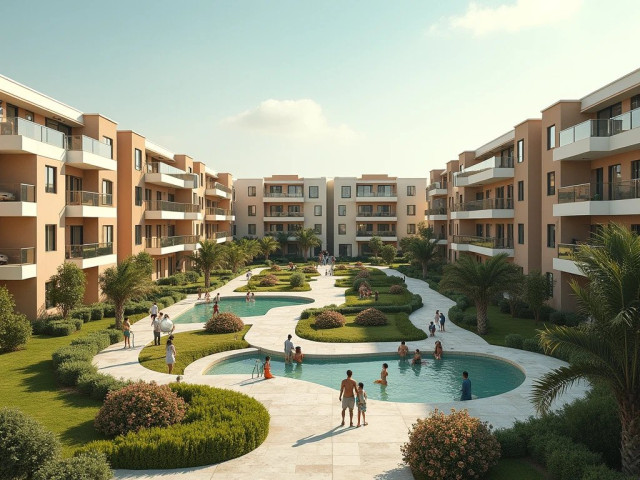
One of the most high-profile Affordable Housing programs in Algeria is the rental-sale housing scheme in the suburban area of Sidi Abdallah near Algiers. Developed by the Housing Improvement and Development Agency (AADL), these units provide a pathway to homeownership for middle-income households through structured payment plans.
Rather than traditional rental or outright sale, the rental-sale model allows households to inhabit units while paying toward eventual ownership. This blended tenure form combines the security and affordability of rental housing with a long-term asset accumulation pathway, making Affordable Housing more accessible to broader income groups.
5.2 Financial Design and Payment Structure
The Affordable Housing rental-sale units are financed via a structured payment schedule that spreads financial obligation over time, reducing upfront cost barriers. Beneficiaries typically pay monthly or periodic amounts that offset rent and towards future ownership, with final legal ownership transfer upon full payment.
This mechanism is particularly important in contexts where households lack access to traditional mortgage finance or face high interest rates. By reducing reliance on external credit and leveraging government support, more families can enter the housing market through Affordable Housing pathways that balance risk and long-term affordability.
5.3 Impact on Household Well-Being
Beneficiaries of Sidi Abdallah’s Affordable Housing programs generally experience improved living conditions, including better infrastructure, sanitation, and security compared to informal settlements. These improvements have positive knock-on effects on health, education, and economic participation.
Residents report greater stability and investment in their communities, as structured ownership pathways encourage long-term settlement and social capital formation. The availability of Affordable Housing thereby enhances both individual and collective outcomes, contributing to urban cohesion and socio-economic advancement.
6. Achievements and Progress in Affordable Housing
6.1 Scale of Production
Over recent decades, Algeria has significantly expanded its Affordable Housing output. Government reports highlight that substantial numbers of public rental and social housing units have been delivered, particularly in urban centers. These include large-scale programs producing hundreds of thousands of units to meet pent-up demand.
For example, housing production during national development plans included construction of hundreds of thousands of units, with public rental and participatory housing forming a large share. This demonstrates that Affordable Housing production has been institutionalized as a priority policy area.
6.2 Reduction of Informal Settlements
Targeted Affordable Housing initiatives have also achieved reductions in informal settlement prevalence, especially in built-up areas of Algiers. The government has implemented slum eradication and rehousing strategies that relocate families from precarious dwellings into structured housing with services, improving overall urban living conditions.
These efforts not only address housing deficits but also contribute to broader urban planning goals by enhancing infrastructure, public safety, and service delivery in rehabilitated neighborhoods.
7. Challenges in Delivering Affordable Housing
7.1 Financing Constraints
Despite progress, scaling Affordable Housing remains resource intensive. High land costs, construction materials expenses, and fiscal limitations constrain the pace and scale of interventions. Governments often require external financing and subsidies to maintain delivery rates, especially for low-income segments.
Securing sustainable financing — including through public budgets, international loans, and innovative financial instruments — is critical for meeting long-term Affordable Housing needs. However, competing public expenditures and economic volatility can complicate funding commitments.
7.2 Balancing Quality and Affordability
Another key challenge is balancing construction quality with cost efficiency. Affordable Housing programs must ensure that homes are durable, safe, and equipped with basic services while still being affordable for intended beneficiaries. Cost pressures and material shortages can undermine quality, requiring careful design and procurement strategies.
7.3 Targeting and Equity Issues
Effective targeting is essential to ensure that Affordable Housing benefits households most in need. Poorly designed eligibility criteria or allocation mechanisms can result in leakage of benefits to higher-income groups or speculative misuse of subsidized units. Transparent processes and clear income thresholds are necessary to preserve equity in provision.
8. Broader Implications and Expectations for Affordable Housing
8.1 Economic and Social Outcomes
The report highlights that Affordable Housing has multidimensional impacts — from improving individual household welfare to strengthening economic participation and reducing urban poverty. Stable housing allows families to allocate resources more effectively to education, health, and business opportunities, reinforcing social mobility.
Moreover, Affordable Housing stimulates construction sector activity, generating jobs and expanding related industries such as building materials production and urban infrastructure services. These economic multipliers strengthen macroeconomic performance while addressing housing shortages.
8.2 Policy Integration and Future Directions
Looking forward, the sustained success of Affordable Housing programs will depend on improved policy integration. This includes linking housing with land-use planning, transportation access, environmental sustainability goals, and economic development strategies. Spatial planning that situates Affordable Housing near employment hubs can enhance accessibility and reduce living costs.
Also, investing in housing finance reforms and innovative subsidy mechanisms — such as interest rate subsidies or cross-subsidization via public-private partnerships — can expand access for lower-income groups without straining public budgets.
9. Comparative Lessons in Affordable Housing Policy
Although the report focuses on Algeria, its insights reflect global patterns: affordable housing crises persist in many regions as urbanization outpaces supply, incomes lag behind housing costs, and market mechanisms on their own cannot meet broad affordability needs. Understanding how policies have been framed, implemented, and adjusted offers lessons for other countries seeking comprehensive Affordable Housing solutions.
Key lessons include the importance of clearly defining affordability relative to incomes, coordinating across sectors (housing, land use, finance), and ensuring robust targeting to preserve equity. Data-driven planning and flexible financing models also widen the toolkit available to policymakers.
10. Conclusion: The Path Forward for Affordable Housing
The Algerian case shows that concerted government efforts can make meaningful inroads on large Affordable Housing shortfalls. Despite persistent challenges — such as financing constraints, quality-cost tradeoffs, and allocation equity — Algeria’s policy frameworks and housing projects like Sidi Abdallah have materially expanded access to decent housing for low- and middle-income households.
The continued evolution of Affordable Housing policies will depend on adaptive strategies that leverage institutional capacity, sustainable financing, and cross-sector integration. Aligning housing delivery with broader socio-economic development goals also remains essential to ensure that access to shelter translates into improved quality of life.
By learning from experience and innovating in policy design and implementation, governments can help ensure that Affordable Housing is not just a theoretical aspiration but a practical reality for families who currently struggle to secure a place to call home.
Also Read: Affordable Housing and Resilient Design: Preparing Low-income Housing for Climate Change Impacts