

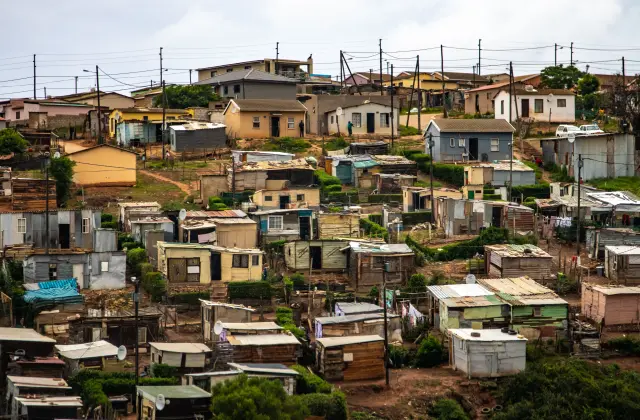
RDP Homes: Are They Still the Solution for South Africa’s Affordable Housing Needs?
The affordability of good housing is one of the most pressing social and economic problems in South Africa, more than 30 years after the fall of apartheid. After major reforms in policies and massive government interventions, South Africa still has millions of people living in informal settlements, overcrowded houses, and poor housing conditions.
 The
Reconstruction and Development Programme (RDP), which was launched in 1994, has
been the central aspect in the post-apartheid housing approach of the country
as a holistic plan to level the historical disparities and offer basic
amenities, such as housing, to the hitherto marginalized communities.
The
Reconstruction and Development Programme (RDP), which was launched in 1994, has
been the central aspect in the post-apartheid housing approach of the country
as a holistic plan to level the historical disparities and offer basic
amenities, such as housing, to the hitherto marginalized communities.
Subsidized or low-cost homes, also known as RDP homes, were developed to provide low-income households with access to secure housing since they could not afford the housing systems in the market.
These homes have, over
the years, been built in large numbers all over the country, virtually
transforming the physical as well as the social landscape of the South African
cities and towns. To many recipients, the RDP homes were the first step to
owning their own property, having a secure tenure, and dignified lives.
Nonetheless, the accumulating housing backlogs, the rapid urbanization, population increase, and the shifting socio-economic status have cast serious doubts on the further suitability of RDP homes.
The issues regarding housing standards, place, access to infrastructure, economic assimilation, and sustainability in the long run have been a source of controversy among policymakers, scholars, and local communities.
With informal settlements increasingly growing and housing demand increasing,
it is only imperative to re-evaluate the issue of whether RDP homes would still
be a viable solution to the affordable housing requirements of South Africa.
This blog critically analyzes how RDP homes can come in to solve the problem of affordable housing in South Africa. It discusses the historical basis of the RDP housing program, its successes and failures, its spatial and economic effects, social performance, its changing policy reforms, and future prospects.
With this analysis, the article aims to establish whether the housing needs in the country can still be met by the RDP homes or whether other and complementary strategies should be adopted.
RDP Housing has had its historical roots and purposes.
The Reconstruction and Development Programme was developed in the early 1990s as a reaction to the high socio-economic inequalities that were firmly embedded in South Africa during the era of apartheid.
During apartheid planning, most South Africans were excluded purposefully on city centres and deprived of proper housing facilities, infrastructure and the provision of basic services.
Millions of people were accommodated in informal
settlements and congested townships, which turned out to be the major form of
accommodation, creating an enormous housing deficit by the onset of democracy
when it was achieved in 1994.
The RDP was an idea of a people-centered developmental agenda which was geared towards fulfilling the basic needs, developing the economy, human resource development and democratization of the state.
Housing
was also considered a pillar of this vision, founded on the concept that safe
shelter is a basic human right, a health decision, and an economic investment.
The RDP housing initiative aimed to provide affordable housing in large
quantities at the same time that it could deal with spatial disparity and fostering social inclusion.
RDP homes were planned to be fully subsidized residential houses where households receiving a certain income, which is below a given income level, are qualified. The government identified the land, serviced plots, and construction subsidies, with the beneficiaries getting ownership rights.
The first concern was quick delivery to serve the massive backlog of houses and standardized housing design to decrease costs and accelerate
the construction process. These houses usually had fundamental buildings that
had access to water, sanitation, and electricity.
The RDP housing program registered significant successes in the initial years of its performance in terms of numerical output. Millions of housing units have been provided, and the immediate crisis of shelter has been lessened to many households.
The program was also an indication of how the new
government was determined to promote social justice and redress which also
strengthened the belief of the people in democratic institutions.
Nevertheless, the fact of focusing on quantity rather than quality and integration did not take long to manifest. Most of the RDP developments were found on the urban edges, which were distant and not near economic opportunities and social facilities.
Lack of community involvement and
poor supervision helped to give rise to construction flaws and poor
consistency. These initial design and implementation decisions still define the
arguments on the effectiveness of RDP homes in the current world, which serves
to reveal the conflict between expediency and long-term urban development.
Achievements of RDP Homes in Expanding Access to Housing
Nevertheless, against all odds, RDP homes have contributed greatly to increased accessibility to shelter for low-income South Africans. These houses offered the first experience of formal housing, legal ownership, and provision of basic services to millions of households.
Secure tenure
minimized the possibility of eviction, and it gave a feeling of security that
the informal settlement lacked. In this regard, RDP housing has made a significant contribution to the alleviation of poverty and social protection.
The number of RDP homes that have been delivered is one of the greatest achievements of the RDP. The housing program of South Africa is one of the biggest state-subsidized residential programs in the world.
This
massive land overhaul has changed whole societies, and informal settlements have
been replaced with formal housing, and living conditions have been enhanced
for beneficiaries. The availability of water, sanitation, and electricity has positively affected the lives of the people in terms of health, safety, and the
quality of life.
The RDP homes have also helped in creating assets for low-income households. Homeownership is one form of wealth that can be accumulated, and this is why it can be transferred to the next generation of families.
In others, small-scale economic activities have been practiced in
houses, including home-based businesses or accommodation, which have been added
to the household income. Formalization of housing has also helped the residents
to have easier access to municipal services and social programs.
Socially, RDP housing has helped increase dignity and
inclusion. Residing in an official house is not only psychologically and
socially advantageous but also contributes to the feeling of belonging and
being a citizen. In most societies, RDP developments have found themselves
being places of rebuilding social networks and enhancing community
identity.
However, the success does not come without some challenges. RDP homes have increased access to housing; however, they have not been able to go as far as to offer solutions to the greater structural drivers of housing demand, like unemployment, inequality, and migration to urban centers.
This has
seen the informal settlements keep on increasing in tandem with the formal
housing delivery and has cast doubts on whether the RDP homes are sufficient in
the long run as a solution on its own.
Disadvantages and drawbacks of the RDP Housing Model.
There has been long-term criticism of the RDP housing model, especially on the quality, location, and sustainability. Among the most frequently raised issues is the issue of the standards of construction. In a few cases, there have been reports of poor workmanship, structural defects,
and
even poor materials in some of the RDP homes. These problems have eroded the
properties of the housing stock and added extra expenses to the homeowners and the
state to renovate and repair.
The other significant limitation is spatial location. The spatial patterns adopted during the apartheid era have been strengthened by the creation of numerous RDP housing developments whose location is cheaper in the outskirts of cities.
The residents are usually subjected to lengthy and
expensive travel to work, school as well as medical facilities. This
territorial marginalization restricts economic access and introduces new
financial strains on already disadvantaged households, which negates the supposed
advantages of homeownership.
Another reason why these homes are criticized is that the
standardized design of the RDP houses does not suit various households and the
evolving family patterns. The small size of the house, few chances of expansion, and inflexibility may lead to congestion in the long run. Some beneficiaries
have been informally making alterations that in some cases affect safety and
building regulations.
Problems with administration and governance also limit the
efficacy of the RDP housing. The system has lost the trust of people due to
delays in distribution, corruption, and poor selection of the beneficiaries.
Housing has been given to the wrong recipients in other situations, and the really
needy families have been on waiting lists waiting to get houses over a period
of years.
These constraints have created arguments as to whether RDP
homes solve the causes of housing insecurity or a stop-gap measure. The RDP
model has flaws in that without the accompanying intervention in economic
development, transport, and urban planning, it is likely to continue the
poverty/spatial inequality cycles instead of discontinuing them.
Social and Economic Consequences to Societies.
RDP homes not only have social and economic effects on
people in terms of providing physical shelter but also influence the dynamics
of the communities and the livelihoods. RDP housing has also helped in the
enhancement of social stability in most instances, as it has offered secure
living conditions. There are positive impacts of reduced exposure to
environmental hazards, informal settlement-related crime, and stress related to
housing on household well-being.
The effects are more complicated economically. Homeownership may help improve financial security, although the marginal location of most RDP developments tends to restrict access to work opportunities.
The economic gains
of free housing can be countered by high costs of transport, and residents
are trapped in poverty ownership. This has seen certain families renting
their RDP homes informally and resorting to informal settlements since they are
nearer to employment.
The local economies have also been affected by RDP
developments. The construction phase creates short-term jobs and the communities
that are already created can create demand in local services and informal
trades. Spa shops, childcare, and home-based businesses are small businesses
that are common in RDP neighborhoods, which help to create economic activity
within their jurisdictions.
RDP communities are diverse in terms of social cohesion. In other regions, mobile populations create close ties among the communities due to the similarity of relocation and settlement.
In others, social
infrastructure, recreational space and poor local governance are caused by weak
social infrastructure, which paves the way to social fragmentation and crime. Lack of schools, clinics, and community centers among certain
developments negates social development in the long term.
These contradictory results point to the necessity to assess
RDP housing as not only the physical product but as a component of a more
comprehensive socio-economic system. Interventions in housing based on housing
strategy that do not incorporate economic opportunities, social services and
community development have little chance of providing a long-lasting positive effect.
Development of the policy and the quest to find alternative approaches.
It is important to note that the housing policy of South Africa has developed over time, considering the constraints of the initial RDP housing model. With the introduction of the Breaking New Ground policy, there was a shift in the direction of more integrated and sustainable human settlements.
In this strategy, there is a focus on mixed-income developments,
higher housing quality, location, and enhanced housing-transport and economic
infrastructure integration.
The newer housing programs aim at supplementing the RDP homes and not substituting them. They are social housing, community residential units, inclusionary housing policy, and upgrading of informal settlements.
Upgrading of informal settlements, especially is a major contrast to relocation strategies and emphasizes the upgrading of living conditions on the ground
without relocating the social networks or livelihoods.
Another thing that is picking up is public-private
partnerships and alternative financing mechanisms. The state is set to increase
the delivery of housing, enhance efficiency and quality by relying on the
investment of the private sector and the development of innovative design
solutions. Incremental housing models enable beneficiaries to develop and
renovate homes with time and provide more flexibility and affordability.
These policy innovations notwithstanding, there are still
implementation issues. The lack of capacity, financial constraints, and lack of
coordination remain to be the obstacles to the progress. Besides, the size of
the housing demand implies that even as alternative methods are considered, RDP
homes continue to take the center stage in the provision of basic shelter
needs.
This continued housing policy development is indicative of
the fact that a single solution does not exist to South African issues of
housing that are complex in nature. The strategic housing policy that
integrates RDP houses with other affordable housing plans is being increasingly
considered as the key to success in the long term.
Conclusion
Since the onset of democracy, RDP homes have been at the forefront of South Africa in its endeavor to solve the affordable housing problem. They have offered millions of households earning low incomes safe shelter, access to basic services, and a pathway.
Being the means of
social redress and overcoming poverty, the RDP housing program is one of the
important milestones in the development history of the country.
The limitations of the RDP model, however, have been
revealed by changing socio-economic realities, ongoing housing backlog and
increasing urbanization. Quality, location, economic integration and
sustainability are raising real concerns about whether RDP homes are the only
solution to the present and future housing demands in South Africa. Although
they are still a significant part of the housing system, they can no longer be
used as a single solution.
Affordable housing in South Africa is in the future in a more integrated and flexible approach that would integrate RDP homes with informal settlement upgrading social housing, mixed-income developments, and better urban planning.
Through the coordination of the delivery of housing and
economic opportunities, transport networks, and social infrastructure, policymakers will be able to develop affordable human settlements that are
inclusive, resilient, and sustainable.
The issue with the RDP homes thus is not that they need to be abandoned, but how they can be rethought and repurposed to address the changing needs of South Africans. Although the original model contributed significantly to the widening of access to housing, the present social, economic, and spatial reality requires a more elastic and inclusive solution.
Through careful reform, it is possible to see RDP housing cease exemplary
concern with the provision of shelters and instead work towards the creation
of integrated human settlements, which will occur in the context of enabling
access to employment, services, and social infrastructure.
The long-term value of RDP developments can be increased through inclusive planning procedures, quality housing, quality location choices, and quality community participation.
RDP homes can still play a significant role in promoting equitable urban growth when they are consistent with other broader urban development plans and consultation with other affordable housing alternatives.
Redefined RDP housing, instead of being seen as an outdated solution, can continue to play a key role in South Africa's quest of equal, sustainable, and inclusive urban growth.
Also read: The Future of RDP Homes In Kenya: Are They Still Relevant for Today’s Housing Needs?





-ySWGlp0vgc.jpg)








LEAVE A REPLY