

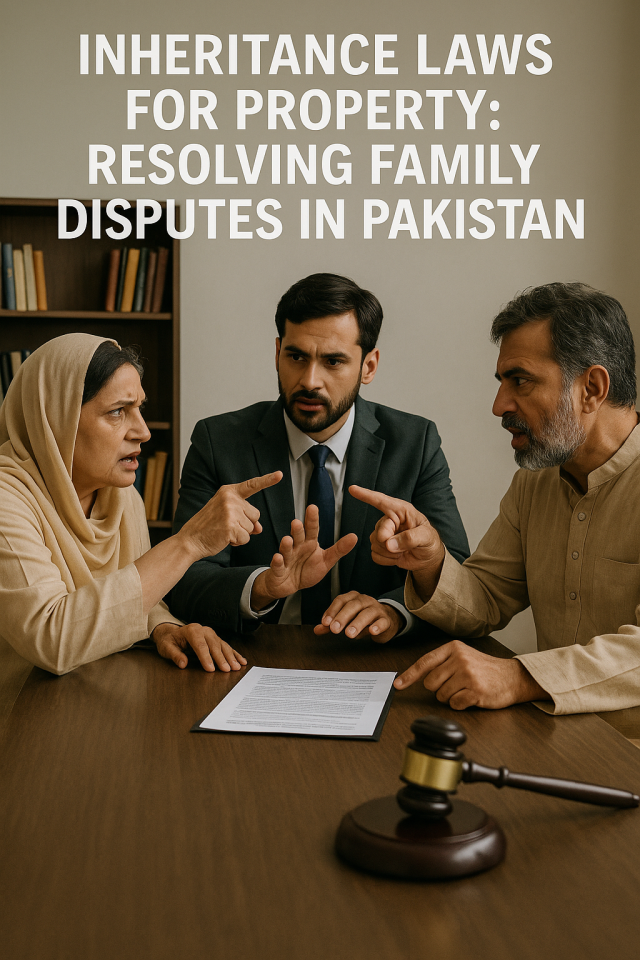
Inheritance Laws for Property: Resolving Family Disputes in Pakistan
Among all legal family disputes in Pakistan the battles that occur over property inheritances are the most difficult to resolve and deal with because of powerful emotions involved. The legal process of inheritance combines civil and religious traditions since these conflicts affect multiple interested family members and large financial distributions. Get Property divisions leading to rightful share disputes usually trigger lengthy court cases and permanent harm to family relationships among the involved parties. Solving disputes in advance combined with knowledge of inheritance regulations protects the peace within families as well as justice between parties.
The inheritance system of Pakistan functions under Islamic legal standards that national legislation includes through the Muslim Family Laws Ordinance together with complementary legal frameworks. The improper handling of property distribution because of missing awareness, fraudulent documentation and intentional delays frequently generates misunderstandings between parties who face conflicts. Your understanding of the legal proceedings protects you from mistreatment and ensures peaceful outcomes because you are either an heir, executor or family mediator. The blog analyzes the legal inheritance system and typical sources of inheritance disagreements together with methods to overcome them while explaining sound procedures for equitable inheritance distribution.

The Legal Framework of Inheritance in Pakistan
The inheritance system of Pakistan follows Islamic law for Muslim populations yet non-Muslim populations follow their spiritual laws when distributing inheritances. Islamic Sharia law provides Muslim inheritors with specified portion amounts that depend on their familial relationships and their gender. The Quran specifies how each family member such as spouse, children, siblings and parents will get their inheritance portions. Muslim males get double the inheritance amount that women receive while parents obtain guaranteed shares from their deceased child's estate. Individual entitlement benefits for widows and widowers depend on whether their spouse left behind children or not.
The legal foundation for inheritance matters consists of Islamic law and the West Pakistan Muslim Personal Law (Shariat) Application Act, 1962 together with the Muslim Family Laws Ordinance, 1961. These laws manage both movable as well as immovable property to dispense automatic inheritance at death without requiring a will. A person may establish a will for one-third of their assets through the practice of wasiyat as long as it respects the legal rights of heirs.
The inheritance process under law begins automatically when a person dies so their legal heirs immediately receive transfer of property. Familial delays in property distribution commonly occur because family members prefer to avoid or resolve inheritance disputes as well as cases of undocumented property and rural property locations. The inheritance process through a succession certificate from NADRA or civil court initiates when legal papers including death certificates and identity documents accompany property registration documents.
Issues tend to occur whenever someone dies without creating a will and whenever there are disagreements about document authenticity. Family disputes about inheritance persist including cases involving forged mutations and family settlements as well as pressure being placed on weak heirs to surrender their inheritance. The pressure particularly affects women heirs. Parties must accomplish success in such legal situations through early legal consultations and respecting the established rules that Pakistani inheritance law provides.
Common Causes of Inheritance Disputes among Families
Multiple reasons lead to inheritance disputes throughout Pakistan where legal confusion combines with family disputes to create the majority of problems. Family inheritance conflicts primarily originate from selfishness combined with power imbalances and insufficient understanding about inheritance divisions. The lack of accurate understanding between Islamic inheritance rules allows powerful heirs to take advantage of the situation by diverting inheritance for their own benefit as they ignore minor heirs and women beneficiaries.
The distribution process stands as the primary source which causes most conflicts to occur. Property distribution among families typically occurs only when elders pass away because they expect disputes to cause problems. The extended distribution process ends up producing complaints and doubt from family members about inheritance matters. Failure to divide property creates conditions where illegal occupation and forged mutations and fraudulent sales by heirs become potential risks for untitled properties.
Gender rights denials represent an essential factor that triggers numerous disputes between family members. Islamic Shariah clearly gives daughters sisters and widows their inheritance rights yet numerous cases exist where they endure refusal of their inheritance from pressured or cultural justifications. Woman are coerced to waive their inheritance rights by being advised to forgive their male relatives while being deceived through emotional intimidation. The cultural practice in rural areas dictates that daughters who get married relinquish the rights to their inheritance.
Document discrepancies lead to increased conflicts between individuals or groups. When ownership documents are hard to understand and properties lack official registration it becomes normal for people to argue over ownership rights. The practice of using oral agreements along with informal partitions between siblings creates many different versions of what occurred which makes solving disputes in court difficult.
Multiple marriage dynamics along with multiple marital relationships make inheritance problems more complex. Shareholdings become the source of conflict between step-siblings and half-siblings and ex-spouses who lacked equal inheritance opportunities from their deceased relative. Widespread disputes occur in situations where the deceased gave different levels of favoritism or unequal treatment during their lifetime.
Involvement of family control and individual grudges tend to turn basic estate partitions into conflictual power confrontations. Family disputes arise when one family member controls the estate without sharing complete information which leads to litigations and unfair suspicion among the family members. The combination between jealousy and mistrust commonly matches legal uncertainty levels as fundamental causes of disputes.
Understanding the fundamental triggers between families helps solve active conflicts and stops conflicts by improving family preparation strategies and clear documentation practices and regular communication systems.
Steps to Legally Resolve Inheritance Disputes
Following a specific legal procedure is vital during inheritance disputes so justice can be achieved without the dispute worsening. The initial requirement involves obtaining documentary evidence starting with the death certificate followed by the family registration certificate and identity proof from all legal heirs and official proof of property ownership. Applicants require these documents to obtain either a succession certificate from civil jurisdiction or a letter of administration from NADRA through their Succession Facilitation Unit.
Transfer of movable assets requires a succession certificate but immovable properties need a letter of administration for such purposes. Through its urban system NADRA has made this process quicker and more cost-effective for Muslims who wish to transfer their assets after death. Legal proceedings within civil court become necessary when succession documents are disputed or when authentic documents do not exist.
People who want to obtain a qualified inheritance lawyer need to complete the second step. Legal expertise becomes mandatory to handle matters which involve multiple heirs together with disputed mutations and previous property sales. Through a suit filed by lawyers the aggrieved party can obtain declaration or partition of their properties and can request the cancellation of forged documents. The legal representatives serve notices to stubborn heirs who refuse to cooperate with the proceedings.
The resolution of legal disputes through mediation along with out-of-court settlements brings about peaceful resolutions for many conflict cases. Elders together with family councils or independent third parties aid dispute resolution through the negotiation of mutually proper resolutions. The mediation process demonstrates great effectiveness when both parties maintain negative emotions towards speaking with each other directly. Any settlement agreement needs written documentation with signatures followed by legal professional endorsement to resist future challenges.
Property owners have the right to take legal action for transaction cancellation when wrong mutations or sales occur. A court has the power to freeze banking accounts while issuing court stay orders as well as property transfer reversal when they prove fraud. The law permits criminal prosecution of forgery along with coercion and illegal occupancy cases.
One legal option to resolve property disputes is partition of property applications. Each group member must receive their exact percentage of property ownership which leads to either a physical split of assets between heirs according to their shares or selling the property to distribute funds. In cases where property split is impossible the court will authorize the sale of assets to share distribution proceeds with family members. This process, while time-consuming, offers a final and enforceable resolution.
Maintenance of patience together with consistency proves essential to this point in time. The long duration of inheritance situations often develops because parties make numerous requests for postponement and there is active court appeal activity. Your active involvement together with your legal team is essential in this period along with your timely responses to legal notices and maintaining consistent communication channels. The strength of your evidence together with your clear legal claims alongside the sincerity of judicial proceedings determines the achievement of justice.
Role of Women and the Importance of Legal Empowerment
The question of women's legal rights to inherit goes beyond the legal framework because it fundamentally represents a social justice issue alongside being religiously obligatory. In accordance with Islamic legal practice women automatically qualify for predetermined inheritance payments through the legal rights of daughters or mothers and wives or sisters. Household customs together with family-based oppression and insufficient awareness prevent Pakistani women from obtaining their rightful property inheritance.
Multiple women face the challenge of being unaware about their true legal inheritance shares while males in their family manipulate property law to gain personal advantage. The women of rural territories abstain from accessing their inheritance rights because they apprehend social exclusion and might face accusations of excessive desire. Risking coercion from their male relatives forces some women to surrender their property shares by affording them only a low payment and empty promises.
Legal empowerment provides the necessary solution to break free from this cycle. The education of women's rights should be accompanied by supportive measures to inspire them in asserting their rights. The process begins by providing legal aid services to people alongside community education programs combined with support from civil society organizations. The proper distribution of inheritance to women depends heavily on women’s centers operated by the government along with NGO services and free legal representation by pro-bono counsel.
Legal institutions show initial indications of response as well. Female heirs now have the ability to use the Ombudsperson after the Punjab government approved the Punjab Enforcement of Women’s Property Rights Act in 2021. Through their official authority the Ombudsperson possesses the power to launch investigations and make enforcement orders that include property ownership commands along with recording corrections and request police intervention. Additional legislation that focuses on the same measures is under review for various provinces.
Religious scholars act as important figures in addressing false beliefs about Islamic laws. Religious teachings through sermons and television broadcasts along with educational programs need to teach that hindering women from receiving their inheritance constitutes a severe violation of Islamic principles. The Prophet Muhammad (PBUH) made public condemnations of such practices while calling for honest treatment of all inheritance recipients.
The change in family attitudes stands as an essential requirement. Justice should be understood when daughters claim their inherited properties since this action cannot be considered disobedience to religion. Male members of the household should back their female family members when they seek out their legal share of inheritance. Strong and prosperous family bonds emerge from situations based on fairness rather than from forceful sacrifice. Our law as well as our future family structures in Pakistan develop fairness through equal inheritance distribution to women.
Preventing Future Disputes through Planning and Transparency
To successfully manage inheritance arguments it is best to stop them before they ever occur. Years of damaging legal battles together with emotional pain can be bypassed by families who use clear communications approaches and ethical planning steps combined with legal documentation. One effective tool is will-writing. A will proves useful to Islamic law through its ability to explain lawful one-third inheritance distributions or outline strategies for debt and funeral expenditure payments. A proper will ensures clear distribution of wealth because it needs signatures and witnessing eventually accompanied by notary attestation to block manipulation in the future.
When parents divide their property holdings before they pass away it becomes an effective solution. A father who possesses multiple properties can use lifetime gifts to divide them in a fair way between his children. The method prevents conflicts arising from several inheritors who attempt to claim a single asset.
Household property documentation requires regular updates. Document verification of land titles together with registry records and mutation records and utility bills requires the correct name of ownership. Any kind of inconsistency requires immediate settlement from all parties. All joint ownership needs documented records which show the exact percentage ownership of each party.
Assets distributed during open family discussions about inheritance will minimize possible future disputes. The duty to discuss life's essential topics belongs to every parent and their children must accept this responsibility in an appropriate manner. The disclosure of all relevant information permits complete awareness between all parties about their standing within a system and their duties.
The distribution of large estates and commercial assets requires family engagement of professionals who include property consultants together with lawyers and accountants for appropriate oversight. Complex financial operations benefit from explicit monitoring by independent third parties that help maintain unbiased choices regarding important decisions. Distribution of inheritance assets should function as a celebration that unites families instead of destroying their relationships. Families in Pakistan who seek foresight and legal assistance together with compassion will transform potential disputes into opportunities for fair and united resolutions.
Conclusion
The inheritance disputes concerning property in Pakistan affect numerous families through widespread bitter and stressful situations. The legal and religious systems define heir rights clearly yet insufficient awareness alongside power manipulation and social pressures cause unfair distribution of inheritance. The conversion of wealth transfer into everlasting family strife alongside household breakups occurs due to poor execution of what should be a peaceful intergenerational wealth transition.
Family success and inheritance rules require knowledge through legal advice which should be combined with clear documentation and transparent practices for proper management. Women need empowerment to assert their rights to inheritance because Islamic teachings and Pakistani law guarantee their inheritance benefits. The act of ending cultural restraint against female silence leads society to greater equity and balance.
The judicial process provides accessible tools including succession certificates as well as partition suits and ombudsperson complaints which offer dispute resolution solutions to appreciative users. Family mediation alongside out-of-court settlements enable individuals to keep their family connections whole during the pursuit of justice.
The prevention of inheritance disputes begins when people write their wills while dividing assets beforehand alongside family discussions for clarity. Family members who take these essential actions will prevent endurance of bitterness and legal struggles that could last for years. The distribution of inheritance serves to both transfer estate value and to display how families value justice as well as honor their deceased loved one's inheritance. As families in Pakistan exercise the rights of their heirs and maintain fair practices they create an Islamic future based on dignity and family unity.











LEAVE A REPLY