

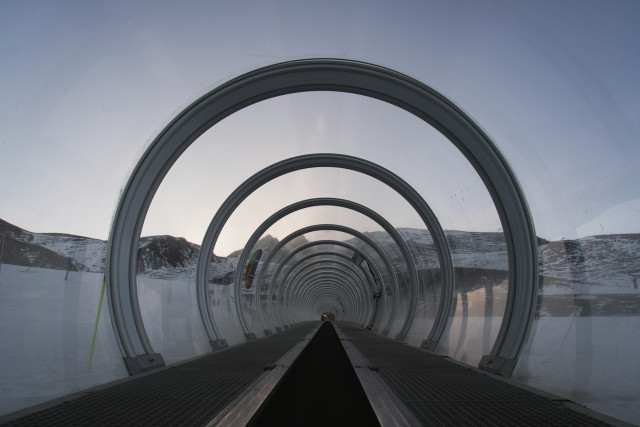
Hyperloop Technology: Revolutionizing Long-Distance Urban Travel
A revolutionary transition in urban travel infrastructure through Hyperloop technology remains imminent because this extreme transportation system allows quick passage between cities with sustainable advantages.
Elon Musk introduced Hyperloop technology during 2013 as a method to move people and goods through low-pressure tubes at higher than 1,000 km/h (621 mph) thus providing quicker and sustainable urban transportation.
The growing congestion in global cities leads existing transportation methods such as trains and planes to struggle with meeting growing demand.
With its revolutionary method Hyperloop delivers emissions-free transportation that also offers economical service while achieving extraordinary speeds.
Packages three key components together: magnetic levitation, vacuum-sealed tunnels, and automated control systems to transform urban transportation networks for the future of commuting.
This blog examines both the possibilities enabled by Hyperloop technology along with its difficulties and its estimated effects on cityscapes around the globe.
The Science and Technology behind the Hyperloop
Through advanced technology Hyperloop implements innovative procedures which minimize air resistance, reduce energy usage and diminish friction to perform exceptional travel speeds.
The fundamental components which drive the system operation include:
- Sealed low-pressure tubes known as Vacuum Tubes enable The Hyperloop to travel supersonically with minimal energy consumption by reducing air resistance. The Hyperloop operates differently than both planes and trains by creating a nearly drag-free environment while these other vehicles continuously fight air resistance.
- Magnetic Levitation (MagLev) technology enables Hyperloop pods to float through the tracks after suspension with electromagnetic force generators which eliminates wheel-based mechanical friction. MagLev trains share the same feature set which allows this technology to provide silent super-fast trains with enhanced operational smoothness.
- Linear Electric Motors use their propulsion to achieve efficient acceleration and deceleration of pods. Because the Hyperloop system works inside a vacuum chamber the needed energy for propulsion remains minimal.
- Several proposed Hyperloop undertaking would use solar alongside wind power along with battery storage solutions for reaching a carbon-neutral state of operation. The installed solar panels across the tube surface would produce excessive energy which exceeds the requirements to power the operational system.
These innovative features enable Hyperloop to reach velocities above 1,000 km/h thus significantly slashing traveling durations between locations.
When operating at full speed the journey between Los Angeles and San Francisco would take only thirty minutes despite the extended 6-hour car duration and 1.5-hour plane duration with security processes.
The successful execution of this technology should lead to better travel results than every current transportation system for both safety performance and speed potential and environmental sustainability.
The Potential Impact of Hyperloop on Cities and Urban Mobility
The adoption of Hyperloop technology leads to major developments in urban development and economic growth alongside daily life changes.
The incorporation of Hyperloop would bring new changes to transportation systems that would both shorten distances traveled while decreasing traffic congestion.
The adoption of Hyperloop technology would bring advantageous changes for cities through these outcomes:
Faster Commutes and Regional Connectivity
The main advantage of Hyperloop systems rests in their ability to transport people between distant cities within short periods.
Countries currently restrict residential and employment zones through extended travel durations enabled by their traditional rail and road systems.
The travel time possible with Hyperloop allows workers who reside 200 kilometers from urban centers to complete their commute within 15 minutes effectively.
Moving forward the development of Hyperloop between Amsterdam and Paris would enable an efficient three-hour rail journey to shorten into an instant thirty-minute journey thereby uniting the European cities as if they were adjacent.
The development of urban decentralization would become possible through this initiative because people may choose affordable suburban or rural residences without sacrificing their ability to work in economic power centers.
Reducing Traffic Congestion and Pollution
Major cities throughout the world are dealing with an escalating challenge of traffic congestion.
Research shows that drivers across Los Angeles, London, and Mumbai waste numerous hundreds of hours annually in traffic congestion thus increasing pollution while harming productivity.
The vehicle system function of Hyperloop provides fast and efficient transportation that helps to decrease traffic congestion problems.
Hyperloop functions through renewable energy power while offering clean emission-free travel which reduces both city pollution problems and carbon emissions standards.
The implementation of Hyperloop for short flights would result in groundbreaking reductions of aviation pollution which drives sustainability forward.
Boosting Economic Growth and Investment
The implementation of Hyperloop will yield economic advantages which surpass enhanced travel time.
Industry investment along with technological advancement combined with workforce training for Hyperloop network construction will produce thousands of employment opportunities.
Businesses will have the ability to connect more regions because cities will function as united network systems thanks to Hyperloop.
The connection of New York to Washington D.C. using Hyperloop travel at 30 minutes speed would enable expanded talent access for businesses and enhance workforce job prospects while spurring real estate market growth in unreachable territories.
The construction of the Hyperloop system would establish an interconnected global economy by reducing major traveling constraints.
Challenges and the Future of Hyperloop in Urban Environments
Hyperloop faces many obstacles regarding widespread adoption that need to be overcome until it transforms into a common transportation system.
The deployment of Hyperloop faces four major obstacles which consist of complex engineering tasks together with high spending levels and complicated administrative barriers and widespread community support issues.
Infrastructure and Construction Costs
Creating Hyperloop network systems demands enormous initial infrastructure expenses.
Building vacuum tubes alongside MagLev tracks and passenger stations will require extraordinarily high expenses which may surpass multi-billion dollar costs for each transportation path.
The engineering team must deal with perfect vacuum maintenance requirements because traditional railways do not need such tight vacuum maintenance.
Government authorities together with private organizations need to establish if the big startup expenses can produce sufficient lasting advantages.
Research indicates that Hyperloop will become financially usable through public-private cooperation along with support from government-funded programs.
Regulatory and Safety Concerns
Hyperloop represents a pure invention in transportation which fails to benefit from existing safety codes and established norms.
Governments must establish new safety standards to design testing systems along with certification procedures for maintaining traveler protection during operations.
Potential concerns include:
- Emergency evacuation procedures in case of system failure
- Structural integrity of vacuum tubes over time
- Quick travel at High Speeds along with atmospheric pressure fluctuations may cause unidentified health-related side effects.
Virgin Hyperloop along with The Boring Company led by Elon Musk maintain active relationships with regulatory authorities to solve concerns which will help them gain authorization for initial testing operations.
Public Perception and Adoption
The acceptance of Hyperloop technology as a widespread standard requires public trust to form first. People express doubts about traveling inside vacuum tubes when vehicles achieve high speeds because they worry about equipment failures and the discomfort of being confined and feeling sick during trips. The commercial success of Hyperloop requires commitment to open safety assessment protocols and educational outreach programs and practical testing activities.

Hyperloop vs. Traditional Transport: A Comparative Analysis
A common comparison exists between the Hyperloop and systems which include high-speed rail and airplanes as well as cars.
The combination of speed and sustainability with efficiency in the Hyperloop transportation system provides features beyond those found in current systems.
Speed and Efficiency
Meetings for the Hyperloop adoption primarily focus on speed performance which remains unmatched by other technologies. High-speed rail services like Japan’s Shinkansen and France’s TGV operate between 300-400 km/h (186-249 mph) yet commercial plane flight speeds stay between 800-900 km/h (497-559 mph).
The Hyperloop system functions at speeds which surpass 1,000 km/h (621 mph) while presenting superior operational capabilities when compared to planes for short routes and high-speed rail systems.
Travel time between Paris and London would require thirty minutes with Hyperloop technology instead of two hours and fifteen minutes by train combined with similar other travel time through air transportation, including check-in and security restrictions.
Slow travel times and improved productivity along with stronger connections between main cities will emerge due to this efficiency.
Energy Consumption and Environmental Impact
The main positive point of Hyperloop technology lies in its remarkable efficiency in energy utilization and environmental advantages.
The Hyperloop system functions using renewable solar power as well as wind power while storing energy within batteries for its operation instead of traditional airplane jet fuels or automotive gasoline.
High-speed rail functions as an environmentally beneficial substitution for air transportation even though its establishment demands substantial electrical infrastructure and power distribution systems which need significant energy to operate.
The Hyperloop technology employs a pressurized tubular system and magnetic levitation technology to minimize wastage of energy during operations because of reduced air resistance and surface friction.
Solar panel integration with Hyperloop tubes creates a sustainability loop which leads to substantial reduction of carbon footprint.
Infrastructure and Cost
The adoption of Hyperloop faces problems because building its infrastructure requires significant financial investment.
Creating wide networks of vacuum tubes alongside deploying state-of-the-art MagLev systems and sustaining low-pressure operations demands substantial monetary funding.
By comparison:
- Billions of dollars per project go into high-speed rail infrastructure and this model already operates in Japan and China and throughout Germany.
- High regulation and expensive expenditures on maintenance and governmental aid cause flights between airports to become costly and complex to manage.
- Road networks together with highways require continuous development and maintenance projects that increase urban traffic congestion.
The large upfront cost needed to develop Hyperloop technology will lead to lesser expenses during its operational period when compared to airplanes and trains. The future expenses of Hyperloop travel tickets are likely to be cheaper since this technology needs lower operating energy and maintains lower maintenance expenses than existing transportation networks.
Passenger Experience and Comfort
Customer satisfaction both during travel and in their overall comfort determines how well transportation systems will perform.
People commonly link air travel with extensive security checks and delays coupled with turbulence and insufficient seating comfort yet trains deliver better ride quality yet have limitations regarding scheduling flexibility.
- The Hyperloop system includes these features among its design characteristics:
- Users benefit from faster procedures during boardings which shortens their periods of waiting.
- A smoother ride, with no turbulence or mechanical vibrations.
Future-oriented cabins minimize discomfort while providing massive quantity space along with practical features for optimal convenience.
Environmental technicians worry about two main problems regarding the combination of tight seating conditions and the unpleasant impact of quick vehicle acceleration.
Engineers pursue the development of ergonomic seating and pressure-adjusting cabins along with artificial windows that utilize virtual reality displays in order to improve total passenger satisfaction.
The Hyperloop system shows promise to transform urban transportation by uniting speed with operational effectiveness together with sustainable features and enhanced passenger comfort despite long-distance transportation which currently relies on high-speed rail and airplanes.
Before inauguring widespread implementation it will be necessary to overcome the problem of infrastructure costs and regulatory approval requirements that prove challenging.
Global Hyperloop Projects and the Race for Implementation
The Hyperloop dream exists beyond theory because several organizations and national governments worldwide experiment with prototypes and start-up projects.
Modern industry has entered a competitive phase to develop the initial operational Hyperloop transportation system and four major organizations including Virgin Hyperloop and Elon Musk's The Boring Company and Hardt Hyperloop and TransPod are at the forefront of this development.
Virgin Hyperloop (USA, India, Middle East)
The development of Hyperloop technology represents Virgin Hyperloop as one of its leading operational entities.
The Nevada test site saw Virgin Hyperloop complete its first human testing in 2020 which proved both operational and safety parameters of the Hyperloop concept.
The company continues development of multiple Hyperloop route proposals that include:
- The proposed connection between Dubai and Abu Dhabi will achieve a 90-minute trip reduction to 12 minutes.
- A Mumbai-Pune Hyperloop in India, cutting travel time from 3.5 hours to 25 minutes.
- A Hyperloop United States network plan would connect Los Angeles to Washington DC together with Chicago.
- The proposed transportation and economic activities will change the future dynamics of their targeted regions.
The Boring Company (Elon Musk’s Vision for Underground Hyperloop)
The Boring Company under Elon Musk operates underground Hyperloop tunnels as its main strategy.
The urban transportation system aims to reduce traffic jams through underground tunnels which allow fast passenger travel.
Current projects include:
- The Boring Company plans to operate a Las Vegas Loop to expedite travel between the convention center and airport.
- The Boring Company has introduced ideas about constructing underground Hyperloop systems connecting cities across California and Texas to shorten transportation times.
- Although The Boring Company has achieved operational tunnel development it continues its core focus on urban travel distances which delays the testing phase for Hyperloop long-distance routes.
Hardt Hyperloop (Europe’s Leading Initiative)
Hardt Hyperloop is a leading organization which directs efforts to study Hyperloop possibilities across multiple cities throughout the Dutch region and German regions as well as parts of France.
- Tests for the European Hyperloop Center are currently occurring inside the Netherlands.
- The European Commission runs feasibility study programs because they see Hyperloop technology as a transformative system for sustainable transportation.
- The proposed Hyperloop connections from Amsterdam to Berlin and from Berlin to Paris can transform European interstate transportation.
TransPod (Canada’s Vision for High-Speed Transport)
TransPod as a Canadian-based Hyperloop company operates in developing a Hyperloop corridor between Calgary and Edmonton that will reduce travel durations to approximately 30 minutes.
Hyperloop obtains powerful backing from the Canadian government as it develops into a better transportation option than both rail systems and flight technology.
The Future of Global Hyperloop Networks
Numerous countries together with multiple corporations currently develop Hyperloop initiatives yet their widespread commercial operation remains delayed by several years.
The extensive adoption of Hyperloop depends on overcoming three essential challenges: funding needs, government approval requirements and extensive infrastructure creation.
With overcoming current challenges Hyperloop establishes itself as the fastest sustainable efficient way of transportation that brings unprecedented city country connections.
Conclusion: The Future of Hyperloop in Cities
The transportation technology known as Hyperloop establishes itself as one of the most momentous and thrilling advancements of modern times.
Such a successful implementation will transform urban mobility through rapid sustainable transportation that sets new efficiency standards.
The zero-emission technology of Hyperloop functions as a valuable method to fight climate change and connect cities together effectively.
Hyperloop needs to handle numerous technological obstacles together with financial hurdles and official regulatory procedures before its development can become possible.
Safe cost-effective scalable solutions will be developed through collective efforts by government’s investors and engineers.
The widespread adoption of Hyperloop technology needs another ten years or longer yet initial test routes together with first-stage Hyperloop projects continue their development across worldwide locations.
Successful implementation of Hyperloop has the potential to transform city development patterns as well as workplace and residential areas along with societal visions regarding future transportation methods.
Also read: How to Reduce Traffic Congestion in Fast-Growing Cities











LEAVE A REPLY