

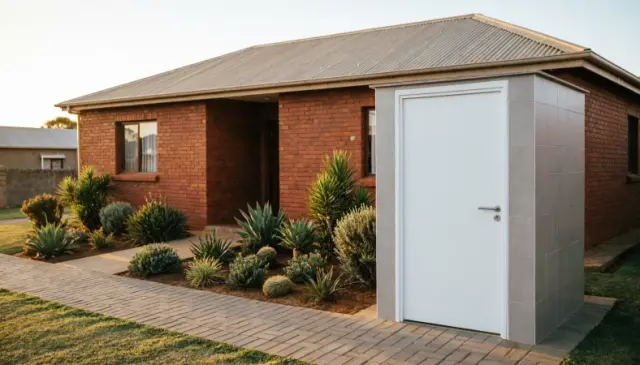
Eradicating Bucket Toilets: How the Bucket Eradication Programme Supports Affordable Housing in South Africa
One of the most basic elements of proper housing is to be able to access safe and dignified sanitation. Another legacy of the inequality in South Africa in terms of housing and service provision is that millions of people have remained without proper sanitation, especially in low-income and informal settlements.

The bucket toilet system is one of the most noticeable and humiliating signs of this disparity as it is a sanitation system that puts households and their lives at risk of health, environmental, and social risks.
The South African government has developed the Bucket Eradication Programme (BEP) which seeks to eradicate the use of bucket toilets and use stable and permanent sanitation systems.
Although it is commonly
referred to as a sanitation programme, the programme has much greater
implications on the development of affordable housing and sustainable human
settlements. Sanitation cannot be isolated of housing quality, urban planning
and social development and as such the BEP is a key aspect of affordable housing
provision.
Affordable housing is also not characterized by the price of
a house only, but by the availability of basic services that enable safety,
health, and dignity. Housing cannot be thought to be actually affordable
without proper sanitation, since homes incur an invisible cost due to the cost
of illness, lost productivity, and a degraded environment. The Bucket Eradication
Programme has responded to these issues by incorporating sanitation enhancement
in the development of housing and settlements.
With South Africa in the process of urbanization and still facing the challenge of trying to clear the backlog of housing, the elimination of bucket toilets has become not only a moral issue but also a development requirement.
This blog explores nine major ways through which the Bucket
Eradication Programme contributes to affordable housing in South Africa and how
it helps in enhancing living conditions, community building and inclusive city
development.
Historical Roots of the Bucket Toilet System
The outhouse system is very ancient in the history of city
development in South Africa. Under apartheid, the black townships and informal
settlements were under-serviced and very little was done to develop infrastructure like water and sanitation. Bucket toilets turned to be a
low-cost and interim measure imposed on marginalized communities and was
frequently explained as cost-effective and quick to implement.
In due time, that which was meant to be a short-term measure
turned out to be a permanent aspect of most low-income regions. Cities did not
replace the sanitation systems and generations of citizens lived on a
sanitation system that was unsanitary, undignified, or harmful to nature. The
continued use of bucket toilets had shown larger trends of spatial inequality
and housing delivery negligence.
On the housing front, bucket toilets strengthened the idea
that housing among the low-income earners could be poor-quality. This weakened
the value of equality of citizens and social fragmentation. The bucket
sanitation housing developments used to be stigmatized, which impacted the
self-worth and belonging of the residents.
Settlement were also influenced by the historical dependence of bucket toilets. The lack of proper sanitation was isolated out of the formal planning of urban areas and restricted investment, which sustained cycles of poverty.
This history is important to understand the importance of bucket
eradication as it does not only represent a technical upgrade, but it
represents a corrective intervention that is geared towards the restoration of
dignity and equity.
Confronting the heritage of the bucket toilet system, South
Africa has realized that affordable housing would not be tied to the old
traditions, but it would provide services both of the current health and human
rights standards.
The Policy Intervention of the Bucket Eradication Programme
The Bucket Eradication Programme was set up as a specific
policy response to get rid of bucket toilets in South Africa. It is part of the
larger governmental obligation to enhance the basic services and to fulfill the
constitutional right to healthy environment and proper housing. The programme
aims at substituting bucket systems with waterborne sanitation or waterborne
systems with other suitable technologies, in line with the local circumstances.
The BEP as a policy intervention identifies sanitation as an
element of human settlements. It closely coordinates with the national housing
and infrastructure systems so that the sanitation upgrades are planned in
conjunction with the housing developments, urban planning, and provision of
municipal services. This combined strategy helps to enhance the effectiveness
of affordable housing programs.
The programme focuses on the communities with a high density
of bucket toilets, which are usually located in low-income communities and
informal settlements. The BEP helps to be equitable in housing objectives and
minimizes the differences in services delivery between various areas of cities,
as it directs resources to the most underserved communities.
The implementation of the BEP is centrally based on the policy alignment of the national, provincial, and local government. Such coordination is used to maintain sanitation upgrades which are affordable and sustainable to long-term housing plans.
Although the problems are still being
encountered, the programme is a major step in acknowledging sanitation as part
of an affordable housing policy. By means of the BEP, the state has made clear
that the removal of bucket toilets is not a choice, but a requirement in
working towards the attainment of inclusive and dignified housing to all.
Improving Public Health and Household Well-Being
Better public health is one of the most short-term effects
of the elimination of bucket toilets. Bucket systems subject households to human waste, therefore putting them at risk of contracting waterborne
diseases, infections, and environmental pollution. Children, the old and
individuals with weakened immune systems are disproportionately exposed to
these health risks.
BEP will decrease the transmission of diseases because
the use of bucket toilets is substituted with safe sanitation systems and
enhance the well-being of households. Better living conditions will mean
reduced medical costs, reduced time away at work due to sickness, and better
achievement in education by the children. The advantages have a direct effect
on making housing more affordable through decreasing indirect living expenses.
Better hygiene also brings about psychological and emotional
health. Using a toilet that is clean and personal gives the person back his
dignity and eliminates stress related to unsanitary hygiene habits. This shift
is an extreme life quality improvement to many households.
In a more general sense of housing, healthier communities
are more robust and in a better place to take advantage of additional schemes
of development. The BEP shows that sanitation upgrades are a core investment
which enhances the social and economic worth of affordable housing.
Supporting Sustainable and Serviced Human Settlements
Inexpensive living conditions need to be backed with good
infrastructure to be sustainable. The Bucket Eradication Programme adds to the
development of complete human settlements by making sure that the sanitation
facilities are in acceptable condition. This becomes important in the long
term settlement.
Sanitation infrastructure determines the settlement and land
use and the management of the environment. With appropriate sewer systems, more
intensive housing and better utilization of land is achieved which is essential
in the delivery of affordable housing in the cities. The BEP hence promotes
efficiency and sustainability in spatial planning of cities.
In regions where sanitation by water means is not an option,
the programme encourages the right alternative technologies that are sensible
in terms of cost, environmental conservation, and health. The flexibility
guarantees that the context-sensitive and sustainable sanitation solutions are
available.
The BEP incorporates sanitation facilities into the housing
projects, thus, underlining the idea that affordable housing should be able to
provide total living conditions and not partial solutions.
Reducing Inequality and Promoting Social Dignity
The presence of bucket toilets is one of the observable
aspects of inequality within the South African society. Their eradication is
thus a strong message on social justice and the human dignity. The BEP is very
vital in bridging service delivery disparities between wealthy and poor
neighborhoods.
Provision of decent sanitation promotes inclusion and
citizenship to the residents. It is a step of the state acknowledgment and a
confirmation that the low-income families do not need other standards of living
than others. This has got good effects on social cohesion and community pride.
The housing developments without bucket toilets are not as
stigmatized and more integral to the urban landscape. This augurs well in wider
campaigns towards having inclusive cities where cheap housing is not tied to
deprivation.
Enhancing Municipal Capacity and Infrastructure Planning
To implement the Bucket Eradication Programme, a good
municipal capacity is needed in planning, engineering and service delivery. The
municipalities develop both technical and administrative capacity through the
programme that is applicable in larger housing and infrastructure programs.
Sanitation improvements can sometimes require the
enhancement of bulk facilities like water and sewerage treatment, and access
roads. Such investments bolster the municipal structures and provide a platform
to affordable housing initiatives in the future. Although capacity constraints
continue to be a problem, BEP is still promoting more coordinated and strategic
planning of the infrastructure which is a key to sustainable housing delivery.
The Economic Effects and Creation of jobs
The Bucket Eradication Programme is a means of economic
development at the local level, investment in infrastructure and creation of
employment. Sanitation systems create jobs especially in the low-income
neighborhoods through construction, maintenance, and operation.
Better sanitation also leads to better productivity since it
helps in minimizing illnesses and healthier workforces. Such economic
advantages enable the sustainability of housing because the household incomes
and local economies are reinforced.
The BEP by connecting sanitation investment to the housing
development illustrates how this can help social as well as economic goals
through the infrastructure programmes.
Difficulties and Addressed Implementation Limitations
Although it is important, the Bucket Eradication Programme
is faced with major challenges. The rate and quality of implementation is
influenced by funding constraints, technical constraints and different
municipal capacity. In certain regions, outdated infrastructure and water
shortage make the process of sanitation upgrades difficult.
It is also important in terms of the community involvement.
Projects can be rejected or even fail to satisfy the needs of the locals
without meaningful involvement. The challenges must be addressed so as to
maximize the impact of the programme in raising affordable housing.
The Future of Sanitation and Affordable Housing in South Africa
Since South Africa is still in the process of rapid urbanization, the need to incorporate proper sanitation in housing development will be an even more burning issue. The increasing number of people in cities is putting too much strain on the available infrastructure and unless planning is done the lack of sanitation is likely to reduce the quality and sustainability of affordable housing.
Sanitation is not an incidental
supplement to housing: it is an inseparable part of human dignity, collective
health and environmental safety. The history of the past has demonstrated that
housing projects without appropriate sanitation tend to recreat the inequality
and expose vulnerable population to social and health challenges which may last
a lifetime.
The Bucket Eradication Programme has something to teach in the manner of dealing with these challenges. The values that underlie the programme, namely equity, sustainability, and human dignity, can be implemented in line with the aims of inclusive and resilient urban development.
The
programme can show how investment in infrastructure can add to the overall
value and livability of affordable housing by focusing on safe, hygienic, and
permanent sanitation solutions.
The housing projects of South Africa in the future cannot be
built without the experience of the BEP as it entails entrenching the
sanitation plan in all levels of housing development. These involve the use of
environmentally friendly technologies, making them available to everyone, and
making sanitation facilities coincide with other urban structures like water
management and garbage disposal. Sanitation will not only make homes physically
whole, but homes will become bases of healthy, secure and dignified living.
By using this method, South Africa will be able to make sure
that the affordable housing will be affordable in the long term. Housing
developments can offer not just shelter, but safe and humane and sustainable
living environments that prolong the urban health by lessening health hazards,
environmental harm and the cost of living.
Gender, Safety, and the Lived Experience of Sanitation in Affordable Housing
Availability or lack of safe sanitation has a
significant influence on gender equality and the safety of individuals in
affordable housing settings. Bucket toilets, which are frequently outside of
houses or shared between several families, have traditionally subjected women,
children, elderly, and people with disabilities to increased harassment,
assault, and bodily injury. These weaknesses are directly addressed in the Bucket
Eradication Programme, whereby priority is given to personal, safe, and clean sanitation
amenities.
To women and girls, the availability of safe toilet either
in the home or outside of the home is a great way to enhance everyday lives. It
minimizes the time spent on traveling long distances at night or early morning,
exposure to violence, and promotes dignity during menstruation and care-giving
duties. The effects of these improvements on education, employment and overall
welfare make the social value of affordable housing stronger.
Children enjoy cleanliness in form of good health and
attendance in schools. By having clean and dependable sanitation facilities,
the number of people being ill decreases, and the caregiving load on families
goes down. This makes the home environment more stable and child development is
supported which again makes housing to be a platform of long term human
development.
Sanitation is also lacking in people with disabilities and
the elderly. The shift to the bucket-less system allows accommodating the
available toilet design which enhances mobility, safety, and autonomy. These
characteristics form the key to making sure that affordable housing is up to
different household requirements.
The Bucket Eradication Programme enhances the lived
experience of affordable housing by covering safety, dignity, and inclusion. It
emphasizes that sanitation is not only a technical service but a social
activity that defines the feeling of security, equality, and quality of life
among the residents of their houses.
Conclusion
Getting rid of bucket toilets is more than just a mere sanitation improvement; it is a very fundamental measure towards decent and affordable housing in South Africa. The state has recognized that sanitation cannot exist outside housing quality, general health, as well as social equity through the Bucket Eradication Programme.
Quality and safe sanitation has a
direct impact on the experiences of living, well-being and human dignity of the
community especially in low income settlements. Focusing on sanitation as an
essential element of housing delivery, the programme strengthens the notion
that affordable housing has to offer full, healthy, and humane living
conditions instead of physical shelter.
The BEP enhances the platform in delivering affordable housing by enhancing living conditions, inequality reduction, and sustainable human settlements. Despite the challenges, the programme provides a good illustration of the role of specific infrastructure interventions in changing lives and ensuring inclusive urban development.
Also read: How the South African Government Is Supporting Long-Term Rental Solutions for the Urban Poor





-ySWGlp0vgc.jpg)










LEAVE A REPLY