

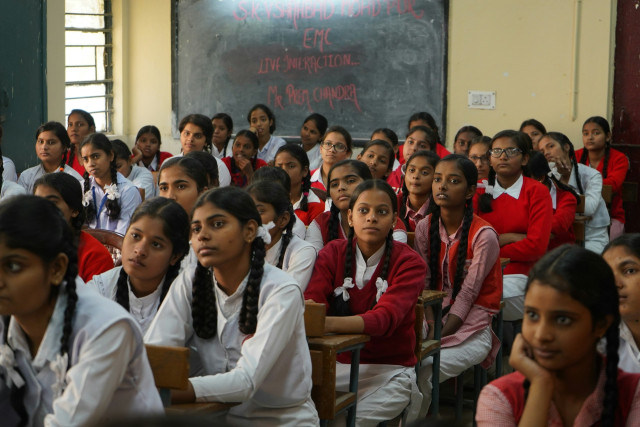
Education in Dharavi: Schools Defying the Odds
The Challenges of Education in Dharavi
Students in the Dharavi slum area fight daily against insufficient resources and poor facilities alongside financial poverty to receive education.
Quality learning remains distant for numerous students and teachers because of the multiple demanding challenges they encounter in Dharavi.
The main difficulty students face originates from inadequate financial resources. Most residents who earn their income through daily wages choose to spend their resources on survival above education.
Young children must leave their studies prematurely to sustain their families through different industrial trades including pottery manufacturing and recycling together with leather manufacturing.
The economic stress forces poor children out of school as they struggle to obtain higher education thus perpetuating generational poverty.
Dharavi faces enormous challenges because its educational facilities experience massive overcrowding together with insufficient equipment for its students.
Because of its large population exceeding one million Dharavi sustains only a few government schools that operate with inadequate staffing.
The educational facilities in many schools remain incomplete because they do not have operational toilets or clean drinking water supply along with appropriate classroom facilities. Lack of proper seating furniture forces students to occupy spaces on the floor.
The absence of libraries and laboratories and computer facilities obstructs students from obtaining comprehensive education at standard competitive levels.
Safety is another critical issue. The fear for personal security leads numerous young female students to discontinue their education.
Girls stop going to school after primary school because of harassment incidents and insufficient transportation systems along with cultural discrimination that society inflicts upon them.
Some conservative families lack awareness about female education therefore they actively discourage their daughters from pursuing education.
The educational system of Dharavi demonstrates rising resistance against the challenges that exist.
Through their joint efforts teachers and NGOs together with local community members strive to establish education opportunities for all children.
The free mid-day meal program of the government maintains school attendance through daily nutrition for students.
Extra efforts must be implemented to fix the root problems and optimize the educational standards in Dharavi.
The Role of NGOs and Community Efforts in Education
The inadequate educational delivery by governmental schools has prompted numerous NGO organizations and community service programs to work toward making Dharavi's education system better.
The organizations facilitate diverse learning alternatives together with grants and practical training opportunities for their community members.
The educational establishments from Pratham and Teach for India and Akanksha Foundation use community-based schools to deliver better resources and individualized instruction together with interactive teaching methods.
The educational institutions teach students literacy as well as important skills for leadership development alongside digital competencies that prepare them for future career opportunities.
The main beneficial work of NGOs involves implementing remedial education programs. Education in Dharavi becomes challenging since children receive inadequate educational support from poor instruction strategies and overly crowded classrooms.
Additional coaching services through remedial programs enable students to fill in their learning gaps by teaching mathematics and science together with English.
The implemented programs lead to better student retention and improved academic achievements.
Organizations use awareness programs to promote female education and supplement their efforts by providing scholarship opportunities.
The mission of NGO members becomes apparent to families during their house visitations when they explain why daughters' education matters. The organizations provide benefits including uniforms and textbooks and transportation services which enable female students to pursue education with less financial burden.
Organizations use their resources to deliver vocational education to multiple audiences. The organizations offer job-specific training in tailoring and computer literacy and spoken English education to students who have abandoned school work.
Through this education pathway students master marketable skills so they can find improved employment opportunities even without traditional schooling.
Educational promotion by the community remains essential for educational advancement. Educated youth and teachers from Dharavi devote their time to lead tuition programs that benefit underprivileged children at either community centers or temporary tent structures.
Local community initiatives play an essential role in protecting educational values by overcoming the obstacles faced by the residents.
Digital Learning: A New Era of Education in Dharavi
Technological advancements have started reshaping educational methods in the area known as Dharavi.
The spread of COVID-19 forced institutions to adopt online education as a requirement instead of an optional choice.
Various organizations actively focus on addressing digital connectivity barriers which prevent people from accessing technology-based services.
The digital learning movement in Dharavi took off through joint efforts of NGOs and private organizations which provided tablets to students and free internet service in community hubs.
Educational programs provide children with the experience of learning through e-learning apps while also offering coding workshops and virtual classrooms to ensure digital inclusion in the changing world.
Diksha alongside e-Pathshala serve as significant government programs that deliver results. Online learning platforms supply digital textbooks with video lessons along with interactive quizzes that enable students to learn outside regular classrooms.
Educational technology training has been provided to teachers throughout Dharavi thus enabling them to deliver lessons that are interactive and effective.
The accessibility problem creates a major obstacle. Families within Dharavi struggle to purchase smartphones or laptops which prevents their children from joining online educational programs. .
Digital learning faces obstacles from persistent power cuts in combination with poor internet connectivity standards.
Several NGOs have developed educational centers equipped with shared computer systems that students can access to sustain their online learning activities.
The educational landscape of Dharavi changes in fundamental ways because of digital learning.
Students who learn digitally gain flexibility alongside interactive learning as well as global knowledge resources which let them dream beyond their current circumstances.
Affordable technological progress suggests a bright future for educational opportunities in Dharavi.
Future of Education in Dharavi: The Road Ahead
Educational development in Dharavi will succeed through public support combined with technological progress while involving the community alongside financial assistance programs for disadvantaged pupils.
The current positive educational initiatives need sustainable long-term solutions to develop a truly effectual educational system.
The government should significantly increase its spending on educational infrastructure to provide complete facilities with trained teaching staff to every school in the district.
Educational policies that offer free education together with scholarships and vocational training opportunities improve attendance and enrollment in higher education levels for children.
Schools will benefit from public-private cooperation models. Philanthropic and corporate institutions should provide financial support to establish education plans as well as digital learning facilities and teaching skills training programs.
Public and private sector entities working with government bodies will accelerate the development of educational reforms in Dharavi.
Educatiual power should be equipped among the teaching staff. The educational workers in Dharavi face challenging environments even though they receive meager earnings and minimal professional development opportunities.
Organized spending on teacher education initiatives leads to enhanced educational quality which results in better learning opportunities for students.
Community participation is equally important. Education advocates need to include parents and area leaders who will support the belief that education serves as the means to escape poverty traps. Institutions need to include life skills as well as financial literacy and career counseling as essential parts of their curriculum to teach students necessary survival skills.
The implementation of modern education methodologies alongside digital tools in conjunction with effective support structures will transform Dharavi education thereby developing skilled prospect that contributes to India's growth.

The Role of Teachers: Unsung Heroes of Dharavi’s Education System
The teaching staff in Dharavi maintain an essential but overlooked position by training the educational advancement of thousands of slum-dwelling children.
Teachers in Dharavi fight unsuccessfully against working conditions while earning minimal pay with scarce resources but they devote themselves to inspire students through their unwavering commitment.
The classrooms of Dharavi remain heavily overcrowded which creates a major challenge for teachers in the area.
The restricted classroom space alongside the large number of students obstructs teachers from delivering personal educational assistance to every student effectively.
Teacher responsibility extends to 50-60 students within one overcrowded classroom space which makes individual student learning difficult to monitor properly.
The teaching profession in Dharavi often surpasses standard working hours with teachers conducting after-school classes and tutoring students who need additional help while also using personal funds to buy teaching supplies.
The need for experienced professionals keeps presenting itself as a major obstacle. Most teachers in Dharavi struggle to implement interactive learning approaches because they lack access to consistent modern teaching methodology training especially in government-run schools.
Approaching this problem several educational institutions together with NGOs launched training programs which teach teachers digital learning methods combined with innovative teaching approaches and student psychology understanding.
The training programs enable educators to adopt contemporary educational techniques which lead to improving instruction even with minimal resource availability.
Besides teaching duties teachers in Dharavi serve as mentors and counselors who function as role models dedicated to the educational development of children in impoverished settings.
Students attend schools rich with families who experience domestic violence along with financial struggles and substance dependency.
The teachers in these situations give their students emotional back up combined with motivational advice to help them stay in school instead of giving in to unfavorable surroundings.
The teachers help students envision their futures through counsel that drives their goals toward goals outside familiar local opportunities.
Local youth volunteers who possess basic education qualifications serve as Community teachers for educational purposes.
Due to their common origin with students they comprehend the difficulties students face and build profound bonds.
Community-driven educational projects reduce the difference between classroom learning and practical problems by delivering student mentorship through which they learn valuable real-world skills.
The education system will improve only through adequate support and acknowledgement of teachers in Dharavi.
An improved compensation plan and teacher training and educational resources enable educators to deliver strong performance thus inspiring students to follow their path to become the next generation of leaders.
Teachers in Dharavi remain the unrecognized heroes of the community because their educational efforts play a pivotal role in uplifting the local community.
Breaking the Cycle: Success Stories of Students from Dharavi
Educational achievement has permitted multiple students from Dharavi to build profitable careers because education remains the most powerful force for transformative change in their lives.
Krishna Yadav from Dharavi represents an inspiring tale of success since he emerged from his impoverished upbringing in this poor Mumbai district. His parents earned money as they worked every day at manual jobs so Krishna endured continuous financial challenges which interfered with his schoolwork.
The combination of NGO-sponsored scholarships together with teacher mentorship enabled him to graduate from school before obtaining admission to an elite engineering college.
At present he develops software as a professional while supporting his family members and motivating neighborhood residents to seek education.
Ayesha Sheikh succeeded in fighting both gender expectations and family opposition to finish her education. School dropout rates among girls in Dharavi remain high because society forces females into leaving education before they finish while financial burdens burden them.
Under the support of educational programs designed for women Ayesha attained upper-level education which led her to become a social worker.
Through her non-profit work she supports other Dharavi girls to pursue education while demonstrating that individual success can improve the entire community.
As a resident of Dharavi’s constricted streets Rahul Jadhav endured severe financial trouble. He was raised in the tight alleyways of Dharavi where his father earned his living as a day-wage worker and his mother maintained a job as a housekeeper.
The value of education always stood central to Rahul's parents' teaching while they persisted through their financial difficulties.
Rahul attended an NGO-operated school that delivered both complimentary education and midday meal services. Rahul experienced an intense passion for both science and space exploration yet he did not have the needed financial assets.
Rahul Jadhav displayed exceptional scientific potential according to his teachers who suggested him to join science competition events. Through his determination together with his commitment he achieved several scholastic awards which led to securing a scholarship at a respected Mumbai institution of higher education.
The turning point in his career occurred when ISRO accepted him for internship which led to international recognition of his satellite technology research.
NASA extended to him a working position on their space exploration programs right afterward. Rahul works as an aerospace engineer as he dedicates himself to encourage numerous children from Dharavi to pursue higher ambitions than their surroundings allow.
Through his story it becomes clear that educational opportunity helps students from any economic background find success while proper academic backing enables such students to overcome social limitations.
Rahul continues visiting Dharavi regularly to mentor young students who aim to pursue his path of success.
Several people without formal education learned through digital platforms to create positive life changes for themselves.
Young students in Dharavi use free online courses and digital learning platforms through their limited access to formal education to develop coding and graphic design skills as well as entrepreneurial capabilities.
Digital education no longer requires traditional classroom settings because individuals have launched their own entrepreneurial businesses as well as freelance careers and online startup ventures.
The success cases demonstrate that education transforms lives because people who want to learn combined with access to knowledge open doors for fundamental changes.
The success stories emphasize the necessity to maintain educational funding alongside scholarship awards and mentoring services together with digital education platforms that will allow additional students from Dharavi to escape poverty and pursue their goals.
The education system of Dharavi becomes a platform to showcase successful students who then serve as mentors for upcoming generations through which students prove education can eliminate economic barriers.
Conclusion
Education at the Dharavi slum represents both knowledge retrieval and the essential pathway that fuels prospects and metamorphic changes for many children from the world's biggest slum area.
The educational community made up of schools along with teachers along with NGOs as well as students continue their tireless efforts against adverse conditions to build a hopeful future.
The educational heroes who teach our youth shape their intellectual growth while building up their mental strength among students who encounter everyday difficulties.
People working in education dedicate themselves to more than standard educational practices because they frequently function as mentors and counselors while modeling positive examples to students.
The educational gaps receive help from NGOs and community-driven programs which supply financial support and digital literacy courses and occupational training to keep learning possible in limited infrastructure areas.
The success of students who triumphed over obstacles helps validate how education can help stop poverty from repeating itself.
Such people act as inspirational figures to others by showing that all dreams are attainable when learning opportunities exist.
A better education system in Dharavi has yet to be completely established. The educational needs require urgent state backing combined with better facilities and advanced teacher development and universal digital learning opportunities.
Learning empowers children to transform the direction of their lives and thereby create societal development throughout their communities.
Dharavi's students use their schools to showcase their dedication to learning because education acts as the strongest instrument to create positive transformations even when faced with tremendous challenges.
Society needs to invest in education to guide future generations into fulfillment while blocking any barriers children may encounter in their learning journey.
Also read: Slum Schools: Challenges and Innovations in Education for Marginalized Children











LEAVE A REPLY