

Climate Insurance for Low-Income Homeowners: What Could Pakistan Pilot?
Pakistan is not the least affected by the effects of climate change because the number of floods, heat waves, droughts, and storms is constantly increasing. These climate shocks have an unequal impact on the low-income homeowners who mostly reside in informal or semi-formal settlements, do not have savings, and lack access to financial insurance.
 A damaged home is
capable of forcing a household that is already a victim into long-term
poverty when the household is hit by a disaster. Conventional disaster relief,
though vital, is usually slow, inadequate and reactive rather than proactive. In that regard, climate insurance is a potentially very useful
instrument that can be used to assist low-income homeowners in dealing with climate risk and recovering faster following the shocks.
Climate insurance describes insurance products that are particularly created to cushion households against climatic risks like floods, cyclones, heat stress, or damage resulting from droughts.
The traditional insurance products are generally inaccessible, unaffordable or unsuitable to the needs of low-income homeowners. High cost, complicated paperwork and lack of trust towards insurance companies further restrict usage.
But experience
globally has demonstrated that under well-defined conditions of climate
insurance, subsidizing and connecting it with the comprehensive resilience
plans, it can be used to provide significant cover to populations under risk.
In the case of Pakistan, it is not about whether climate insurance is necessary or not, but what type of models may be practical. Local risk patterns, income level, typology of houses, and institutional capacity should be reflected by any pilot. It should also be used to supplement rather than run separately with the current social protection programs.
This blog discusses what climate insurance for low-income Pakistani homeowners might be, what the models may be, how it is designed, how it is financed, what institutions play, and what the challenges of implementing it are.
It is hoped
that the target is not to dwell on theories but rather on the physical pilots
that can be experimented on by Pakistan so as to safeguard the most vulnerable
homeowners in the country against the increasing risks of climate change.
Causes of Climate Disaster in Pakistan: Climate Risk and Housing Vulnerability
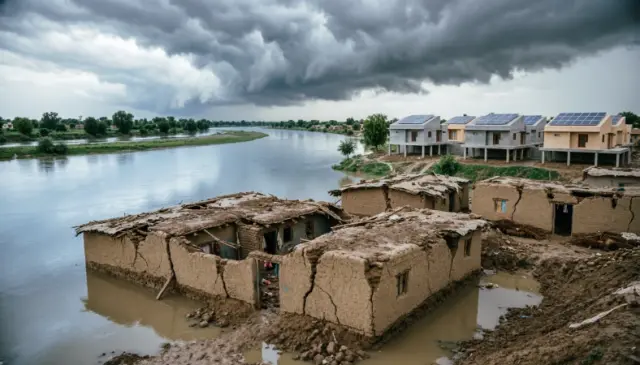
The housing business in Pakistan is highly vulnerable to climate risk because of the geographical, economic, and structural factors. With the major part of the population residing in rivers basins prone to flooding, coastal lands, or even in the informal urban settlements where drainage systems are poor and building quality is low.
Rural houses are highly
susceptible to floods and extreme weather as most of them are constructed using
mud, brick and non-engineered materials. These threats are multiplied by limited
access to credit, insurance, and formal land tenure by the low-income
homeowners.
The greatest climate risk facing housing in Pakistan is flooding. The occurrence of major flood events has severally wiped hundreds of thousands of properties with lifetime assets all ruined in few days. Heat waves, which are not as visible forms of destruction, deteriorate the quality of housing over time by compromising health risks and making it less habitable.
In dry areas, households have a hard time keeping or reconstructing their homes
due to the loss of livelihoods due to drought. All these risks are being
compounded by climate change, making the occurrence and the consequences of
destruction more common and intense.
Homeowners with low income have a structural protection gap. Although the more affluent households can come up with money through savings or individual insurance, poorer households are largely reliant on government indemnification or humanitarian assistance.
These processes are usually slow,
unpredictable and inadequate to meet the total cost of rebuilding.
Consequently, families are reconstituted in bits, and they tend to recreate the
same weaknesses that destroyed to occur in the first instance.
Informality is also associated with housing vulnerability. The problem is that many low-income homeowners do not have formal property titles and therefore cannot receive the conventional products of insurance.
Awareness and trust are weak even in areas where there is an actual presence of
insurance. Most people tend to think that insurance is not very important or
reliable, particularly when their previous experiences with claims are not good.
This context is critical in the development of climate
insurance pilots. The products should be easy, comfortable, and in line with informal housing and unstable income. They should also be incorporated with
risk mitigation strategies like safer construction and early warning. It is not
possible to offer meaningful protection through insurance without considering the underlying vulnerability of the housing.
Why Traditional Insurance Fails Low-Income Homeowners
The traditional property insurance schemes do not well adapt
to low-income Pakistan homeowners. These goods are generally aimed at formal
housing market, permanent and stable incomes and proper legal possession.
Consequently, they do not cover entire population groups which are those who
experience the biggest impact of climate.
The nearest barrier is affordability. Routine payments of insurance plans compete with vital costs in the household like food, education, and healthcare. Even small payments every month can be risky to families that live near the line of poverty particular when benefits are at stake or they are late.
The lump-sum payments or annual renewal requirements in traditional
insurance also do not conform to the irregular income patterns among households
with low income.
Difficulty also hinders adoption. The insurance contracts
are not always easy to comprehend but are full of legal language and
exceptions. Most low-income homeowners do not have trust in how to enter into
claims processes especially after the disasters when documents are lost.
Sluggish payouts and legal challenges in regard to the damage appraisal worsen
confidence and deter the involvement.
Risk assessment is another big problem. The low-income
housing in the high-risk regions is considered unprofitable by the insurers
because of the high risk of claims. This causes high premiums, coverage or even
exclusion. Commercially, the insuring of floodplains or informal settlement
homes is considered too risky without government assistance or reinsurance.
The tenure of land is also very crucial. Most of the low-income homeowners lack proper title documents, something that is usually demanded by insurers. Although long-term occupants who are well known to the community may be locked out due to their non-legal status in the property.
The failures mention above underscore the need to adopt
alternative insurance strategies. Low-income homeowners should leave the
traditional framework of climate insurance and adopt simplified products,
government-business relationships, and new risk-sharing solutions. In the
absence of such accommodations, the insurance will not be available to the
neediest people.
What Climate
Insurance Models Could Work for Pakistan
Through international experience and using the local conditions as a baseline, Pakistan can pilot a number of climate insurance models, which are designed to support low-income homeowners.
A major
potential solution is the so-called parametric insurance, which is paid out
through predetermined parameters like rain levels or river heights, and not
through individual damage estimates. It is highly applicable in places prone to
disasters as it is quick to pay and it can also cut down on the administrative
complexity.
Parametric insurance may be tied to floods, heat wave or
cyclones, where automatic payouts would be released once the thresholds have
been surpassed. For low-income homeowners, this gives them instant cash to
fix or construct a temporary home or even meet basic needs. Although it might not be
enough to reconstruct the houses in entirety, the payouts would help ensure that
households do not sink deeper into debt or poverty.
The other model that can be proposed is bundled micro insurance that can be attached to social protection plans that are already available. The initiatives that may incorporate climate insurance include housing subsidies, cash transfer programs or utility services.
One such example
is that households under government housing assistance can be automatically
enrolled into a simple climate insurance scheme with premiums being partially
paid by the state.
There is also potential in community-based insurance models.
These schemes pool the risk at the community level and are usually supported by NGOs or local governments. These models use social trust and local
knowledge and they help to minimize the cost of transactions and enhance
participation. Risk reduction measures like better construction practices can
also be promoted by community involvement.
These models require the creation of public- private
partnerships. The government can absorb risk by providing subsidies, guarantees, or reinsurance, while private insurers handle product design and administration. International donors and development banks may rescue pilots by covering start-up premiums or providing technical
assistance.
In the case of Pakistan, it is very important to begin small
and to learn. The pilots are advised to concentrate on risky areas, experiment
with various models, and collect uptake, payouts, and behavioral effects data.
Effective pilot success can then be increased progressively.
Funding, Subsidies and Institutional Roles
The provision of low-income homeowners with climate
insurance is a complex project that should have various institutions involved.
In the early stages, it will be required to subsidies products through premiums
to make them affordable and appealing. The subsidies are to be regarded as
resilience investments and not welfare expenses that are repeated.
The federal and provincial governments are in the center
stage. They would be able to finance, regulate and give information on climate
risks. Climate insurance by the government can lower future disaster relief
costs by providing a quick responsive and focused recovery.
The insurance companies contribute technical capacity in the
product design, risk modeling and claims management. Nonetheless, they will
have to avail risk sharing institutions like reinsurance or government
guarantees in order to enter high-risk markets. The financing institutions can
aid in closing this gap by providing concessional finance or guaranteeing
catastrophic losses.
Intermediate entities: NGOs and community organizations play
a very important role. They are able to create awareness, develop trust, and
enable enrollment and claims. It is especially crucial that they are involved
in informal settlements where formal institutions are not well penetrated.
Financing and implementation can also be provided by data
and technology. Better weather forecasts, satellite images and electronic
payment can save money and enhance accountability. Premium collection and quick
payouts, even in far-flung locations, can be made possible by mobile banking.
There must be institutional coordination. Climate insurance
is to be consistent with disaster risk reduction, housing policy, and social
protection frameworks. Disjointed efforts will be subject to duplication and
inefficiencies. Pilots could be coordinated by a specific coordination
mechanism at the national or provincial level and scale-up directed.
Difficulties, risks and ethical aspects
Climate insurance is promising but it also creates
significant challenges and ethical issues. One of them is the basis risk,
especially when it comes to the parametric insurance where payments made might
not be exactly proportional to the actual damages. In case of damaged
households, which fail to obtain payouts, the credibility of the system may be
easily subdued.
Affordability is an issue that persists. Even the subsidized
premiums cannot be afforded by the poorest families. The issue of who pays, how
much, and under what condition needs to be taken into consideration by the
policymakers. Public assistance to disasters should not be substituted with
climate insurance.
Moral hazard or maladaptation is also a possibility. Without
risk reduction associated with insurance, households will continue to be
exposed to risk by building in unsafe places or using materials that are
susceptible. Pairs of insurance pilots are thus supposed to be accompanied with
safer construction and relocation incentives where they are required.
Equity is another concern. Included in the marginalized
groups should be women headed families and informal settlers among others who
must not be left out by pilots. Clear eligibility standards and wide-ranging
outreach is necessary.
Lastly, climate insurance cannot be regarded as a solution
on its own. It will not help in offsetting poor infrastructure, urban planning
and standards of housing. Insurance will not provide lasting protection without
more extensive investments in resilience.
To overcome these challenges, it is necessary to design it
carefully, monitor it regularly, and be ready to make changes. Pilot
development should be founded on ethical considerations so that climate
insurance can be used as an empowerment tool and not a marginalizing tool.
Linking Climate Insurance with Resilient Housing and Risk Reduction
Climate insurance will be more effective in the case of
low-income homeowners in Pakistan only when it is closely connected with the
endeavors to make housing more resilient. Insurance is not a solution that
minimizes the probability or the extent of damages since it only takes care of
the financial consequences of the disasters. Insurance together with risk
mitigation and resilient building can move housing system on repetition of loss
and recovery to the stability that is long term.
Tying insurance eligibility (or premium discounts) to simple resilience measures is one of these practical solutions. As an illustration, homeowners who raise the plinth heights in flood-prone locations, strengthen their walls or install flood-resistant materials would be charged low premiums or paid more.
This builds a direct motivation towards safer building, but
without strictly restrictive requirements that lock out the poor. Small
changes, including better drainage systems around houses or better roofing
bondage can dramatically decrease the damage caused by extreme events.
Post-disaster rebuilding programs would also be able to be
coupled with climate insurance pilots. Following floods or storms, payouts to
insured households might be tailored in a way that would facilitate build back
better practices and not just the restoration of pre-disaster conditions.
Insurance payouts might be an option to implement safer construction by
providing technical guidance, standardized resilient designs, and access to
approved materials.
The housing authorities and the local government play a significant role in this connection. Construction principles of low-cost, climate-resistant housing are already in place in different formats but are not usually implemented or encouraged.
Climate insurance can assist in
operationalizing these guidelines, as it will make resilience financially
appealing, not conservative. Improvements on the community level in informal
settlements (elevated footways, community drainage, floodwalls etc) might be
identified within insurance plans that spread risk among the communities.
Conclusion
Climate insurance will provide Pakistan with a good chance to enhance coverage of low-income homeowners in the face of increasing climate risks. Although the conventional forms of insurance have not accessed the vulnerable groups, some of the new solutions like parametric insurance, community-based insurance schemes, and micro insurance under the patronage of the state can address this gap. The trick is in intelligent design, effective institutional relationships, and conformity to the wider housing and social protection policies.
The introduction of climate insurance in the context of
Pakistan must start with well-informed experiments with a focus on local
realities. This will require subsidies, government-partnerships, and
involvement of communities to be successful. More importantly, risk reduction
and resilient housing practices should be also correlated with insurance in
order to prevent the continuation of vulnerability.
The risk of housing in Pakistan is being transformed by climate change. The price of inaction will be increasing as the frequency and severity of disasters increase. This is not the silver bullet of climate insurance, but when it is in place as a comprehensive resilience strategy, it may act as the much-needed safety net to low-income homeowners.
Inclusive, affordable and well-designed insurance models piloted today can be an important step taken by Pakistan to secure homes, livelihoods and dignity in a changing climate.
Also read: Courtyard Housing for Affordability: Climate-Smart Tradition Revisited




-ySWGlp0vgc.jpg)





LEAVE A REPLY