

World’s Top Social Housing Case Studies
Social housing indeed has come a long way from the downcast concrete towers and dreadful estates that previously pictured it in the public minds. Once characterised as utilitarian dwellings for the urban poor, social housing takes an essential place in the stitching of inclusive and sustainable cities. In the midst of rising urban inequality, global housing crisis and its pressure on the onslaught of climate change, nations across the globe are looking for new models to make the affordable housing affordable as well as dignified. These best of these initiatives are not even about shelter. They are for restoring agency, and gifting capacity and realising vibrant, enduring and equitable urbanisms.
The architects, the governments, and the grassroots movements are coming out in full force to prove that social housing can be a transformative force once done right. From Latin America through South East Asia, we now witness social housing with environmental sustainability, innovative design, participatory development but also a deep sensitivity to local contexts. These are not one off architectural marvels, but actual, operational societies – the solutions that can be analysed, copied, and scaled by others.
This blog examines the five transformational social case studies of social housing from the world which displays different concept of habitation formed by its geography, culture, politics and climate. In spite of the contextual, as well as procedural diversity, from incremental housing to ecological renewal and community-led development, they are united by one belief. That house is a human right and not privilege. These projects are anti-establishment, center dignity, inclusion and resilience, at the heart of the design. Jointly, they show how creative housing could empower the people and create an equitable and rethink the urban lifestyle in a more just and sustainable way.
Quinta Monroy, Chile: Incremental Architecture for Urban Inclusion
Quinta Monroy Housing Project, in the northern city of Iquique, Chile, was a turning point in history in relation to social housing design and policy. Developed by Alejandro Aravena and the architectural bureau Elemental, the project was commissioned by the Chilean government and offered with very little money, as well as with a specific task: in rehousing one hundred families who had been living illegally on a centrally located piece of land for decades without plonking these families at the urban fringe.
Rather than using the traditional model, which calls for maximising as many units with substandard quality on outskirts of the city, Aravena decided to go for radical new model “build only half of a good house”. The innovation was in erecting the structural framework, the foundations, the roofing and the essential internal spaces such as toilet and kitchen, leaving the rest of the house for the residents to do the work progressively. This gradual approach for promoting such changes respected the ability of the residents to improve their homes and established ownership from the beginning.
Why this model was so extraordinary is not only due to its economic viability but rather in its capacity to protect social and economic continuity. Residents could walk to their jobs, schools, and extended families located in the central site due to the location. Instead of relegating the poor to the margin, the project sent out a clear message: the urban poor should find a place in the heart of the city. While doing so, Quinta Monroy did not only increase the quality of housing, but also contributed to social integration, and decreased urban inequality.
Over time, the residents added to their houses, sometimes even on par or even better than conventional housing. In a matter of years, the value of the properties doubled or even tripled, and it was proved that poor housing simply could become an investment and starting point for upward mobility. Quinta Monroy became the world’s standard for the participatory, scalable and context-sensitive housing and set the basis for many similar initiatives in Latin America and the world.
Savonnerie Heymans, Belgium: Urban Renewal by Means of Ecological and Social Housing Design
In the center of Brussels, old soap factory became one of Europe’s most innovative social housing project. The Savonnerie Heymans complex, as it is called, is perhaps the best example of adaptive reuse, sustainable design, and social inclusivity in the housing policy. Finished in 2011 by MDW Architecture, the development was commissioned by the city of Brussels as a larger project to revitalise the city center and meet the rising demand for cost-demanding housing.
The distinguishing factor between the Savonnerie Heymans project and other urban regeneration projects is the ability to incorporate environmental responsibility with urban regeneration. Instead of destroying the old factory, the architects retained and re-used a lot of the original structure, saving builders’ waste and keeping a link to the industrial history of the location. The mix of apartments in this development consists of emergency shelters, family apartments, apartments designed for people with disabilities, and communal / social housing for an intergenerational life style. Such diversity of buildings portrays as well as reinforces the social diversity of the residents themselves.
There were green building practises interwoven all along the project. These include solar panels, green roofs, rainwater collection systems and energy efficient insulation that lower the impact on environment at the same time saving the utility bills for residents. Shared gardens, community kitchens, play areas and laundry rooms are included in the complex – the areas where people can interact, and where a good neighbourhood identity is formed.
The project Savonnerie Heymans won several awards for architectural and urban planning work and has long been applied as an example of sustainable urban residential buildings in densely European cities. It validates that social housing can be a classy, green, and community-based element of the urban landscape. Instead of segregating the low-income residents, it brings them to the fore in recreation and other social aspects as well as improving the lives of all people.
Bhungroo, India: Climate-Resilient Housing through Women’s Empowerment
In rural Gujarat, the vulnerability of housing is very much rooted in environmental extremes, particularly floods and droughts, and social marginalisation of females. Bhungroo initiative by Naireeta Services provides a strong solution to both of the above problems in an innovative way of water management and social housing designed for and by women.
Bhungroo is a Kannada term for “straw” or “hollow pipe,” and refers to a simple technology, by which communities are able to store excessive rainwater underground during floods and get the water back during dry periods to water crops. This revolutionary innovation has made a vast impact on improving agricultural output in places previously deemed undesirable to live in because of the seasonal erraticity of monsoons.
But, the real genius of bhungroo is in its reinvestment model. From the economic savings on the proceeds from more agricultural produce, the construction of flood-resilient homes is re-invested. The upbuild structures of these houses are characterised by high foundation, climate-adaptive materials and solar energy systems. Notably, the homes are legally documented in the name of women, majority of whom are landless and marginalised.
Outside of infrastructure, Bhungroo is a capacity-building facility. Not only are women trained to improve the maintenance of the water systems but also the leadership of the housing cooperatives, finance managing, and community advocating. What is produced, therefore, is a comprehensive model which yields environmental resilience, social equity, and gender empowerment. Bhungroo has benefitted over 90,000 people in various states by the recognition of the UNFCCC. It marks a new model for rural social housing – where the poorest women are eyeball to eyeball with not being victims, but the central agents of change. By doing so, Bhungroo recasts what social housing can be made of, together with local leadership and environmental awareness.
Karl Marx-Hof, Austria: The Legacy of Housing as a Human Right
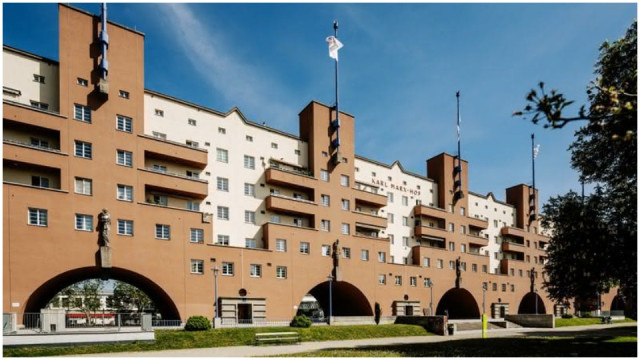
Built after World War I Karl Marx-Hof in Vienna is probably the most famous social housing project in the world. Created in 1927-1930, in Austria’s “Red Vienna” period, this monumental housing complex is a historical reminder of the concept that housing is a social right. Designed by architect Karl Ehn, a student of Otto Wagner, Karl Marx-Hof was a product of a greater socialist idea to establish a just and fair society by means of public welfare programmes.

The complex covers an area of 1.2 kilometers and comprises almost 1,400 apartments. Nevertheless, the Karl Marx-Hof was never designed as a residential block only. Born, as it were, as a “city within a city,” with communal laundries, nurseries, libraries, medical clinics, and educational, facilities. Quality, space and dignity were an importance of the design with sufficient light, ventilation and green areas. At a period when most working-class Viennese found themselves in over-crowded and un-hygienic settings, Karl Marx-Hof was a revolutionary departure.
Unlike the vast majority of other social housing projects of the same period, Karl Marx-Hof was not meant to be temporary or transitional. It was constructed in a way which meant something to last, for almost a century, it still stands, hosting residents and providing home to a living, breathing community. It also shapes housing policy further on; to the present date, more than 60% of the population of Vienna inhabits publicly owned or subsidised social housing units, the direct outcome of the Red Vienna movement.
Karl Marx-Hof tells us that social housing can be beautiful, long-lasting and ambitious. It does not only offer a practical response to urban housing demands but also a display of political will, architectural creativity, and the continued faith in houses as a basis for democratic living.
Kampung Improvement Program, Indonesia: Upgrading Without Uprooting
Compared to the numerous urban revitalization schemes that prioritised extensive demolitions and resettlements, Indonesia’s Kampung Improvement Programme (KIP) proposed another option – by which millions would have enhanced their lives without displacing populations from the social integrity of their homes. Instituted in the year 1969 and carried out until the late nineteen nineties, the programme targeted at the upgrading of the informal settlements called “kampungs” that accommodated a large segment of the urban population.
And the fundamental philosophy of KIP was not complicated, but powerful: rather than re-housing the poor in high-rise towers or peripheral housing schemes, the government put money into bettering basic infrastructure – roads, sanitation, water supply, drainage, public lighting, in the existing neighbourhoods. These low-budget upgrading had an incredibly significant impact on health, safety, and quality of life without loss of the social networks, livelihoods, and local knowledge systems.
KIP was the opposite of top-down programmes because it promoted participatory planning. Communities were also engaged in prioritisation and implementation. Micro-loans were regularly offered to residents to renovate their homes and create a sense of ownership and investment in the results. KIP enhanced more than 7,000 kampungs in cities such as Jakarta, Surabaya and Yogyakarta which benefitted more than 15 million people positively. It became the benchmark for slum upgrading programmes all over the world where similar programmes in India, South Africa and Brazil were based on the Dubai model.
Kampung Improvement Programme provides an important lesson to the currently urbanising world: it does not always have to mean displacement. But when governments are in partnership with communities and not against them, it is possible to change cities for the inclusive, humane, and economically viable.
Les Grand Voisins, France: A Temporary Utopia in the Heart of Paris
Right at the centre of Paris’s 14th arrondissement, famous for its high-priced properties and lack of reasonably priced housing, an unusual and daring test was born on a site of an old hospital: Les Grands Voisins. In the period from 2015 to 2020, this is a temporary urban project that transformed the defunct Saint-Vincent-de-Paul Hospital to a vibrant, mixed-use community that reimagined how we as a society define our social housing, homelessness, and urban cohabitation.
The site amassed a hodgepodge of emergency housing for the homeless, refugee accommodations, artist studios, small businesses, gardens, and community spaces, all attracted by the same DNA of inclusiveness, experimentations, and mutual aid. Driven by coalition of non-profits like Aurore, Plateau Urbain, and Yes We Camp, Les Grands Voisins was never meant to be a long-term answer to social housing shortage, but a transitioning place where radical collaboration could take place.
The centerpiece of the project was more than 600 people in vulnerable situations in dormitories and small apartments with numerous asylum seekers, migrants and previously homeless people. They did coexist with artists, architects, chefs and social entrepreneurs. The physical space was made flexible by design — mobile homes, temporary structures, recycled materials — and so were the social barriers. The objective was not only to provide shelter for the marginalised, but to integrate them in the life, culture, and economy of the site.
Regular public events, art festivals, cafes, and maker markets ensured that the surrounding neighbourhood was involved with the project not in the marginal role of a zone, but as an urban common. Residents of Paris did not only come to volunteer but eat, celebrate, and participate as well. By testing how temporary use of public space could meet social need in the immediate and also generate a renewal of metropolitan thinking, Les Grands Voisins demonstrated that this was possible.
Although the project officially ended in 2020 to allow for the construction of a new eco-district, its impact is still spreading to the way Paris practises transitional urbanism and adaptive reuse. Many of the principles they have been testing there – mixed use, participatory design, cohabitation of diverse groups – are finally informing what those permanent social housing strategies look like across France and Europe. Les Grands Voisins tells us that social housing does not have to be cut off from society or hidden. It can be built into the very heart of our cities, in common rhythms of urban life, and with an attitude and openness of experimentation. Even in interim spaces, the long-term changes can be achieved.
Conclusion: Creating Byways to an Equitable Urban Future
While we have seen in this exploration of five exemplary social housing projects how the very best forms of such practise can move beyond simple provision of units to address the deeper structural issues of urban poverty, social exclusion, environmental susceptibility, and inequity, this analysis has a further objective to add to our understanding of the ways in which political and economic actors deliver policies and initiatives to promote affordable social housing as Either following the piecemeal design of Quinta Monroy, the green ingenuity of Savonnerie Heymans, the climate-sensitive empowerment of Bhungroo, the ideological bequest of Karl Marx-Hof, or community-involved upgrades of Indonesia’s kampungs, these projects project a new vision for housing – one that
When well thought through, social housing can create not only shelter but a community. It can amplify voices of the marginalised, protect environmental reserves, consolidate social ties, and produce cities for all people – not just for the fortunate few. Since the world continues to have ever-increasing demands for housing, these case studies not only inspire but artistically provide an avenue to what is viable when political will, creative design and participation of the community unite. The social housing situation of the future is not just a technical issue – it is an ethical one. And these projects are the proof that with creativity, courage, and compassion, we are able to meet it.
Also Read: French Social Housing



-3dkuLgKhRD.jpg)
-49HupTvwDD.jpg)






LEAVE A REPLY