

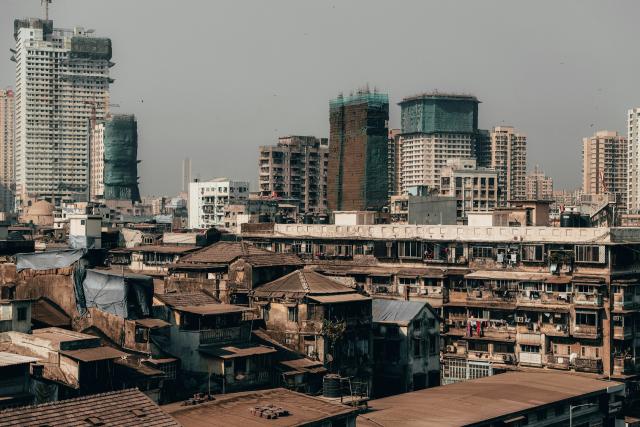
What is slum?
One of the latest forms of contradiction that exist today is the existence of slums in a world which has undergone towering urban development and features endless metropolitan areas. Slums are the dense areas in a city which are economically underdeveloped while the rest of the city has seen better developmental stages. Slums are often regarded as having poorly built infrastructure which lacks basic amenities like sanitation and fresh water, along with elevated levels of poverty. In order to define a slum, I propose we attempt to dig deeper into the political, social and economic ideologies surrounding the existence of these places rather than judging them at face value.
As stated previously, the definition of a slum could be simplified to an area of a city which is poorly constructed along with the socially accepted notion of overcrowding. This alone allows me to state that slums are present all around the globe. In more developed countries slums could be considered as neglected ghettos, the Brazil favelas bang South Africa and of South Africa along with Pakistan's katchi abadis all serve as examples of this.
The emergence of slums is associated with the rapid growth of cities, increases in economic disparity, inadequate affordable housing, rural to urban migration, and poor overall urban planning. When people move to cities in search of better employment opportunities, the demand for housing increases, often surpassing the available supply. This dire financial situation compels low-income earners to seek shelter in informal settlements, known as slums. In many countries, slums are actually outpacing formal housing due to a lack of systematic regulations, and thus become an integral part of urban life.
This is the very reason why such a broad notion as ‘slum’ is considered to be the focus of attention. In the subsequent blogs, we will analyze how slums develop, their forming processes, the living conditions inside, and the socio-economic contribution they convey to cities. Additionally, we will delve into the factors of slum rehabilitation and cross-examine global case studies in order to explore the developmental divergence and convergence of slums within different cultures and geographies. Addressing the issues of slums is essential, not solely from an academic viewpoint, but from a humanitarian and a developmental perspective as well, given that billions worldwide live in and are impacted by these settings.
The Development and Causes of Slums
The progression of slums is seldom a spontaneous phenomenon. Inadequate housing results from a pervasive socio-economic system, governance and planning failures. Migration from rural areas to urban centers is one of the reasons rural slum areas are set up. People look for job opportunities and better standards of living; thus, they move out of small towns and villages to bigger cities. Unfortunately, cities are not equipped to deal with this rush in population and a steep increase in informal settlements.
Another important reason is the rapid increase in population within the city. City expansion occurs at an astonishing rate; thus, there is little to no municipal service provision.There are usually financial constraints or political reasons limiting public housing projects in most parts of the developing world. Thus, people build informal settlements. The areas outside towns or cities such as on empty land or worse yet, along rivers, train tracks and high mountains, are where slums are typically located, since building there is often forbidden.
Poverty and inequality also have significant importance. The majority of the individuals residing in slums get their livelihood from informal work and making just enough to survive, but not to afford reasonable accommodation. The absence of access to credit, formal employment, and legal safeguards locks these people into poverty and transforms any hope for better living conditions into an almost impossible task. The problem is made worse by corruption, issues of land tenure, and fragile governance which invite land mafias and speculatively illegal developers to take advantage of the housing crisis for profit.
Displacement due to conflict and natural disasters also have a hand in the growth of slums. Typically, those who are informally housed do not have other options. By living for longer periods, these people start building slums where they live. Consequently, slums are caused by poverty for individuals and various other factors affecting society as a whole which should be addressed by policies.
Life in Substandard Living Conditions
Surviving in a slum is life in its most difficult form due to endless unsolvable pain caused by lack of recourses and inadequate infrastructure. Most slums feature a high degree of spatial congestion, with entire families living in a single room or in improvised units constructed from recycled wood, tin, plastic, or mud. These units afford little ventilation, are poorly constructed, and therefore become unsafe and uncomfortable during the rain, extreme heat, and cold.
Sanitary conditions in slum settlements are very poor. Often, residents have no choice but to use open defecation, communal latrines, or generic toilets that contaminate local water bodies along with sewage systems. Clean water that is safe for drinking is scarce and is frequently shared between hundreds of individuals which makes them vulnerable to diseases like cholera, typhoid, and dysentery. Many slums are devoid of sanitation services, and as a result, waste is left to accumulate in streets, public spaces, and open drainage systems.
Slum healthcare as an industry is sorely underfunded in both availability and affordability. Medically trained personnel often have access to poorly stocked medical facilities which leads to them being overworked. Residents often turn to local healers or unlicensed practitioners which amplifies the problem as misdiagnoses and mistreatments become commonplace. Malnutrition along with infectious diseases, respiratory diseases, and maternal mortality are also extremely common as lack of overall living standards alongside neglected preventive care further deteriorates the conditions.
Education is yet another area which requires urgent attention. Schools as a whole are usually underfunded and inadequately staffed, which leads to extreme overcrowding. Children living in slums face and have to deal with a myriad of barriers when it comes to education such as child labor, family duties, and poverty stricken households lacking necessary school materials. This leads to a great many children dropping out of school to earn money which further exacerbates the cycle of poverty.
Regardless of the harsh conditions, slums are remarkable in their ability to foster strong social ties as well as enable collective action. Small scale industries, service businesses, street vendors, and artisans are all part of a self-sustaining ecosystem, enabling informal economies to thrive in slums. Support networks at the community level tend to be more robust in slums when compared to formal urban regions. These strengths do not address the gaps in infrastructure that enable residents to achieve a minimum acceptable standard of living, however. Improving life in slums requires dealing with physical conditions alongside legal and social empowerment.
Social and Economic Consequences of Slums
The economic functions of slums are contradictory. They serve as the most striking indicators of failure in city planning and governance, while simultaneously serving as the primary source of labor and services on which urban life depends. Many city-dwellers at the lower-end of the socio-economic ladder, who partake in construction, domestic work, transport, manufacturing, trade, and other informal activities, form the backbone of the city. While these people sustain the city, very little is done to acknowledge their contribution and they lack access to subsidized welfare services.
While the informal economy within slums may appear rudimentary, it is actually quite sophisticated. Residents of slums and other urban areas are employed in small scale businesses, street vending, food, and tailoring, which all provide valuable income. Informal economies allow for greater diversity but they also expose people to legal risks, exploitation, and vulnerability. Mobility within slum economies is remarkably high but due to their informal nature makes them ineligible for taxation, which prevents slums from forming the tax base economically necessary for government service funding.
Slums socially are a mixture of vibrant and challenging. Enclaves have distinct pockets of self-governance organized by local leaders as well as organizations, which function autonomously. These social constructs help coordinate and manage fights, community activities, and deal with other authorities. Subordinate institutional fragmentation leaves inhabitants politically uninformed and participants in the decision-making process of the governance policies, which impacts the day-to-day.to day life of slum ghetto economically and socially, and makes them susceptible, with no control over it. This can result in social control over people, social, welfare and at some point, social outburst.
Despite not being universally valid, poverty concentration in slums has been linked to an increase in crime rates. Most slum areas have a strong social collective and self-policing systems. Nonetheless, the absence of legal housing rights, property ownership, and police custody renders residents of slums susceptible to eviction, violence, and exploitation done by criminal groups and corrupt administrators.
The existence of slums also alters the perception as well as the functionality of cities. While providing affordable accommodation slums constantly require urban infrastructure and maintenance, therefore straining public resources, as well as adding to environmental harm. Urban areas can face severe consequences for sustainability because of water contamination, air pollution from unabated cooking fires, and construction that does not comply with national and local regulations. From a slack socio-economic point of view, slums carry negative socio-economic effects which are complex multi-dimensional challenges needing intertwined approaches and mediated compassion policy reform solutions.
Slum Upgrading and Rehabilitation Efforts
A holistic strategy that incorporates immediate relief alongside long-term solutions is essential to alleviating the issues caused by slums. For many years, international bodies, along with local and national governments, have attempted to implement several slum upgrading and rehabilitation projects that improve the conditions of slum dwellers without forcibly evicting them. These projects often include the development of roads and sanitation as well as the provision of water, waste management services, electricity, legal recognition, and ownership rights.
One of the most efficient ways of improving a slum is through in situ upgrading, which allows for the improvement of facilities without physically displacing the residents. This method maintains social order by reducing the level at which communities are disturbed. Projects could consist of the construction of paved roads, public toilets, drainage systems, and community centers. Some other projects incorporate micro financing so that residents are able to improve the quality of their homes or start small businesses. Land registration is very important because it gives sense of property security to the people and motivates them to invest.
On the other hand, s relocate-based schemes are methods that shift residents to government-built housing projects, are often low on meeting expectations. Social and economic particularities of slum dwellers are frequently ignored while constructing such initiatives. Relocating people to the periphery (despite the lack of competition for space), tend to disconnect them from their places of work, and support structures, precipitating decline in standard of living and even the development of new slum like areas adjacent to urban centers.
Community participations in in planning and implementation are fundamental to the success of any slum rehabilitation initiative. If community members are actively in decision making, the chances of projects outliving their initial acceptance is significantly increased. Earning and maintaining trust and reducing resistance with authority is crucial for overcoming barriers to successful long-term change.
Irrespective of having few salient success stories from Brazil, India, and Kenya, slum rehabilitation still poses a difficult problem to crack. The mix of rampant political interference, inadequate sustaining funding, corruption, delay at bureaucracy, and overall lack of funds is still major challenge. Despite this reality, there is a growing sentiment that slums are not fleeting or peripheral, but a permanent reality within urban infrastructure, which is tended to in a more pragmatic humane manner. The move from elimination to integration is a much welcomed shift in attitudes.
The Role of Government and Policy in Slum Development
From attention (or the juvenile lack of it) given by the authorities, one way or another illustrates the exact reason why slums emerge and why they hold the possibility to be transformed. No effort was made in attempts to predict or accommodate urban sprawl, which partly explains the existence of slums across the globe. The absence of affordable housing, poor management of land, and strict zoning regulations leads to the need of low-income families to seek accommodation, however primitive nature such accommodation might be.
The planning of lower income lacks without options sadly is regulated to shelters which by no means meet even the lowest standard requirements. Dwelling in slums is often viewed as an illegal or temporary existence, which results in government passive aggressive actions geared towards makeshift beautification or infrastructural works. Such approaches create a paradox of paradoxes as the attempts to beautify by forced eviction further deepens the pre-existing crisis.
Developing policies provide increased evidence to illustrate possible solutions the government can provide. Improvement of residents’ conditions is something that could be achieved by making urban development policies that recognize informal settlements, grant them area ownership, and incorporate them into the heel of the city.
The planning and execution of multi-agency activities is extremely important. There should be an integration of effort among the construction ministries, local administrative units, cleansing units, and social welfare institutions in order to arrive at comprehensive alternatives. Worldwide experiences indicate that local governments not only have the ability to make sustainable change when they treat residents of slum areas as stakeholders instead of barriers, but that such change is much more positive and lasting.
The construction and improvement of slums is more than just providing shelter – it is a complex policy issue that necessitates a determination, political commitment, social adoption, and an outlook for deep beyond the immediate future. The supporting policies tend to be forward-thinking in regard to determining slum habitation and the borders because cities where their population’s needs are considered and met without deluding the rest of the people tend to be more equitably and resiliently populated. Resolving the issue of slums, therefore requires far more advanced governance frameworks, which value the essence of existence instead of frameworks that treat humans as mere challenges to be dealt with.
Conclusion
Slums represent systemic failures in planning as much as they reflect the endurance of human communities. As case studies in undisciplined growth, slums epitomize the lack of planning strategies which accommodate sociocultural developments. Economically and sociocultural, slums contribute to the satellite cities that house them. The fact that they are often neglected makes the situation worse not better, amplifying the concerns of inequality.
In order to solve the phenomenon of inequitable urbanization, it is necessary to combine moral sensibility with accurate and comprehensive data analysis. Slums beg the question, where is society headed, where is a particular policy going, and what problems does a specific social policy try to solve? There is no questioning the existence of staggering gaps in governance and equitable social policy along with economic planning. Those are challenges, I believe, that can be overcome so long as there is participatory policy-making approach that integrates sustained investment within the urban development paradigm.
The transition from a slum to a fully functioning sustainable urban community is difficult, but it must be done. While cities continue to expand, the focus should not be on ‘if’ slums will be a part of the future, but rather ‘how’ they will be integrated into urban evolution. Providing safe and affordable housing to every city dweller is not merely an infrastructural issue—it’s fundamentally an equity issue. The discussion around slums needs to be coupled with critical discussions on the global future: what kind of world do we wish to inhabit, a place that encompasses all.
Also Read: 10 Biggest Slums In The World: Understanding Urban Poverty



-3dkuLgKhRD.jpg)
-49HupTvwDD.jpg)



LEAVE A REPLY