

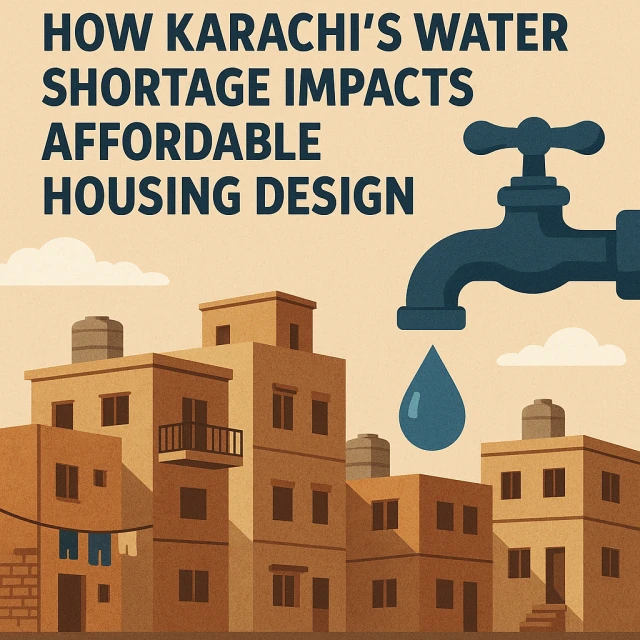
How Karachi’s Water Shortage Impacts Affordable Housing Design
Pakistan’s largest city Karachi experiences a water emergency that affects its approximately 20 million densely packed residents. As Karachi has more than 20 million residents the megacity fails to deliver basic water quantities to its citizens. World Health Organization establishes 50 liters per day as the standard requirement for available water for every person.
Neighborhoods throughout Karachi consistently experience weak water supply as they receive much less than 50 liters per day. The complete water needs of the city amount to 1.2 billion gallons per day but the city only gets between 550 and 600 million gallons of water supply. Therefore, scarcity of water supplies has affected almost fifty percent of the residents who lack appropriate water access which triggers multiple economic and environmental difficulties.

Understanding Karachi’s Water Crisis
A breakdown in both infrastructure maintenance and inadequate governance mechanisms cause the main difficulties in the situation. Karachi's principal river source employs the Indus River but it operates a traditional water distribution network that has deteriorated from excessive leakages and unauthorized service lines combined with inadequate maintenance procedures. The independent organization Karachi Water and Sewerage Board (KWSB) experienced regular struggles with funding and administrative ability while managing the city water system. The existing systemic weaknesses allow water theft and tanker mafias to exploit the situation. They sell valuable water to wealthy citizens but neglect to provide access to their basic needs to the poor residents.
Climate change compounds the problem. Freshwater resources are disappearing at an unprecedented rate because of increasing temperatures as well as changing rainfall patterns and worsening droughts. The expansion of urban areas damages both water recharge zones and underground water storage systems which diminishes the natural water replenishment process. The geographical condition of Karachi makes the water crisis in the metropolis even more difficult to manage. The arid coastal climate of the city prevents the availability of large natural water reservoirs which are located at significant distances from its metropolitan area. Large-scale desalination remains unfeasible because of high prices.
Every human activity in Karachi faces challenges because of the dire water situation which interferes with personal cleanliness and medical services as well as educational standards and workplace activities. Among all affected areas the housing sector stands as the most significantly disrupted one. Water resource availability together with their management strongly influences what it costs to build affordable homes. The growing number of migrants into Karachi's expanding urban area along with rising unregulated settlements require more attention on how limited water supply interacts with residential structure design.
The Link between Water Access and Housing Affordability
The present definition of affordable housing fails to capture other essential factors which determine sustainability because it bases its measurement on financial accessibility to specific income brackets. Water, a basic human necessity, plays a central role in this equation. The limited water supply of Karachi raises both the price and imposes complicated requirements on accessible residential options. The residents of low-income neighborhoods must sustain their water needs through unauthorized water tanker services along with private bore well systems and communal water distribution points rather than through official utility accounts. The water supply arrangements impose social pressures as well as being unreliable while being expensive and unhygienic.
The lack of sustainable water management during housing construction drives people toward using informal water systems which ends up making their housing less affordable. People who live in low-income housing manage to pay rent or mortgage payments although monthly water bills put together exceed their total housing costs. Affordable housing description becomes meaningless when such situations occur.
Most people living in poverty across Karachi's urban areas reside in katchi abadis without any established basic infrastructure. Water retrieval in these zones requires residents to obtain water from faraway sources which they store in unclean receptacles while using precise measurement of their water supply. Public health threats become worse when communities have high population density since waterborne diseases easily transfer from person to person. Cholera and dysentery as well as skin infections occur with regularity mainly affecting both children and senior citizens. The traditional female role of water transportation and household requirements results in women bearing physically and psychologically hard challenges.
Typical housing unit plans should adapt to the conditions of specific environments. The construction of homes in various low-income developments happens without proper attention to plumbing features and water storage facilities or drainage systems. The absence of proper planning in building design yields deteriorating structures together with mold formation and unsafe housing that affects residents. The inability to access reliable water leads to poor hygiene practices among tenants who subsequently devalue their houses along with facing community stigma.
The challenge in planned housing schemes develops its unique characteristics. Water sustainability gets neglected by developers who choose more attractive solutions or less expensive choices. Fancy exterior designs combined with tight floor plans suggest efficiency yet adequate water infrastructure components such as rainwater storage and gray water recycling along with water-efficient hardware become responsibilities of the residents. New gated communities construct their own water treatment facilities along with underground storage units while doing so increases building costs that homeowners need to pay thus the units become unattainable for their target audience.
A sustainable approach to affordable housing in Karachi should embody components that reach further than the standard construction scope. The city's water restrictions should be included as an essential part in architectural and urban design processes. Any sustainable long-term solution for water needs to implement into operation decentralized water systems and local filtration units through community water cooperative organizations.
Rethinking Housing Design for Water Resilience
The intense water crises in Karachi require organisations to reassess principles used when designing affordable housing. The architectural models developers presently use which frequently coming from different regions lack effectiveness in handling Karachi's native environmental elements. Designing homes presents an opportunity to construct buildings which solve affordability problems together with their capacity to withstand water scarcity risks.
The most successful technique for water management in urban design uses water-sensitive urban design (WSUD) principles. The design philosophy of WSUD builds communities and buildings to follow natural water processes thus decreasing the need for outside water supply. A rainwater catchment system using rooftops can redirect collected water to underground tanks that function as storage facilities until usage is needed. The limited rainfall in Karachi becomes an important water source by effective collection and storage methods.
Gray water recycling represents an important principle in water conservation systems. Household water used for washing dishes along with laundry and bathing enables filtration into water suitable for toilet flushing and irrigation purposes or cleaning activities. The establishment of recycling systems inside residential units allows the reduction of fresh water consumption by twenty to fifty percent. Low-income housing units achieve substantial cost reductions together with better sanitation by implementing this system.
Water-smart design heavily depends on the selection of appropriate materials for its implementation. Porous pavements, green roofs, and permeable landscaping help with water absorption and groundwater recharge. A combination of improper sewage management and inadequate drainage systems has transformed Karachi urban slum neighborhoods into areas of simultaneous water shortage and flood conditions. Strategic choices between materials together with strategic spatial organization serve to decrease these safety hazards.
Building community infrastructure stands at equal importance with other matters. Shared sanitation blocks together with community laundries and centralized water storage facilities enhance water efficiency as well as decrease waste. These solutions build collective management systems which enhance community ownership of resources and promote inter resident responsibility through group stewardship. The implementation of water conservation programs requires adequate training and public sensitization specifically for communities that exhibit cultural practices of mismanaging and wasting water.
Technology presents alternative resources in addition to its existing devices and methods. Predictive low-cost water sensors evaluate reservoir levels and spot potential leaks to protect valuable resources from careless mishandling. The development of mobile applications provides residents with advanced tracking capabilities for water consumption and better tanker delivery scheduling operations. Larger development areas benefit from smart meters which optimize consumption patterns by detecting real-time anomalies. The high initial expenditure for these technologies yields long-term cost reductions together with resilience benefits which justify their investment.
Policy intervention serves as the vital element to complete the entire process. The new requirements under urban planning codes must include compulsory water conservation standards for modern residential developments. Sustainable development practices in new projects can get financial assistance by way of government support. The key action of the government involves equal distribution of water resources while enforcing illegal water theft policies and investing in seawater purification and wastewater clean-up systems.
Educational programs should participate in these efforts to achieve their objectives. People living in the area should learn about both water preservation significance and available saving practices. To practice water conservation we need to follow recommendations which start from installing low-water fixtures up to dry-cleaning methods and preventing liquid waste during home cleaning activities. The multiplication of awareness will occur when educational organizations and religious bodies and community leadership teams work together to propagate this knowledge.
The water emergency facing Karachi exists as both a housing problem and a public health emergency as well as a gender issue and an economic disaster. Homes qualify as genuinely affordable only when they incorporate both water costs and accessibility as definitional standards. The continuous growth of the city requires adoption of an entirely new vision based on foundational water resilience principles that will avoid treating it as an afterthought. Landmark homes of dignity and sustainability can emerge in Karachi through innovative designs combined with technological innovation supported by community engagement.
Socioeconomic Inequality Amplified by Water-Insecure Housing
The water emergency of Karachi affects different community segments differently. The division between people who have money for substitute water access stands opposite those who lack financial means in Karachi's housing districts. People who live in wealthy areas depend on personal dug wells and water filtration units combined with premium payment for tankers to obtain water. Urban poverty affects the people living in informal settlements and low-income housing blocks who experience severe water shortages and encounter contaminated water supplies.
The gap between individuals who have steady access to water and those who lack it establishes an endless pattern where limited water access causes health problems that reduce work capability while deepening poverty levels. Children experience absent days from school because of water-related diseases and workers win no wages while waiting in queues for water collection as women must sacrifice both time and safety during their household water responsibilities. Different impacts from this situation lead to direct consequences on housing stability and upward mobility.
The increasing social inequalities need attention from policy makers and housing strategists during discussions. The provision of affordable housing which lacks water access fails to achieve the target of equitable urban development. Addressing water equity stands on equal footing with housing equity when resolving urban challenges because policymakers should deploy combined programs of targeted subsidies and inclusive planning and infrastructure development in underserved neighborhoods.
The Future of Water-Conscious Architecture in Karachi
Future sustainability of Karachi depends on how architects will solve water challenges moving forward. Today's architects and urban designers alongside planners have started to grasp the necessity of housing solutions which both respond to climate changes and manage water usage sensibly. The market adoption pace of architectural designs using vertical gardens with passive cooling capabilities and compost toilets and modular water tanks is persistently slow although these concepts thrive in academic pilot studies.
The implementation of research grants and public-private partnerships with design competitions helps speed up the testing process for innovative water solutions to meet deployment requirements. Such programs merge experimental approaches with methods to develop localized scalable solutions. All Karachi-based universities together with technical institutes hold vital responsibilities. Working on water-resilient design concepts which fit their particular context enables them to solve the city’s exclusive environmental and socio-economic issues. Academic research united with practical city development processes will guarantee that upcoming housing developments and infrastructure systems are cost-effective while also being sustainable and ready to face water scarcity conditions.
The city requires an updated housing policy structure to establish water sustainability as an essential criterion for every development project. The development regulations must incorporate water audit mandatories along with rules for rainwater harvesting and enforceable waste disposal systems. Through this essential measure the city will be able to create an affordable and resilient housing ecosystem.
Informal innovation patterns have emerged from local community adaptations
Members of the community confront Karachi's water crisis through resilient adaptive measures despite receiving scarce support from institutional organizations. The residents of numerous informal settlements have designed affordable strategies to address their water supply problems. People implement simple rainwater harvesting systems made from tarpaulin and gutters as well as transform plastic containers into water transportation systems due to their improvised response to internal water challenges.
People in different regions of Karachi have established functional local solutions to resolve ongoing water scarcity problems. Residents have started their own governance systems which involve jointly purchasing water tankers and shared bore wells with pooled financial resources. Water accessibility combined with community teamed efforts provides local communities both access to water supply and promotes shared ownership throughout the community.
Local communities took this a step beyond regular distribution schedules to arrange unified water distribution periods to efficiently manage their limited resources as well as minimize resource-related conflicts. The survival-driven strategies operate as useful lessons for official urban planning. These examples show local community participation works in tandem with government strategies to improve water access in areas without enough state infrastructure. Official urban planning policies should integrate community-driven models which will create resilient systems matching the actual needs of those served.
Non-governmental organizations and social enterprises now understand the power of community involvement for developing water-resistant residential areas. Community-driven initiatives have implemented basic water cleaning systems and portable water storage packages along with sanitation teaching programs which reduce the divide between government-led projects and inhabitants' day-to-day needs. Such grassroots initiatives show promise of reshaping the current understanding of "affordable and sustainable" housing standards for Karachi.
Conclusion
Water scarcity in Karachi exists beyond supply limitations to become an essential urban problem which impacts all elements of everyday life especially the residential sector. The rapid demographic and structural growth of the city demands that leaders address the established connection between water resources and sustainable housing prices. Creating genuine habitable homes demands designing systems that handle water for accessibility alongside storage for use and recycling with emphasis on fairness alongside enduring strength.
Various solutions between formal architectural designs and informal adaptations can already be seen across the city. The present need requires three essential aspects: policies which support innovation while architects design through local understanding and community participants direct urban planning toward its future course. The future of Karachi needs an alternative framework based on equal measurement of price value and social dignity alongside healthcare equity and environmental sustainability. The city will become resilient and inclusive only when it succeeds in transforming its housing crisis into an opportunity.










LEAVE A REPLY