

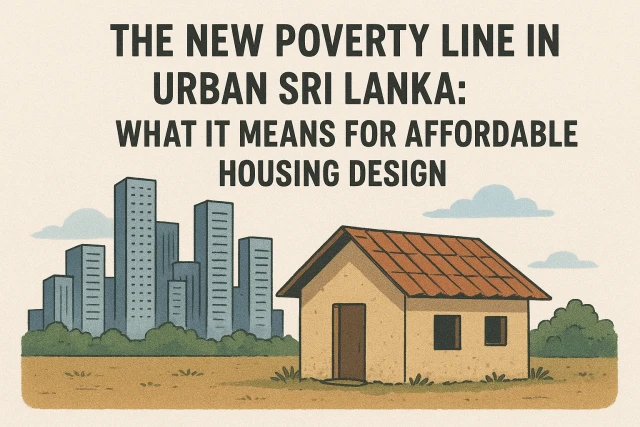
The New Poverty Line in Urban Sri Lanka: What It Means for Affordable Housing Design
In recent years the urban poverty in the country of Sri Lanka has changed due to the economical strain, inflation and employment alterations. Consequently, a new form of urban poverty line is transforming the minds of the policy makers, developers and communities on the basic needs. There is more to the new poverty line than mere income poorness; there is also the cost of living in such big cities as Colombo where cost of living due to housing, food transportation and utilities amongst others keep on increasing. The significance of this emerging standard is on the design, as well as delivery of the urban development and housing in particular.

Understanding the New Urban Poverty Line in Sri Lanka
The poverty in urban areas is not a black and white as in the past because it has different dimensions. Not only does it consist of the homeless or unemployed persons, it encompasses people who have full time jobs yet they still find it difficult to sustain daily expenditures. These are people in transport, retail, healthcare, education, and many other necessary working positions, who, even though they get regular wages, cannot afford housing. The new poverty line takes into consideration the reality that to be able to survive in urban areas, people now need much more money as it was even ten or five years ago.
The great expenses of urban life are proclaimed by a couple of factors connected with each other. The prices of foods and utilities are on the rise, the public transport is erratic, and the rate of rents is record high. Even the amount spent in commuting between different streets of the city is a loss. This has the effect of leaving many families with low wages to save, and very few options through which to get access to decent housing. This is not a housing problem, it is a human development problem, a problem which has implications in health, education, productivity and dignity.
Not merely monetary shortage is what the new poverty line holds, but also vulnerability. It appreciates the fact that most residents of cities live just above the established poverty lines, yet they exist in the state of financial insecurity. They can be driven to crisis by a medical bill, a job loss, or a rent increase, etc. It is usually the housing since it is the biggest monthly cost of the majority of the families. When housing is not affordable, then all other things are shaky.
Such knowledge of this new poverty level is crucial to governments and housing developers. It alters the definitions of what constitutes affordable housing and what defines affordable housing. The problem with the income assumptions used in calculating the price of affordable housing is that it won’t serve the target population because it is based on old economic realities. To balance provision in the housing policy and housing design with the new line of poverty will allow stakeholders providing support to the people with necessary needs and in ways that they can practically use.
Affordable housing in this respect can be not so much of minimum standard but being reasonable and very much comfortable in the current economic hard facts. The new urban poverty line is an indication. It gives the message that the old measurements are outdated and that we direly need new, innovative thinking to create cities where everybody belongs and whole selves can thrive.
Rethinking Affordability: Beyond Cheap Materials and Small Spaces
The concept of affordable housing has always been associated with cost-minimization: lower quality building materials, diminished unit size and designs, reduced functionality. However, it is not the case anymore, as poverty has been redefined in urban Sri Lanka. Initial cost of construction of buildings is not the only factor to consider today when it comes to affordability. It must consider financial sustainability of its residents in the long run, livability and dynamisms of economy.
The fact is that most of the so-called affordable homes do not address the practical considerations of the targeted people. Units can be small, badly ventilated, or have insufficient space storage, and functionality. And all this is accompanied by the construction of these developments in remote locations, isolated, such as in terms of transport, school, healthcare or employment. People come with their families and realise that it is not the dream life that they are leading because the cost of living in such outskirts and living off long commutes and underdeveloped infrastructure are more expensive to lead a life and not cheaper.
We must think in new ways, to ensure that housing can really become affordable. Affordability is not only the price tag of a house but how much it cost to live there. This implies coming up with units that are energy efficient, insulated and easy to take care of. It also constitutes the availability of housing close to work, public transport and other essential services in an attempt to ensure that residents do not have to pay high cost of transport and utilities.
This is the other key consideration, which is the flexibility of housing design. Families in the city are different- some are older-generation families, other ones are one parent, or young city workers, who have just begun. The housing must be flexible in terms of the size of the family and family structure. The option of having different sizes of units, such as small studios to bigger family homes gives ample room to utilize in the long- term, and avoid future upgrades and moving houses, which will cost a lot of money.
Affordability is also durability. The issue of cheaply and loosely built houses can be a source of relief in a short-term basis; however, it costs more to maintain, wears out quickly and also poses health hazards. Construction with cheap but quality and durable materials, though they might prove a bit costly at the onset, makes it affordable in the long run. The tenants will have less chances of experiencing leaks, molds, or breakdowns that have to be fixed regularly.
There is also the role of community design. The shared amenities provided in housing with common grounds and play area, communal halls and the like can facilitate social integration and prevent single-homes being overloaded on providing recreational opportunities within the home. The sharing of facilities reduces the density of housing, making it easier to live in and distributes the maintenance costs, which reduces the overall cost to each individual.
Finally, the current context of affordable housing has to be positioned between cost and dignity. It has to make environmental enablers that not only enable people to survive but people to live well. We should have a new definition of affordable, which is to include all aspects of affordability: maintenance, location, energy consumption, flexibility of designs that build homes which actually benefit the people who are worst off due to the increase in poverty lines in urban Sri Lanka.
Urban Planning and the Role of Location in Affordability
Where the house is located is equally commendable as how the house is designed. The location cannot be left out when considering affordability. A house might be cheap to purchase, although one might have to spend a lot of money sustaining there due to its distance to places of work, education or essential services. This is increasingly so in the city of Sri Lanka where the recent poverty line has captured the economic strain on the working-class families.
Suburban life conceivably implies having to put up with costly and unreliable transportation. Houses are commuting and days and money are being wasted by the family. Rather often, one could say that over a third of the household income is spent on transportation, which entirely disproves the notion that their home is affordable at all. Area of location is also important in terms of access to health facilities, education, markets and even sources of jobs. This excludes people being part of city life when these are far away even when they technically belong to its boundary.
Good urban planning should make affordable housing be no longer a hide-out in remote corners but rather part of the overall urban set-up. This does not imply necessarily housing new apartments in the heart of the city, commonly unaffordable, but rather, selecting locations that are well-serviced by infrastructural arrangements and roads, buses and trains. It is critical that the housing is constructed near the public transport corridors in what is known as the transit-oriented development.
Another solution is the mixing-use neighborhoods. They are developments in which households, businesses, and schools are constructed with shopping, entertainment, parks, and clinics. Instead, lowering the costs and quality of life is increased when the people can either walk or ride a bike to obtain their necessity of the day. It also enhances economic growth in neighborhoods which also substantiates employment and neighborhood services. Housing will no longer be an environment of a sleeping place, but one that is a self-sustaining ecosystem.
The affordability of the land in the areas that people desire remains a problem, however, land use policies that are smarter can be a solution. Architectural land owned by the government that is being under utilised especially around railway stations or bus terminals can be used to develop an affordable housing. The structure of public-private partnerships can also be done in a manner that there is no concentration of the high end projects on the best land in terms of availability but quotas of low end and middle income homes have to be implemented.
In addition, the zoning laws and building regulations are also required to be changed so that more forms of housing may be adapted to. Whether single-family homes would be permitted or 10-story towers would be prohibited, the regulation must favor mid-rise buildings, row houses, and co-operative lodging that are more integrated into neighborhoods and are more economical with the use of shared infrastructure.
Opportunity is defined by location. It determines whether a child can reach school safely, whether a mother can arrive to a place of work on time or whether a senior citizen can reach a clinic easily. The problem with this affordable housing lies not only in the bricks and mortar involved, but also in being able to be there at a particular location, and be able to relate and identify with it. Whether it is an urban centre or a city, urban planning needs to convey that the affordable home should not equate an isolated existence and that every new building will push its residents towards a better future.
Designing for Dignity: Human-Centered Housing for the Urban Poor
Since clarity is being sought in terms of redefinition of the urban poverty line, it is important to note that in as much as shelter is one of the key basic needs of people, it is not the only basic need people have. Housing should not only be support of dignity of people, but shelter over their heads. The urban poor will need a change in thinking in the design work; not necessarily cost-minimizing but value-maximising. Housing that is built with care and in a manner that reduces barriers and helps in the mobility of residents makes a positive impact not only on a person but also a whole neighborhood.
Space is the first principle of dignity in housing. The boxes without windows or spaciousness could be firm constructions on the one hand, but they are sickening both psychologically and physically. Proper ventilation, exposure to natural daylight and even simple privacy are not luxuries, they are necessities. The layout design is particularly essential to little kids, the aged, and the disabled as this can mean the difference between surviving and living. The local minimum can be big enough when properly designed, with good storage, distinct division of living zones, and access to the common outdoor environments.
Another non-concession is sanitation. In the past, and too long in the past, there has been a trade off between quality and safety of toilets, bathing facilities and water provision within affordable housing. Such aspects on the design are more detrimental to women, children, and individuals with health conditions. Dignity entails making the provision of facilities that are personal, clean, and of a gender-sensitive manner. Shared amenities should be in high standards and should be taken care properly by individual residents in the multi-unit buildings with the aim of creating a feeling of ownership and maintenance among them.
Relevancy based on culture is also concerned. Housing needs to be realistic in terms of how people live. Social structure there are also a large number of individuals that still desire to cook and eat communally, eat outside, and dwell with their extended family in Sri Lanka. The sense of belonging will be added to designing places where cultural and social practices are supported, such as open kitchen, verandas, and space to accommodate altars or elders. The visibility of identities makes people feel respected and committed to their surroundings when they can identify with their residence.
Also of concern among low-income residents is that of safety and security as low-income residents tend to face more risk of theft, fire and structural risks. Good lighting in common places, clear escape paths, high security locks, and inflammable materials are basic design features that save lives. More than physical security, emotional security, the feeling that your place of residence is safe, legal, permanent is also important. Residents should be assured that they will not be driven pertinaciously away or that there will be no demolishing of their neighborhood owing to speculative development.
Participation is also involved in designing dignity. The people in the housing do not need to accept charity sheltering, they should engage in planning, design, and managing of their settlements. The participatory housing design enables the individuals to reveal their needs, prioritize features, and in the end, feels a stronger connection to the result. Housing, in its turn, changes moving out of the status of a product to a process that allows residents to empower themselves by providing the residents with agency, resilience, and pride.
Conclusion
The new poverty line in urban Sri Lanka does not only bring out the basic figures regarding income it brings out into light the actual realities of modern urban lives of thousands of poor households. With the increased cost of living and the notion of what constitutes a person as being poor, it becomes evident that yesteryear ideas of low-income housing are not sufficient anymore. The greater, more compassionate attitude is required and the values should not be expressed in terms of how much it costs to erect homes, but how much it costs to live in the house, preserve and prosper in it.
Contemporary urban poverty now has many dimensions. Neither is it limited to unemployment or even homelessness, millions of people are categorized in this definition as they are laborers in the day and unable to find good housing. Such a demand requires a more inclusive definition of affordability, which is still linked to the realities experienced by the residents. Affordable housing needs to deal with place, and long life, safety, access to services, and cultural appropriateness. First of all, it should not be indecent.
The solutions will have to be systemic. The homes must become more than just affordable based on their cost of acquisition, but sustainable and empowering throughout time by necessitating proper planning, policy, design and finance. Cities can do this through better infrastructure, or clever land planning and design, or bottom up development, or any combination: but there is an obligation to get this right so that it is no longer an afterthought affordable housing should be a keystone of urban development.
Also Read: Urban Housing Affordability Problem in Africa: A Search for Pragmatic Solution?



-3dkuLgKhRD.jpg)
-49HupTvwDD.jpg)






LEAVE A REPLY