USA Decline in Low-Cost Rented Housing Units in Its Eight Large Southeastern Cities
Introduction
Decline in low-cost rented housing has emerged as a defining urban crisis across the United States, particularly in its fast-growing southeastern region. In eight major cities—Atlanta, Charlotte, Miami, Nashville, Orlando, Raleigh, Tampa, and Jacksonville—the loss of affordable rental units has accelerated over the past two decades, pushing low- and moderate-income households to the brink of housing instability. Driven by surging property values, speculative real estate investment, lax tenant protections, and insufficient public investment, this decline in low-cost rented housing is reshaping the social and economic fabric of these communities.
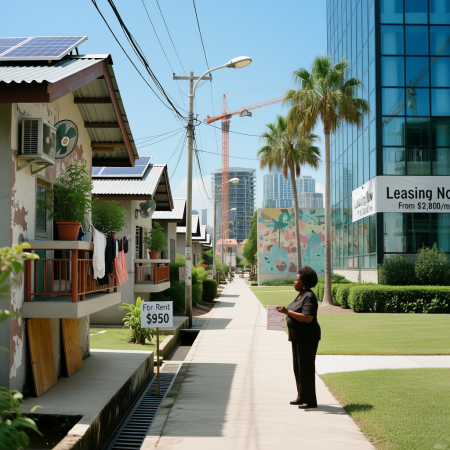
As wages stagnate and construction focuses overwhelmingly on luxury developments, the gap between housing need and availability widens. This summary examines the root causes, consequences, and potential solutions to the decline in low-cost rented housing in these eight southeastern urban centers, highlighting why reversing this trend is essential for equitable and sustainable urban growth.
1. The Scale of the Crisis: Numbers That Tell a Stark Story
Between 2000 and 2022, the eight southeastern cities collectively lost over 200,000 rental units affordable to households earning below 50% of the
area median income (AMI). In Atlanta alone, nearly 30,000 such units vanished—often replaced by high-end apartments or converted into short-term rentals via platforms like Airbnb. Miami and Orlando, fueled by tourism and migration, saw some of the sharpest drops, with affordability thresholds shrinking even as populations swelled. This decline in low-cost rented housing is not just about quantity; it’s also about accessibility.
Remaining affordable units are increasingly concentrated in neighborhoods with underfunded schools, limited transit, and higher crime rates—deepening spatial inequality. Without urgent intervention, the decline in low-cost rented housing threatens to displace hundreds of thousands more residents, especially Black, Latino, and elderly populations who disproportionately rely on these units.
2. Gentrification and Urban Redevelopment: Progress at a Cost
Many southeastern cities have embraced downtown revitalization as a path to economic growth. While new parks, mixed-use developments, and tech hubs bring jobs and tax revenue, they often come at the expense of existing low-income renters. Neighborhoods like Old Fourth Ward in Atlanta or Wynwood in Miami—once home to working-class communities—have been transformed into trendy districts where median rents tripled in a decade.
This process, known as gentrification, directly fuels the decline in low-cost rented housing by pricing out long-term tenants and incentivizing landlords to sell or reposition properties for higher returns. Even publicly funded redevelopment projects sometimes lack strong inclusionary mandates, resulting in minimal replacement of lost affordable stock. Thus, urban “progress” becomes a double-edged sword, accelerating the decline in low-cost rented housing under the guise of modernization.
3. The Short-Term Rental Boom: Turning Homes into Hotels
The rise of platforms like Airbnb and Vrbo has dramatically altered the rental landscape in tourist-heavy southeastern cities. In Miami, Orlando, and Tampa, entire apartment buildings are now operated as de facto hotels, removing thousands of long-term rental units from the market. A 2023 study found that a 10% increase in short-term rentals correlates with a 1.5% drop in long-term affordable inventory.
This commercialization of housing directly contributes to the decline in low-cost rented housing, as investors prioritize nightly profits over community stability. While some cities have enacted registration requirements or occupancy limits, enforcement remains weak, and state laws in places like Florida often preempt local regulation. Until short-term rentals are meaningfully curtailed, they will continue to drive the decline in low-cost rented housing in high-demand urban cores.
4. Weak Rent Control and Tenant Protections
Unlike states such as California or New York, most southeastern states—including Georgia, Florida, and North Carolina—have banned or severely restricted local rent control measures. This legal framework leaves tenants vulnerable to sudden rent hikes, no-cause evictions, and poor maintenance. In Nashville and Raleigh, median rents rose by over 60% between 2015 and 2023, far outpacing wage growth.
Without legal safeguards, landlords can easily convert or demolish older, naturally affordable buildings—the backbone of the decline in low-cost rented housing. Moreover, the lack of “just cause” eviction laws means families can be displaced with minimal notice, often with nowhere affordable to go. Strengthening tenant rights is not just a social imperative; it’s a practical tool to slow the decline in low-cost rented housing by preserving existing stock.
5. Underinvestment in Public and Subsidized Housing
Federal funding for public housing has stagnated for decades, and southeastern cities have not sufficiently filled the gap with local resources. The U.S. Department of Housing and Urban Development (HUD) reports that over 70% of public housing units in these eight cities are at least 30 years old, with significant deferred maintenance. Meanwhile, the Low-Income Housing Tax Credit (LIHTC)—the primary tool for building new affordable units—often fails to serve the poorest households, targeting those at 60% AMI instead of 30%.
This mismatch, combined with NIMBY (“Not in My Backyard”) opposition to new developments, limits the pipeline of replacement units. Consequently, public disinvestment exacerbates the decline in low-cost rented housing, leaving the most vulnerable with few options beyond overcrowded or substandard dwellings. Reversing this trend requires bold reinvestment in deeply affordable housing—units that truly serve those earning below 30% AMI.
6. Zoning and Land-Use Policies That Favor Exclusion
Outdated zoning codes in southeastern cities often mandate large lot sizes, single-family-only districts, and parking minimums—policies that discourage dense, affordable housing types like duplexes, townhomes, or small apartment buildings. In Charlotte and Jacksonville, over 70% of residential land is zoned exclusively for single-family homes, artificially constraining supply and inflating land costs. These exclusionary practices, rooted in historical segregation, continue to shape who can live where.
By limiting “missing middle” housing, cities inadvertently accelerate the decline in low-cost rented housing, as developers focus on high-margin luxury towers that do little to address core affordability needs. Reforming zoning to allow gentle density—especially near transit corridors—is a critical step toward halting the decline in low-cost rented housing.
7. The Role of Institutional Investors and Corporate Landlords
In recent years, private equity firms and real estate investment trusts (REITs) have poured billions into the southeastern rental market, buying up single-family homes and small apartment complexes at scale. Companies like Invitation Homes and American Homes 4 Rent now own tens of thousands of units across Atlanta, Tampa, and Orlando. While they bring capital, they also prioritize shareholder returns over affordability, often raising rents aggressively and minimizing maintenance.
Research shows that neighborhoods with high concentrations of institutional ownership experience faster rent growth and higher eviction rates. This financialization of housing turns shelter into a commodity, directly fueling the decline in low-cost rented housing. Without transparency requirements or affordability covenants on large-scale purchases, corporate landlords will remain a key driver of the decline in low-cost rented housing.
8. Climate Vulnerability and Displacement Pressures
Southeastern cities face heightened climate risks—hurricanes, flooding, and extreme heat—that disproportionately impact low-income renters. After disasters like Hurricane Irma or frequent flooding in Miami, damaged affordable units are rarely rebuilt as affordable. Instead, they’re redeveloped as market-rate or luxury properties, permanently removing them from the low-cost stock.
Climate gentrification—where safer, elevated neighborhoods become unaffordable—further strains the system. This environmental pressure intensifies the decline in low-cost rented housing, creating a cycle of displacement and loss. Climate resilience planning must therefore integrate housing preservation strategies to prevent disaster recovery from becoming another vector of the decline in low-cost rented housing.
9. Wage Stagnation and the Affordability Gap
Even if more units were available, many workers in service, retail, and care sectors cannot afford rising rents. In Nashville and Raleigh, a full-time minimum wage earner would need to work 2.5 jobs to afford a modest one-bedroom apartment. This income-rent mismatch means that the decline in low-cost rented housing is not just a supply issue—it’s also a demand-side crisis rooted in economic inequality. Without living wage policies, expanded housing vouchers, or rent subsidies, new construction alone cannot solve the problem. The decline in low-cost rented housing thus reflects a broader failure to align housing policy with labor market realities in the modern South.
10. Community Resistance and Political Will
Efforts to build or preserve affordable housing often face fierce local opposition. Concerns about traffic, property values, or “changing neighborhood character” lead to delays or cancellations of proposed developments—even modest ones.
In affluent suburbs of Atlanta and Miami, such resistance has blocked inclusionary zoning and affordable housing projects for years. This lack of political courage perpetuates the decline in low-cost rented housing by privileging exclusion over equity. Building public support through education, community benefits agreements, and participatory planning is essential to overcome these barriers and reverse the decline in low-cost rented housing.
11. Promising Solutions and Policy Innovations
Despite the challenges, several cities are experimenting with effective strategies. Atlanta’s “Missing Middle” pilot allows duplexes and fourplexes in select neighborhoods. Miami-Dade County has tightened short-term rental regulations in high-displacement zones. Charlotte launched a $50 million housing trust fund to preserve at-risk properties.
These initiatives, while modest, show that targeted action can slow the decline in low-cost rented housing. Scaling them up—through state enabling legislation, federal grants, and cross-sector partnerships—is key. Permanent affordability covenants, community land trusts, and acquisition funds that buy and preserve existing affordable stock offer proven models to combat the decline in low-cost rented housing.
12. The Human Cost: Beyond Statistics
Behind every lost unit is a family forced to double up, commute hours, or sleep in shelters. Children change schools mid-year. Seniors choose between rent and medication. The decline in low-cost rented housing erodes community cohesion, increases homelessness, and deepens racial and economic divides. In cities celebrated for their growth and innovation, this crisis reveals a troubling paradox: prosperity for some, precarity for many. Addressing the decline in low-cost rented housing is not just about bricks and mortar—it’s about justice, dignity, and belonging.
Conclusion: Reversing the Trend Requires Urgent, Coordinated Action
The decline in low-cost rented housing across America’s eight large southeastern cities is a systemic failure with deep historical roots and accelerating consequences. It is driven by market forces, policy choices, and social inequities that intersect in complex ways. Yet it is not inevitable. With strong tenant protections, inclusive zoning, robust public investment, and community-centered planning, cities can stabilize and rebuild their affordable rental stock. The decline in low-cost rented housing must be met with equal urgency as infrastructure or economic development—because without affordable homes, there can be no thriving cities.
Also read: Public Housing in USA

Sweet blog! I found it while surfing around on Yahoo News. Do you have any tips on how to get listed in Yahoo News? I've been trying for a while but I never seem to get there! Thank you
Thanks.