
THE STATE OF THE NATION’S HOUSING 2020
Introduction
The state of the nation’s housing in 2020 was not merely a snapshot — it was a seismic reading. As the calendar flipped to a new decade, the United States stood at the precipice of a housing crisis decades in the making, now amplified by a global pandemic, economic volatility, and deepening inequality. Homeownership rates teetered, rents soared, homelessness surged, and millions found themselves one paycheck away from eviction.
The American Dream — once synonymous with a white picket fence and a mortgage — had become, for many, a mirage. The state of the nation’s housing revealed a system straining under the weight of its own contradictions: abundant wealth, yet scarce affordability; record-low interest rates, yet record-high barriers to entry; innovation in design and finance, yet stagnation in policy and equity. This was not just a housing report — it was a diagnosis of national well-being.
Homeownership: The Shrinking Dream
The state of the nation’s housing showed that the dream of owning a home — long considered the bedrock of middle-class stability — was slipping further out of reach. In 2020, the national homeownership rate hovered around 65.8%, a modest rebound from post-2008 lows but still far below the peak of 69.2% in 2004. For Black and Hispanic households, the gap yawned wider: just 44% and 49.8% respectively owned homes, compared to 73.7% of white households — disparities rooted in decades of redlining, predatory lending, and wealth inequality. Even for those who qualified, down payments remained a formidable hurdle. The median price of a starter home had climbed 77% since 2000, while median household income rose only 30%. The state of the nation’s housing wasn’t just about bricks and mortgages — it was about who gets to build generational wealth, and who gets left behind.The Rent Trap: Rising Costs, Stagnant Wages
The state of the nation’s housing exposed a brutal math: nearly half of all renters — 22.4 million households — were “cost-burdened,” spending more than 30% of their income on rent. Of those, 11.3 million were “severely burdened,” paying over 50%. In cities like San Francisco, New York, and Boston, minimum-wage workers would need to clock 90+ hours a week to afford a one-bedroom apartment at fair market rent. The pandemic only deepened the crisis: while white-collar workers Zoomed from spare rooms, service workers faced eviction notices taped to doors. Emergency moratoriums offered temporary relief, but they didn’t erase debt — they deferred it. The state of the nation’s housing made clear that renting was no longer a steppingstone — for millions, it was a life sentence of financial precarity.Homelessness: The Crisis on Our Doorsteps
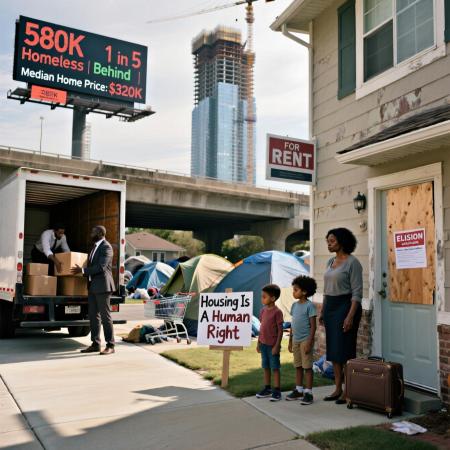
The state of the nation’s housing could not ignore the tents. In 2020, over 580,000 people experienced homelessness on a single night — a 2% increase from 2019 and the fourth consecutive year of growth. Unsheltered homelessness — people sleeping in cars, parks, or streets — surged by 7%, concentrated in West Coast cities where rents had spiraled beyond reach. Veterans, youth aging out of foster care, domestic violence survivors, and disabled individuals bore the brunt. The pandemic turned encampments into public health emergencies — yet sweeps continued, displacing people without offering alternatives. The state of the nation’s housing wasn’t just failing the housed — it was abandoning the unhoused, treating human beings as problems to be managed rather than lives to be restored.The Pandemic Effect: Shelter in Place — But where?
The state of the nation’s housing collided head-on with COVID-19. “Shelter in place” became a cruel irony for those without shelter — or those crammed into overcrowded, substandard units. Multigenerational households, disproportionately Black and Latino, faced higher infection risks. College students were evicted from dorms. Nursing homes became death traps. Meanwhile, remote work triggered a suburban exodus among the privileged — driving up home prices in Sun Belt cities and rural towns, pricing out locals. The CARES Act’s eviction moratorium and stimulus checks were lifelines — but temporary ones. By December 2020, 1 in 5 renters was behind on payments, owing an average of $5,600. The state of the nation’s housing revealed that in a pandemic, your zip code — and your housing status — could determine whether you lived or died.The Supply Squeeze: Why We Can’t Build Our Way Out — Fast Enough
The state of the nation’s housing pointed to a glaring mismatch: demand soaring, supply stagnant. The U.S. was short 3.8 million homes — a deficit built over decades of underbuilding, exclusionary zoning, and NIMBYism. In 2020, builders broke ground on just 1.3 million units — far below the 1.5–2 million needed annually to keep pace. Single-family zoning in affluent suburbs blocked denser, more affordable housing. Construction labor shortages and rising material costs (lumber prices spiked 170% in 2020) slowed production. Tiny homes, ADUs, and modular units offered promise — but faced regulatory headwinds. The state of the nation’s housing wasn’t a failure of imagination — it was a failure of political will and systemic inertia.The Racial Divide: Housing as Legacy, Housing as Loss
The state of the nation’s housing laid bare America’s original sin: racism baked into the foundation. Redlining maps from the 1930s still predicted neighborhood investment — and disinvestment — in 2020. Black families were denied mortgages at twice the rate of white families with similar incomes. Appraisals for homes in Black neighborhoods came in lower — regardless of condition. Predatory investors targeted communities of color, buying foreclosed homes and converting them to high-rent rentals. The racial wealth gap — $188,200 median net worth for white families vs. $24,100 for Black families — was largely a housing gap. The state of the nation’s housing wasn’t just unequal — it was engineered that way, and 2020 demanded a reckoning.The Suburban Exodus and Urban Exodus — At the Same Time
The state of the nation’s housing captured a paradox: cities emptying, suburbs swelling — simultaneously. Remote work liberated knowledge workers from commutes, triggering a migration to larger homes, home offices, and yards. Austin, Boise, and Phoenix boomed. But downtowns hollowed out — retail districts ghostly, transit ridership plummeting, small landlords drowning in vacancies. Meanwhile, low-wage essential workers — unable to flee — remained trapped in overcrowded urban cores. The bifurcation threatened urban tax bases and widened geographic inequality. The state of the nation’s housing revealed two Americas: one mobile, one immobile; one choosing where to live, one surviving where they could.The Investor Takeover: Wall Street Buys Main Street
The state of the nation’s housing documented a quiet revolution: institutional investors buying up single-family homes by the thousands. Firms like Blackstone, Invitation Homes, and Pretium snapped up foreclosures and new builds, turning them into rental portfolios. In some Sun Belt markets, investors accounted for 1 in 5 home purchases. For families, this meant fewer starter homes on the market — and higher prices. For renters, it meant corporate landlords with algorithm-driven rent hikes and minimal maintenance. The American home — once a symbol of independence — was becoming a financialized asset class. The state of the nation’s housing warned that when homes are treated as stocks, people become tenants — forever.The Policy Gap: Good Intentions, Weak Tools
The state of the nation’s housing highlighted a tragic irony: widespread consensus on the problem, fragmented action on solutions. The Low-Income Housing Tax Credit (LIHTC) remained the largest federal subsidy — yet produced just 100,000 units annually, far short of need. Section 8 vouchers helped 2.2 million households — but waitlists stretched years, and many landlords refused them. Zoning reform bills died in committee. Rent control remained politically toxic in most states. The 2020 election brought housing to the forefront — but federal action stalled. The state of the nation’s housing proved that without bold, coordinated policy — from zoning to subsidies to tenant protections — market forces alone would deepen the crisis.The Green Imperative: Climate and Housing Collide
The state of the nation’s housing intersected with another existential threat: climate change. Homes in wildfire zones (California), floodplains (Florida), and heat domes (Arizona) faced rising insurance costs — or outright abandonment. Energy-inefficient housing burdened low-income families with high utility bills — “energy poverty” affected 1 in 3 households. Yet green retrofits and resilient construction remained out of reach for most. The pandemic pause offered a glimpse of cleaner air — but also exposed how housing location dictated environmental risk. The state of the nation’s housing made clear: you can’t solve the climate crisis without solving the housing crisis — and vice versa.Technology’s Promise — and Limits
The state of the nation’s housing flirted with innovation. Proptech platforms streamlined rentals and sales. 3D-printed homes promised faster, cheaper construction. AI matched tenants to affordable units. Yet tech also exacerbated inequality: algorithmic bias in lending, “surveillance rentals” with facial recognition, and digital redlining in appraisals. For the unhoused, a smartphone app was no substitute for a roof. The state of the nation’s housing reminded us that technology is a tool — not a savior. Without equity-centered design, it risks automating injustice.The Mental Health Toll: Housing as a Determinant of Wellbeing
The state of the nation’s housing acknowledged what public health experts had long known: housing is healthcare. Families doubled up in garages suffered higher rates of depression. Children in unstable housing lagged in school. Seniors facing eviction experienced spikes in heart attacks. The pandemic amplified trauma — isolation in unsafe homes, anxiety over looming evictions. Yet mental health services remained siloed from housing agencies. The state of the nation’s housing argued that a roof isn’t just shelter — it’s the foundation of mental, physical, and emotional stability.