
THE IMPACT OF POPULATION MIGRATION ON URBAN HOUSING PRICES IN CHINA
Introduction
The impact of population migration on urban housing prices in China is one of the most defining forces shaping the country’s economic and social landscape in the 21st century. As the world’s most populous nation undergoes rapid urbanization, millions of people are moving from rural villages to bustling cities in search of better employment, education, healthcare, and living standards.
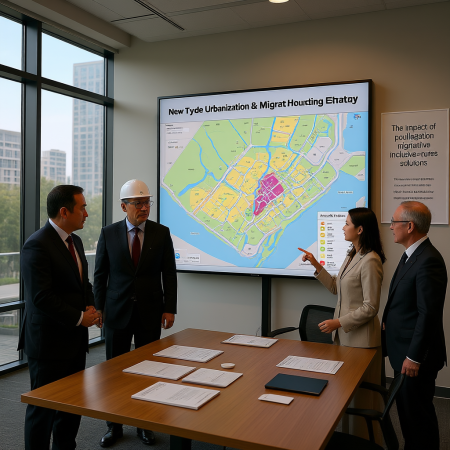
This massive internal migration—driven by economic reform, industrial expansion, and regional development policies—has fueled the growth of megacities like Beijing, Shanghai, Shenzhen, and Guangzhou. However, this transformation has also triggered a housing crisis, with skyrocketing property prices, overcrowding, and growing inequality. The impact of population migration is not just a demographic trend—it is a powerful economic engine that has reshaped real estate markets, urban planning, and government policy across China.
China’s Great Migration: A Demographic Revolution
Over the past four decades, China has experienced the largest internal migration in human history. Since the economic reforms of the late 1970s, over 300 million people have moved from rural areas to urban centers. Known as the nongmingong (migrant workers), these individuals form the backbone of China’s manufacturing, construction, and service sectors. They build skyscrapers, staff factories, and deliver goods—yet often live on the margins of the cities they help create. This migration is not random. It is driven by stark regional disparities in income and opportunity. Coastal cities offer wages several times higher than those in inland provinces. As a result, young workers leave their hometowns, often leaving children and elderly parents behind. The impact of population migration is thus not only economic but deeply social, affecting family structures, education, and mental health. But one of the most visible and immediate consequences of this movement is its effect on housing demand—and prices.Urban Housing Demand: Supply vs. Soaring Need
As migrants flood into cities, the demand for housing skyrockets. However, the supply of affordable housing has not kept pace. In major cities, land is limited, development is tightly regulated, and much of the new construction caters to middle- and high-income buyers rather than low-wage migrants. The impact of population migration has created a two-tier housing market:- Formal housing: High-rise apartments and gated communities for registered urban residents (hukou holders)
- Informal housing: Overcrowded dormitories, subdivided apartments, or makeshift homes in urban villages
Housing Price Inflation in Tier-1 Cities
The impact of population migration is most pronounced in China’s Tier-1 cities—Beijing, Shanghai, Guangzhou, and Shenzhen. These economic powerhouses attract the largest influx of workers and professionals. Between 2010 and 2020, housing prices in these cities doubled or tripled, far outpacing income growth. For example:- In Shenzhen, the average price per square meter rose from ¥15,000 in 2015 to over ¥70,000 in 2021.
- In Shanghai, a modest apartment in a central district can cost over ¥10 million—equivalent to 50 years of average income.
The Role of Hukou and Social Exclusion
The hukou system is central to understanding the impact of population migration on housing. Introduced in the 1950s to control population movement, it ties access to social services to one’s place of birth. Migrants may live in a city for decades, but without local hukou, they cannot access public housing, buy subsidized units, or send their children to top public schools. This creates a paradox: migrants are essential to the city’s economy but are treated as temporary residents. As a result:- They pay market-rate rents despite low incomes
- They live in overcrowded, poorly maintained housing
- They are excluded from homeownership programs
Urban Villages and Informal Settlements
To accommodate the influx, many cities have developed or tolerated “urban villages”—densely populated, unplanned neighborhoods within city limits where land is owned collectively by former village communities. These areas offer cheap rents and are often located near industrial zones or transport hubs. While urban villages provide essential shelter, they are frequently overcrowded, lack proper sanitation, and are vulnerable to demolition during redevelopment. The impact of population migration has made these zones both a lifeline and a liability. As cities redevelop, millions are displaced, pushing housing demand—and prices—further into surrounding areas. In Guangzhou and Shenzhen, entire urban villages have been razed to make way for high-end commercial projects, exacerbating housing shortages and increasing displacement. The impact of population migration thus fuels both demand and instability.Government Response: Affordable Housing and Urban Planning
Recognizing the risks of unaffordable housing, the Chinese government has launched several initiatives to mitigate the impact of population migration on urban markets. Since 2010, the state has invested heavily in public rental housing and affordable housing projects, aiming to build millions of units by 2035. In cities like Chongqing and Chengdu, local governments have expanded access to subsidized housing for migrants, relaxed hukou requirements, and built large-scale affordable communities. These efforts have helped stabilize prices to some extent. Additionally, the concept of “sponge cities,” “15-minute communities,” and “new-type urbanization” reflects a shift toward more inclusive planning. The impact of population migration is now being addressed not just through housing supply, but through integrated urban design that includes transport, green space, and social services.Speculation and Investment Culture
While migration drives demand, it interacts with another powerful force: real estate speculation. In China, property is not just a home—it is the primary vehicle for wealth accumulation. With limited investment options (e.g., weak stock markets, capital controls), families pour savings into real estate, often buying multiple units. This speculative behavior amplifies the impact of population migration. As more people move to cities, investors anticipate future price growth and buy up properties, reducing supply and inflating prices. In some cases, entire apartment complexes stand empty—“ghost buildings” owned by investors waiting for appreciation. The government has responded with cooling measures:- Purchase limits (e.g., only one home per family)
- Higher down payments for second homes
- Property taxes in pilot cities (e.g., Shanghai, Chongqing)
Regional Disparities and Tier-2/3 Cities
While Tier-1 cities face extreme pressure, the impact of population migration is also reshaping Tier-2 and Tier-3 cities. As housing becomes unaffordable in Beijing or Shanghai, some migrants are moving to secondary cities like Hangzhou, Wuhan, or Xi’an, where costs are lower and local governments offer incentives. This “spillover migration” has led to rapid growth in these cities, driving up prices there as well. However, infrastructure and job markets often lag behind, creating new imbalances. The impact of population migration is thus not confined to a few megacities—it is a nationwide phenomenon with ripple effects across the urban hierarchy.Rural-Urban Divide and Reverse Migration
In recent years, signs of reverse migration have emerged. High living costs, housing stress, and improved infrastructure in rural areas have led some migrants to return home. The government’s rural revitalization strategy has also created new opportunities in agriculture, e-commerce, and tourism. While this trend is still limited, it suggests that the impact of population migration may begin to stabilize. However, for most young workers, cities remain the only path to upward mobility. The impact of population migration will continue to shape housing markets for decades.Environmental and Social Costs
The impact of population migration extends beyond economics. Rapid urban expansion leads to environmental degradation—loss of farmland, air and water pollution, and increased carbon emissions. High-density housing in megacities strains infrastructure, leading to traffic congestion and energy shortages. Socially, the separation of families—children left behind in villages, elderly parents without care—creates long-term challenges. The impact of population migration is not just about housing prices—it is about the human cost of urbanization.The Future: Balancing Growth and Equity
Looking ahead, China faces a critical challenge: how to manage the impact of population migration without sacrificing social equity or economic growth. The government’s “dual circulation” strategy and emphasis on domestic consumption depend on a stable, urbanized middle class. To achieve this, reforms are needed:- Hukou reform to grant migrants full urban rights
- Expanded affordable housing in high-demand cities
- Transit-oriented development to reduce sprawl
- Stronger rent controls and tenant protections