
THE DEVELOPMENT OF AFFORDABLE HOUSING
Introduction
The development of affordable housing is one of the most pressing and enduring challenges of the 21st century. Across cities, suburbs, and rural communities, millions of people struggle to find safe, stable, and reasonably priced homes. As urban populations swell and housing costs outpace income growth, the gap between need and availability continues to widen. At the heart of this crisis lies the urgent need for coordinated, scalable, and equitable solutions—making the development of affordable housing not just a social imperative, but an economic and moral one as well.
Historical Context of the Development of Affordable Housing
The development of affordable housing has deep roots in urban reform movements of the 19th and early 20th centuries. In the United States, the first major public housing initiatives emerged during the Great Depression, with the passage of the Housing Act of 1937. This legislation established the foundation for government-supported housing, aiming to replace slums with decent, sanitary, and affordable units. Over the following decades, federal programs expanded, including the creation of the Department of Housing and Urban Development (HUD) in 1965 and the introduction of Section 8 rental assistance in the 1970s. However, by the 1980s, federal investment in public housing began to decline, shifting responsibility to states, local governments, and nonprofit developers. This transition marked a pivotal shift in the development of affordable housing, from direct government construction to subsidy-driven, market-embedded models. Despite these efforts, decades of underfunding, racial segregation, and disinvestment have left a legacy of housing shortages and systemic inequity—issues that continue to shape the development of affordable housing today.The Current Housing Crisis
Today, the United States faces a shortage of over 7 million affordable and available rental homes for low-income households. According to the National Low Income Housing Coalition, there are only 37 affordable units for every 100 extremely low-income renter families. This deficit is not limited to major cities; it affects rural towns, suburban communities, and fast-growing metropolitan areas alike. Rising construction costs, land scarcity, and restrictive zoning laws have made it increasingly difficult to build new affordable units. At the same time, gentrification and rising property values are displacing long-time residents from historically low-income neighborhoods. Without intervention, the development of affordable housing will continue to lag behind demand, deepening inequality and housing instability.Government Policies and Public Investment
Government leadership remains essential to the development of affordable housing. Federal, state, and local agencies play critical roles in funding, regulating, and incentivizing affordable housing projects. Key federal programs include:- The Low-Income Housing Tax Credit (LIHTC), which has financed over 3 million units since 1986.
- Section 8 Housing Choice Vouchers, which help low-income families rent in the private market.
- HUD’s HOME Investment Partnerships Program, which provides grants to local governments.
The Role of Nonprofits and Community Organizations
Nonprofit developers and community-based organizations are at the forefront of the development of affordable housing. Groups like Habitat for Humanity, Enterprise Community Partners, and local housing development corporations specialize in creating and preserving affordable units with a focus on long-term community impact. These organizations often prioritize resident engagement, sustainability, and supportive services. They are more likely than for-profit developers to build in high-need, lower-return areas and to incorporate social equity into their mission. Community land trusts (CLTs), which separate land ownership from housing to preserve affordability permanently, are another powerful model advanced by nonprofits. By reinvesting profits into new projects and emphasizing stewardship over speculation, nonprofits ensure that the development of affordable housing serves people—not just markets.Private Sector Involvement and Public-Private Partnerships
The private sector plays an increasingly important role in the development of affordable housing. Developers, investors, and financial institutions bring capital, expertise, and innovation to the table. Public-private partnerships (PPPs) have proven effective in accelerating the delivery of affordable units, particularly when combined with tax credits, land donations, or density bonuses. For example, a developer might receive zoning approval for a larger market-rate project in exchange for including a percentage of affordable units. These inclusionary zoning agreements help integrate affordability into new neighborhoods without relying solely on public funding. However, private involvement introduces risks. Profit motives may lead to compromises in location, design, or long-term affordability. To ensure lasting impact, public oversight, affordability covenants, and strong tenant protections must be embedded in all PPPs related to the development of affordable housing.Financing Mechanisms and Economic Models
One of the biggest challenges in the development of affordable housing is securing sustainable financing. Construction costs—driven by labor, materials, and land prices—often exceed what low-income renters can afford to pay. As a result, nearly every affordable housing project relies on a “financing stack” of public subsidies, tax credits, grants, and low-interest loans. The Low-Income Housing Tax Credit (LIHTC) remains the primary funding tool, but it is competitive and complex to administer. Additional models are emerging:- Social impact bonds, where private investors fund housing in exchange for returns tied to social outcomes.
- Green housing bonds, which finance energy-efficient and climate-resilient developments.
- Community development financial institutions (CDFIs), which provide flexible loans to underserved developers.
Zoning, Land Use, and Regulatory Barriers
Zoning laws remain one of the most significant obstacles to the development of affordable housing. In many municipalities, single-family zoning dominates, effectively banning duplexes, townhomes, and apartment buildings in large swaths of residential land. Minimum lot sizes, parking requirements, and lengthy approval processes further inflate costs and delay projects. Reforming these regulations is critical. “Missing middle” housing—such as duplexes, cottage courts, and accessory dwelling units (ADUs)—offers a scalable, neighborhood-compatible solution. Cities that have legalized ADUs or eliminated exclusionary zoning have seen measurable increases in housing supply and affordability. Streamlining permitting, reducing fees, and adopting “by-right” development (where projects meeting criteria are automatically approved) can also accelerate the development of affordable housing and reduce developer uncertainty.Sustainable and Resilient Design
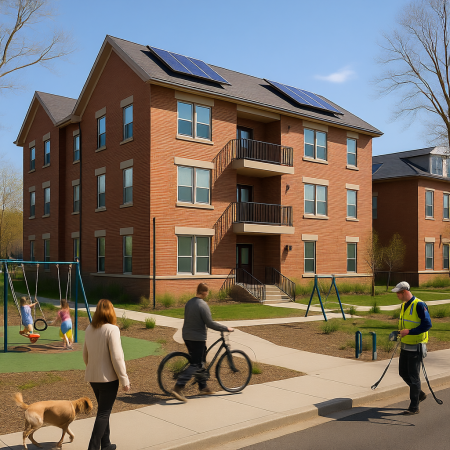
As climate change intensifies, the development of affordable housing must incorporate sustainability and resilience. Energy-efficient buildings reduce utility costs—critical for low-income households—while green materials and renewable energy lower carbon emissions. Many new affordable housing projects now include:- Solar panels
- High-efficiency HVAC systems
- Water-saving fixtures
- Green roofs and rainwater harvesting
- Passive solar design
Community Engagement and Resident Empowerment
The most successful affordable housing projects are those that involve residents from the start. Participatory planning—where community members help design, locate, and manage housing—leads to better outcomes and greater long-term stability. Models like community land trusts (CLTs) and housing cooperatives place ownership and decision-making power in the hands of residents. CLTs, in particular, have proven effective in preserving affordability for generations by retaining ownership of the land while leasing it to homeowners or tenants. By centering community voices, the development of affordable housing becomes more than just construction—it becomes a process of empowerment, equity, and collective ownership.Addressing Displacement and Gentrification
A major concern with new affordable housing is the risk of displacement. In some cases, investment in a neighborhood—such as transit upgrades or new housing—can raise property values and push out existing residents. This phenomenon, known as gentrification, undermines the goal of the development of affordable housing. To prevent displacement, cities must implement anti-displacement policies such as:- Rent stabilization
- Right-to-counsel for tenants facing eviction
- Property tax relief for long-term homeowners
- Acquisition funds to preserve existing affordable units
Technology and Innovation in Housing Development
Technology is transforming the development of affordable housing. Off-site construction methods—such as modular and panelized housing—can reduce build times by up to 50%, lower costs, and improve quality control. Companies like Factory OS and Blokable are pioneering factory-built units that meet high standards at lower prices. Smart building technologies—automated heating, lighting, and security systems—enhance comfort and reduce energy use. Digital platforms streamline applications for housing assistance, improve property management, and expand access to financial literacy tools. When combined with data analytics, these innovations help developers and policymakers make smarter, faster decisions—accelerating the development of affordable housing at scale.The Economic and Social Benefits
Investing in the development of affordable housing yields powerful returns. Every dollar invested generates approximately $1.44 in local economic activity, according to HUD. Construction creates jobs, and stable housing enables people to work, attend school, and contribute to their communities. Health outcomes improve as families move from overcrowded or substandard housing into safe, healthy homes. Children in stable housing perform better in school and are more likely to graduate. Homelessness declines, reducing strain on emergency services and shelters. From a fiscal perspective, preventing housing instability is far less expensive than managing its consequences. Permanent supportive housing for chronically homeless individuals, for example, saves cities millions annually in healthcare, incarceration, and shelter costs.Future Outlook and Policy Recommendations
Looking ahead, the development of affordable housing requires a bold, coordinated national strategy. Key recommendations include:- Tripling federal funding for housing vouchers and LIHTC
- Reforming exclusionary zoning at the state level
- Establishing a national housing trust fund
- Expanding support for community land trusts and cooperatives
- Integrating affordable housing into climate and infrastructure plans