
THE CONTINUING STRUGGLE FOR HOUSING IN INDIA
Introduction
Continuing struggle for housing, India faces one of the most pressing urban challenges of the 21st century. Despite rapid economic growth and ambitious development projects, millions of Indians remain without access to safe, secure, and affordable shelter. The continuing struggle for housing is not confined to rural areas or small towns—it cuts across megacities like Mumbai, Delhi, and Bengaluru, where informal settlements grow alongside gleaming skyscrapers and luxury apartments. This stark contrast underscores a deeper crisis: a systemic failure to recognize housing as a fundamental human right rather than a market commodity.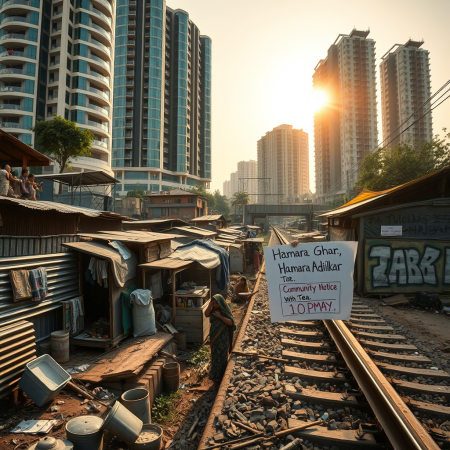
Historical Roots of the Crisis – Continuing Struggle for Housing
To understand the continuing struggle for housing, one must look back at India’s post-independence urban planning. After 1947, cities expanded rapidly due to partition-induced migration, rural-to-urban shifts, and industrialization. However, urban infrastructure and affordable housing did not keep pace. The state prioritized formal sectors and elite neighborhoods, while low-income populations were left to fend for themselves. Slums began to emerge as self-organized responses to this neglect. Areas like Dharavi in Mumbai or Turkman Gate in Delhi grew organically, housing workers essential to the city’s economy. Yet, instead of integrating them into urban life, authorities labeled these settlements as “illegal” or “encroachments.” The continuing struggle for housing was born from this contradiction: dependence on informal labor while denying informal dwellers basic rights. Colonial-era land laws and rent control policies further complicated ownership and tenancy. Over time, speculative real estate markets drove up prices, making homeownership impossible for most. The continuing struggle for housing became institutionalized—a cycle of exclusion passed down through generations.Scale of the Housing Deficit – Continuing Struggle for Housing
India faces a massive housing shortage, particularly in urban areas. According to estimates by the Ministry of Housing and Urban Affairs, the urban housing deficit exceeds 10 million units , with the poorest households accounting for the majority. The continuing struggle for housing is most acute among economically weaker sections (EWS) and low-income groups (LIG), who make up over 80% of the urban population but receive minimal attention in housing policy. In cities like Delhi, Chennai, and Kolkata, more than a third of residents live in informal settlements. These homes lack legal recognition, secure water supply, sanitation, and electricity. Many are built on public land, railway tracks, or riverbanks, leaving families vulnerable to eviction during monsoon seasons or “beautification” drives. The continuing struggle for housing is not temporary—it is a permanent condition for millions who have lived in these conditions for decades. Moreover, the definition of “housing” itself is narrow. Government data often counts a structure as “pucca” (permanent) if it has brick walls and a concrete roof, ignoring whether it provides safety, privacy, or basic services. The continuing struggle for housing demands a broader understanding—one that includes security, location, affordability, and social infrastructure.Policy Efforts and Gaps – Continuing Struggle for Housing
Over the years, several national initiatives have aimed to address the continuing struggle for housing. The most prominent is the Pradhan Mantri Awas Yojana (PMAY), launched in 2015 with the goal of "Housing for All by 2022." The scheme offers financial assistance for home construction, credit-linked subsidies, and slum rehabilitation. While PMAY has funded millions of homes, its impact remains uneven. Many beneficiaries are from the middle-income group, while the poorest—especially pavement dwellers and homeless individuals—are excluded. Eligibility criteria often require documentation like Aadhaar cards and bank accounts, which marginalized communities may lack. The continuing struggle for housing persists because policies fail to reach those most in need.Additionally, slum rehabilitation projects under public-private partnerships have led to displacement. In Mumbai, the Slum Rehabilitation Authority (SRA) promises free flats in exchange for vacating land, but delays, corruption, and poor construction quality undermine trust. Families relocated to high-rises on city outskirts lose access to jobs, schools, and healthcare. The continuing struggle for housing is worsened when “solutions” deepen alienation rather than provide stability.
Rural-Urban Divide – Continuing Struggle for Housing
The continuing struggle for housing is not limited to cities. In rural India, inadequate housing affects hundreds of millions. Many homes are made of mud, thatch, or bamboo, offering little protection from weather or pests. Government schemes like the Indira Awaas Yojana (now part of PMAY-Gramin) aim to build pucca houses, but progress is slow. Corruption at the local level often results in substandard construction or funds being siphoned off. Women-headed households, Dalits, and tribal communities face additional barriers in accessing benefits. The continuing struggle for housing in rural areas is compounded by landlessness, climate vulnerability, and lack of infrastructure. Seasonal migration to cities intensifies the problem. Migrant workers live in temporary shelters near construction sites, returning home only to find their houses damaged by floods or storms. Without durable housing in either location, they remain trapped in cycles of poverty. The continuing struggle for housing must therefore be addressed holistically—across both urban and rural landscapes.Gender and Housing Insecurity – Continuing Struggle for Housing
A critical yet often overlooked aspect of the continuing struggle for housing is its gendered dimension. Women, especially widows, single mothers, and elderly women, are disproportionately affected by insecure housing. Property ownership in India remains heavily skewed toward men due to patriarchal norms and inheritance practices. Without legal title, women cannot access housing loans, claim benefits under government schemes, or resist eviction. Domestic violence survivors often have nowhere to go, as shelters are scarce and underfunded. The continuing struggle for housing becomes a matter of personal safety and autonomy. When relocation occurs, women bear the burden of longer commutes, lack of childcare, and reduced mobility. Public toilets and bathing facilities in slums are often unsafe or inaccessible after dark. The continuing struggle for housing must include gender-sensitive policies—such as joint titling, women-led cooperatives, and safe community spaces—to ensure true equity.Climate Change and Environmental Risks – Continuing Struggle for Housing
Another growing factor in the continuing struggle for housing is environmental vulnerability. Many informal settlements are located in ecologically fragile zones—floodplains, coastal belts, or low-lying areas—because land there is cheap or unclaimed. During monsoon seasons, entire neighborhoods are submerged, destroying homes and spreading disease. Climate change is increasing the frequency and intensity of extreme weather events. Cyclones, heatwaves, and urban flooding disproportionately impact those living in poorly constructed homes without insurance or emergency support. The continuing struggle for housing now includes resilience against climate shocks. Yet, disaster response often ignores long-term housing needs. Temporary relief camps do not offer permanence, and reconstruction efforts rarely involve affected communities. The continuing struggle for housing requires climate-adaptive design—elevated homes, green materials, rainwater harvesting—and inclusive planning that protects the most vulnerable.Role of Informal Markets and Renting – Continuing Struggle for Housing
For millions, owning a home is out of reach. The continuing struggle for housing leads many to rely on rental markets, which remain largely unregulated and exploitative. Landlords charge high rents, demand large deposits, and can evict tenants without notice. In cities like Bangalore and Hyderabad, rising property prices have pushed renters into distant suburbs with poor transport links. There is no national rental housing policy, leaving tenants with little legal protection. The Model Tenancy Act (2021) aims to create a balanced framework, but adoption by states has been slow. The continuing struggle for housing in the rental sector highlights the need for secure, affordable renting options—not just ownership. Community-based rental models, such as cooperative housing societies or nonprofit-managed units, offer alternatives. The continuing struggle for housing can be eased by recognizing renting as a legitimate and dignified form of tenure.Grassroots Movements and Resistance – Continuing Struggle for Housing
Despite systemic neglect, communities across India have organized to assert their right to housing. The continuing struggle for housing has inspired powerful social movements—from the pavement dwellers’ protests in Mumbai led by Pavement Dwellers Association , to the Ekta Abhiyan in Delhi demanding land rights. Women have played a central role in these struggles. In Pune and Ahmedabad, self-help groups have negotiated with municipalities for in-situ slum upgrades. In Chennai, fisherfolk communities have resisted eviction from coastal zones, arguing for their traditional livelihoods and homes. The continuing struggle for housing is not passive suffering—it is active resistance and collective action. NGOs like SPARC (Society for the Promotion of Area Resource Centres) have partnered with grassroots organizations to map settlements, document residents, and advocate for policy change. These efforts show that when people are empowered, they can drive meaningful transformation. The continuing struggle for housing gains strength through solidarity and voice.Urban Planning and Exclusionary Development – Continuing Struggle for Housing
At the heart of the continuing struggle for housing is flawed urban planning. Indian cities are designed for cars, malls, and corporate offices—not for people. Master plans prioritize commercial development over affordable housing, pushing the poor to city fringes. Metro projects and flyovers often displace thousands without adequate resettlement. The Smart Cities Mission, launched in 2015, focuses on technology-driven solutions but pays little attention to slum dwellers. Surveillance systems, digital billing, and app-based services assume smartphone access and literacy—luxuries many lack. The continuing struggle for housing is intensified when modernization excludes rather than includes. True smart cities must be inclusive cities. Upgrading infrastructure should happen in situ , preserving social networks and livelihoods. The continuing struggle for housing calls for participatory planning—were residents co-design solutions with planners and officials.Pathways to Justice – Continuing Struggle for Housing
Resolving the continuing struggle for housing requires bold, rights-based reforms:- Secure Tenure: Grant legal recognition and occupancy rights to slum dwellers.
- In-Situ Upgrading: Improve water, sanitation, and drainage within existing settlements.
- Affordable Rental Housing : Develop regulated, subsidized rental stock.
- Gender-Just Policies : Ensure women’s names on titles and access to housing schemes.
- Climate-Resilient Design : Build homes that withstand floods, heat, and storms.
- Community Participation: Involve residents in planning and monitoring.
- Transparency and Accountability: Strengthen oversight of housing funds.