
INDIA: THE BEST IDEA TO REDEVELOP DHARAVI SLUM
Introduction
The best idea to redevelop Dharavi slum isn’t about bulldozing homes and building high-rises—it’s about recognizing Dharavi not as a problem to erase, but as a dynamic, self-organized urban ecosystem teeming with enterprise, community, and resilience. Sprawling across 2.1 square kilometers in the heart of Mumbai, Dharavi is home to over 700,000 people and hosts an informal economy estimated at $1 billion annually, with thriving micro-industries in recycling, leatherwork, pottery, and textiles.
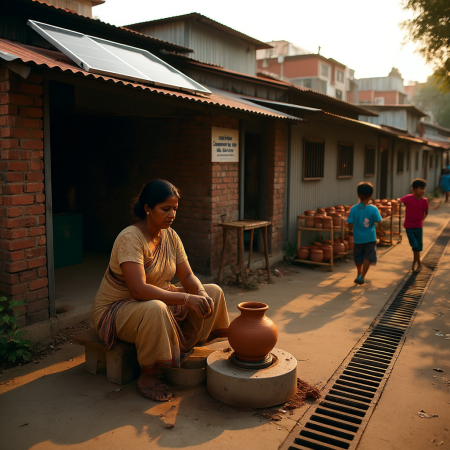
Yet decades of top-down redevelopment plans have failed, often ignoring the voices of residents and the intricate social and economic fabric that makes Dharavi function. Today, as India reimagines urban futures, the best idea to redevelop Dharavi slum must be inclusive, incremental, and co-created—prioritizing people over profit, dignity over displacement, and sustainability over spectacle.
Why Past Redevelopment Plans Failed
Since the 1990s, numerous proposals—most notably the Dharavi Redevelopment Project (DRP) launched in 2004—have promised transformation. The dominant model offered residents a “free” 225–300 sq. ft. flat in exchange for their existing structures, while developers received rights to build and sell commercial and luxury residential space on the remaining land. On paper, it sounded fair. In practice, it unraveled due to:- Lack of community consultation: Residents were treated as obstacles, not partners.
- Inadequate housing size: 225 sq. ft. is insufficient for multi-generational families or home-based businesses.
- Disruption of livelihoods: Many rely on ground-floor workshops; high-rise living severs this link.
- Tenure insecurity: Only those with pre-2000 documentation qualified, excluding thousands.
- Developer delays and exits: Projects stalled for years due to financial or legal issues.
Learning from Global Slum Upgrading Successes
Cities like Medellín (Colombia), Bangkok (Thailand), and Cape Town (South Africa) offer powerful lessons. Instead of wholesale clearance, they pursued in-situ upgrading improving infrastructure—water, sanitation, drainage, roads—while allowing communities to stay and rebuild incrementally. Thailand’s Baan Mankong program, for instance, provides government-backed loans directly to community cooperatives, who then design and manage their own housing upgrades. These models prove that the best idea to redevelop Dharavi slum lies not in demolition, but in dignified enhancement—strengthening what already works.The Core Principles of a People-Centered Approach
So, what truly constitutes the best idea to redevelop Dharavi slum? It rests on five pillars:- In-situ Development: No forced relocation. Families stay in place while their neighborhoods are upgraded.
- Community-Led Planning: Residents map their own lanes, identify hazards, and co-design housing and infrastructure.
- Livelihood Integration: Housing designs must accommodate home-based enterprises—e.g., ground-floor workshops, ventilation for pottery kilns.
- Secure Tenure: Legal recognition of occupancy, even if not full ownership, to enable investment and access to finance.
- Phased, Incremental Upgrading: Start with urgent needs (drainage, fire lanes, toilets), then move to housing and public spaces.
The Role of Community Organizations
Dharavi is not voiceless. Groups like the Dharavi Residents’ Association, Mahila Milan (a women’s collective), and SPARC (Society for Promotion of Area Resource Centres) have decades of experience in community mobilization, savings groups, and participatory mapping. They’ve already built demonstration toilets, documented 15,000+ households, and proposed alternative layouts. The best idea to redevelop Dharavi slum leverages this existing social infrastructure. Instead of outsourcing planning to foreign architects or profit-driven developers, the government should fund and empower these grassroots federations as primary implementation partners.A Practical Model: Community-Managed Redevelopment
Imagine this: The government provides long-term leases and infrastructure grants. Community cooperatives pool savings and access low-interest housing loans. With technical support from architects trained in participatory design, residents rebuild their homes in phases—first strengthening foundations, then adding floors, all while keeping their businesses running. Public spaces—parks, childcare centers, waste collection points—are co-designed and maintained by neighborhood committees. Recycling units (a Dharavi specialty) are formalized and integrated into the city’s circular economy. This isn’t utopian—it’s already happening in pockets of Pune, Indore, and Chennai under India’s Deendayal Antyodaya Yojana – National Urban Livelihoods Mission (DAY-NULM). Scaling it to Dharavi is the logical next step.Financing the Vision: Beyond Public-Private Partnerships
Traditional public-private partnership (PPP) models prioritize developer profits, leading to unaffordable commercial spaces and minimal community benefit. The best idea to redevelop Dharavi slum uses blended finance:- Municipal bonds earmarked for inclusive urban development
- Community land trusts to prevent speculation
- National Urban Housing Fund allocations for in-situ upgrading
- Impact investors supporting social enterprises (e.g., clean energy, waste management)
Addressing Real Challenges: Density, Drainage, and Disasters
Dharavi faces genuine risks: flooding during monsoons, fire hazards due to narrow lanes, and poor sanitation. But these are engineering and governance challenges—not reasons for eviction. The best idea to redevelop Dharavi slum includes:- Widening key access lanes for fire trucks and ambulances
- Building decentralized sewage treatment and stormwater drains
- Installing solar microgrids and rooftop rainwater harvesting
- Creating elevated community shelters for flood emergencies
The Political and Bureaucratic Hurdles
Let’s be honest: the biggest barrier isn’t technical—it’s political. Dharavi’s land is immensely valuable. There’s pressure to “unlock” it for luxury real estate. Bureaucrats prefer quick, visible projects over slow, participatory ones. And elections often turn Dharavi into a bargaining chip. Yet public opinion is shifting. After decades of broken promises, residents are demanding transparency and agency. Civil society, media, and courts are increasingly holding authorities accountable. The best idea to redevelop Dharavi slum requires political courage—to choose long-term equity over short-term profit.What Success Looks Like
Success isn’t glass towers or manicured parks imposed from outside. It’s:- A potter continuing her craft in a well-ventilated ground-floor unit
- A child walking safely to school on a widened, lit lane
- A family accessing clean water and a private toilet
- A recycling cooperative exporting sorted plastic to formal industries
- A community trust managing maintenance funds democratically