SYSTEMATIC APPROACH IN LOW-COST HOUSING IN INDIA
Introduction
Systematic Approach in Low-Cost Housing — India’s dream of “Housing for All” remains just that — a dream — for millions. With an urban housing shortage exceeding 10 million units (MoHUA, 2022), and rural deficits persisting despite flagship schemes like PMAY-G, the need for affordable, dignified shelter is urgent. Slums mushroom in metros, families cram into single rooms, and informal settlements lack basic services. Piecemeal interventions — a few units here, a subsidy there — won’t close this gap. What’s required is precisely this framework: an integrated, end-to-end model that coordinates land, finance, design, labor, policy, and community participation into a unified, scalable, and accountable delivery system — the true meaning of a Systematic Approach in Low-Cost Housing.
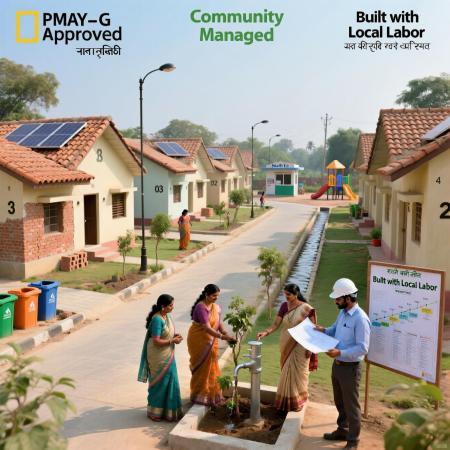
Land: The First Hurdle — And How to Systematically Overcome It
Land scarcity and inflated prices are the biggest bottlenecks in urban housing. A Systematic Approach in Low-Cost Housing tackles this by reimagining land use — identifying underutilized government plots, repurposing defunct industrial zones, and leveraging Transit-Oriented Development (TOD) near metro corridors. States like Tamil Nadu have successfully used land pooling, where small private plots are consolidated for planned development, with owners receiving built units or serviced plots in return. This requires legal clarity, transparent negotiation, and participatory mapping — all hallmarks of a Systematic Approach in Low-Cost Housing.
Financing Innovation: Making Credit Accessible to the Invisible
Most EWS/LIG households are excluded from formal finance — no credit history, no collateral, irregular incomes. A Systematic Approach in Low-Cost Housing integrates layered financial solutions: interest subsidies (PMAY-U’s CLSS), microfinance linkages, community savings collectives, and blended capital (public + private + philanthropic). Equally important is financial literacy — training beneficiaries to manage EMIs, maintenance funds, and long-term budgets. Without embedding these elements, even generous subsidies risk default or misuse. Hence, a Systematic Approach in Low-Cost Housing must include financial inclusion as a core pillar.
Design & Technology: Building Smarter, Faster, Cheaper — Without Sacrificing Quality
Traditional brick-and-mortar construction is slow, wasteful, and expensive. A Systematic Approach in Low-Cost Housing promotes context-appropriate, industrialized building technologies: precast concrete, compressed stabilized earth blocks (CSEB), ferrocement roofs, bamboo frames, and modular steel systems. The Building Materials & Technology Promotion Council (BMTPC) has validated over 40 such technologies suited to India’s diverse climates and seismic zones. But tech alone fails without skilled labor and supply chains. Thus, a Systematic Approach in Low-Cost Housing pairs innovation with mason training, QA/QC protocols, and local material procurement — ensuring affordability doesn’t mean fragility.
Community at the Core: Nothing About Them, Without Them
Top-down housing projects often collapse because they ignore cultural preferences, spatial needs, and social dynamics. In Indore and Bhopal, slum dweller federations co-designed in-situ rehabilitation projects — choosing layouts, managing construction, and resolving disputes. This deep participation builds ownership, reduces conflict, and improves maintenance. A Systematic Approach in Low-Cost Housing doesn’t “consult” communities — it embeds them in governance structures, from planning committees to monitoring cells. Only then does housing become truly sustainable.
Governance & Convergence: Breaking Silos for Integrated Delivery
Housing isn’t just about walls and roofs — it’s water, sewerage, roads, electricity, and waste management. Yet in India, these are handled by separate departments with no coordination. A Systematic Approach in Low-Cost Housing mandates convergence: when a housing project is approved, utilities and infrastructure must be planned, budgeted, and executed simultaneously. Smart Cities Mission’s Integrated Command Centers offer a template but need scaling. Real success requires legal mandates, shared KPIs, and inter-departmental task forces — all part of a Systematic Approach in Low-Cost Housing.
Policy & Regulation: Cutting Red Tape Without Cutting Corners
India’s building approval process can take 18–24 months — a death sentence for low-cost projects with tight margins. A Systematic Approach in Low-Cost Housing pushes for fast-track clearances: deemed approvals for EWS projects, pre-certified standard designs, single-window digital portals. Maharashtra’s self-certification system for G+3 buildings cut approval time from 6 months to 15 days. Such reforms, when embedded within a broader Systematic Approach in Low-Cost Housing, reduce delays, lower costs, and deter corruption.
Monitoring That Matters: Beyond “Units Completed” to “Lives Transformed”
Too many schemes count “completed units” without verifying occupancy, structural safety, or service functionality. A Systematic Approach in Low-Cost Housing embeds real-time, tech-enabled monitoring: geotagged progress photos, beneficiary feedback via mobile apps, third-party technical audits, and social audits by community reps. PMAY-U’s AwaasSoft is a start but needs ground-truthing. Layering in grievance redressal and adaptive management turns data into action — a non-negotiable in any Systematic Approach in Low-Cost Housing.
Sustainability by Design: Green, Resilient, and Still Affordable
Low-cost must not mean ecologically reckless. A Systematic Approach in Low-Cost Housing bakes in passive design: optimal orientation for light/ventilation, rainwater harvesting, solar-ready rooftops, waste segregation at source. In Auroville and post-tsunami Kerala, eco-housing was delivered affordably using local materials and labor. Climate resilience — flood-proof plinths, cyclone-resistant roofs — is also integrated, not added later. Sustainability here isn’t a luxury; it’s operational efficiency and long-term cost reduction — central to a Systematic Approach in Low-Cost Housing.
Building Capacity: Training the Hands That Build the Nation
Municipal engineers, junior architects, and contractors often lack exposure to low-cost tech or participatory methods. A Systematic Approach in Low-Cost Housing includes institutionalized skilling: NULM’s certified mason programs, CIDC’s supervisor training, university modules on affordable housing. Tamil Nadu’s “Housing University” trains officials across departments. Without this human infrastructure, even the best policies fail. Capacity building isn’t an add-on — it’s the engine of a Systematic Approach in Low-Cost Housing.
Digital Leverage: Drones, GIS, and Apps as Force Multipliers
Technology can revolutionize housing delivery. SVAMITVA’s drone-based land mapping has issued 7+ million rural property cards, unlocking credit and reducing disputes. GIS identifies vacant public land; blockchain ensures transparent subsidy flow; apps streamline beneficiary applications. A Systematic Approach in Low-Cost Housing doesn’t fetishize tech — it strategically deploys it to reduce leakage, accelerate timelines, and empower citizens. Digitization, when inclusive and offline-compatible, becomes a pillar of accountability.
Private Sector: Incentivizing Ethical Participation
Developers avoid EWS projects — low margins, high execution risk. A Systematic Approach in Low-Cost Housing creates smart incentives: extra FAR, faster approvals,
viability gap funding, and cross-subsidy models (e.g., sell MIG units to fund EWS). Ahmedabad’s PPPs delivered 20,000+ units via this model. But success hinges on strong contracts, performance bonds, and community safeguards. The private sector isn’t a villain — it’s a partner, when properly aligned within a Systematic Approach in Low-Cost Housing.
Beyond Handover: The Critical Phase of Post-Occupancy Support
Moving in is just the start. New residents need help with maintenance, utility payments, waste management, and forming RWAs. A Systematic Approach in Low-Cost Housing includes “handholding”: municipal helpdesks, NGO-run orientation camps, peer mentor systems. In Tenkasi, TN, monthly “maintenance mohallas” reduced infrastructure failures by 70%. Neglecting this phase leads to rapid deterioration — making post-occupancy support a vital, often overlooked, component of a Systematic Approach in Low-Cost Housing.
Replication & Adaptation: From Pilot to National Blueprint
A project that works in Coimbatore may fail in Patna — unless its methodology is documented, modularized, and adaptable. The “Laddoo” model (Jharkhand) — disaster-resilient, earth-block housing — was replicated in Odisha and Chhattisgarh because its cost sheets, training manuals, and material specs were systematically archived. A Systematic Approach in Low-Cost Housing treats every project as a learning lab — codifying successes and failures into open-source toolkits for others to adapt, not copy-paste.
Equity by Design: Ensuring No One Is Left Behind
Women, Dalits, tribals, and persons with disabilities face systemic barriers in housing access. A Systematic Approach in Low-Cost Housing hardwires inclusion: 40% of Kerala’s PMAY units go to women-headed households; Tamil Nadu mandates disability ramps and tactile paths; Rajasthan reserves plots for SC/ST communities. Gender-responsive design (private courtyards, safe WASH access) and caste-sensitive site allocation aren’t “extras” — they’re justice. And justice must be engineered into the system — a core ethic of a Systematic Approach in Low-Cost Housing.
Political Will & Institutional Memory: Outlasting Election Cycles
Housing projects span 3–5 years — longer than most political tenures. A Systematic Approach in Low-Cost Housing anchors programs in city master plans, state policies, and statutory missions — making them less vulnerable to regime change. It also builds public champions: mayors who showcase housing wins, media that tracks progress, citizens who demand accountability. When housing becomes a bipartisan priority, not a campaign slogan, sustainability is possible. That’s the ultimate test of a Systematic Approach in Low-Cost Housing.
The Road Ahead: Scaling the Systematic Model Nationally
India has all the pieces — policies, technologies, case studies, financing tools. What’s missing is the connective tissue: the integration, the discipline, the feedback loops. A Systematic Approach in Low-Cost Housing provides that. It’s not a silver bullet — it’s a scaffold. It doesn’t guarantee perfection — it enables continuous improvement. From Surat’s slum redevelopment to Tripura’s bamboo housing clusters, the seeds exist. What we need now is deliberate, patient, nationwide scaling — backed by data, driven by communities, and held together by a Systematic Approach in Low-Cost Housing.
Conclusion: From Fragmentation to Framework — The Time Is Now
The era of scattered, donor-driven, photo-op housing is over. India’s urban explosion, climate vulnerabilities, and social inequities demand a new paradigm — one that is coordinated, adaptive, and relentlessly focused on outcomes, not outputs. A Systematic Approach in Low-Cost Housing is that paradigm. It’s the difference between building houses and building neighborhoods; between counting units and transforming lives. Twenty times we’ve named it — not as a mantra, but as a methodology. Let’s stop talking about housing deficits. Let’s start building systematic solutions. The blueprint exists. The need is urgent. The time for a Systematic Approach in Low-Cost Housing is now.
Also read: Towards a pro-poor framework for slum upgrading in Mumbai, India
