Sustainable Perspectives for Affordable Housing
Introduction
Sustainable Perspectives for Affordable Housing represent a vital intersection between environmental responsibility, economic feasibility, and social equity. As urban populations swell and housing shortages intensify—particularly in low- and middle-income communities—the need for housing solutions that are both affordable and sustainable has never been more urgent.
Traditional approaches to affordable housing often prioritize cost-cutting over long-term environmental and social outcomes, leading to inefficient energy use, poor indoor air quality, and increased vulnerability to climate change. In contrast, Sustainable Perspectives for Affordable Housing advocate for integrated strategies that reduce ecological footprints while enhancing residents’ health, comfort, and financial stability.
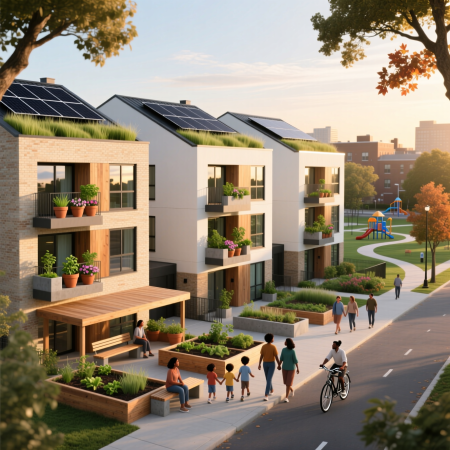
This summary explores the core principles, challenges, innovations, and policy frameworks that define Sustainable Perspectives for Affordable Housing, illustrating why this approach is not just desirable but essential for resilient, inclusive communities.
Defining the Dual Imperative
At its core, Sustainable Perspectives for Affordable Housing address two intertwined crises: the global housing affordability gap and the escalating climate emergency. According to the United Nations, over 1.6 billion people currently live in inadequate housing, with projections suggesting this number will rise as urbanization accelerates. Simultaneously, the building sector accounts for nearly 40% of global energy-related carbon emissions.
Without a paradigm shift, efforts to expand housing access could exacerbate environmental degradation. Sustainable Perspectives for Affordable Housing challenge this false dichotomy by demonstrating that affordability and sustainability are not mutually exclusive but mutually reinforcing.
Energy-efficient design, for example, lowers utility bills—freeing up household income—while reducing greenhouse gas emissions. Thus, Sustainable Perspectives for Affordable Housing reframe affordability as a long-term economic and ecological proposition, not merely a short-term construction cost metric.
Environmental Benefits and Resource Efficiency
One of the most compelling arguments for Sustainable Perspectives for Affordable Housing lies in their environmental advantages. Sustainable construction techniques—such as passive solar design, high-performance insulation, and water-efficient fixtures—dramatically reduce resource consumption. When scaled across entire developments, these features can significantly lower a community’s carbon footprint.
Moreover, the use of locally sourced, renewable, or recycled materials minimizes transportation emissions and supports circular economies. Green roofs, permeable pavements, and urban tree canopies further enhance biodiversity and mitigate urban heat island effects.
These environmental co-benefits underscore why Sustainable Perspectives for Affordable Housing must be central to climate adaptation and mitigation strategies, especially in vulnerable regions. By embedding ecological intelligence into housing design from the outset, Sustainable Perspectives for Affordable Housing ensure that affordability does not come at the planet’s expense.
Economic Viability and Lifecycle Costing
Critics often argue that sustainable housing is too expensive for low-income populations. However, Sustainable Perspectives for Affordable Housing counter this myth through lifecycle cost analysis. While upfront costs may be marginally higher, the long-term savings from reduced energy, water, and maintenance expenses often outweigh initial investments.
For instance, installing solar panels or energy-efficient appliances may increase construction costs by 5–10%, but can cut utility bills by 30–50% annually. For households spending a disproportionate share of income on rent and utilities, these savings are transformative. Furthermore, green affordable housing projects frequently qualify for government incentives, tax credits, and low-interest financing, further improving economic feasibility.
Thus, Sustainable Perspectives for Affordable Housing promote a more accurate understanding of affordability—one that accounts for total cost of ownership rather than just purchase or rental price. This shift in financial perspective is critical to scaling Sustainable Perspectives for Affordable Housing across diverse markets.
Social Equity and Community Well-being
Beyond environmental and economic dimensions, Sustainable Perspectives for Affordable Housing prioritize social outcomes. Poorly constructed, energy-inefficient housing often correlates with health issues such as asthma, respiratory infections, and mental stress—disproportionately affecting marginalized communities. In contrast, sustainably designed homes feature improved ventilation, non-toxic materials, natural daylight, and thermal comfort, all of which enhance physical and psychological well-being.
Additionally, participatory design processes—where residents co-create housing solutions—foster a sense of ownership, dignity, and community cohesion. Sustainable Perspectives for Affordable Housing thus reject the notion that low-income residents should accept substandard living conditions. Instead, they assert that everyone deserves safe, healthy, and dignified housing—a principle that lies at the heart of Sustainable Perspectives for Affordable Housing.
Innovative Design and Construction Methods
Technological and methodological innovations are accelerating the adoption of Sustainable Perspectives for Affordable Housing. Modular and prefabricated construction, for example, reduces waste, shortens build times, and improves quality control—all while lowering costs.
3D printing with eco-friendly materials is emerging as another frontier, enabling rapid, customizable housing units with minimal environmental impact. Passive house standards, net-zero energy designs, and bioclimatic architecture are also being adapted for affordability through simplified detailing and local material sourcing.
These innovations prove that Sustainable Perspectives for Affordable Housing are not static ideals but dynamic, evolving practices shaped by creativity and pragmatism. As these methods mature and scale, they will further bridge the gap between sustainability ambitions and affordability realities—making Sustainable Perspectives for Affordable Housing increasingly accessible worldwide.
Policy and Regulatory Enablers
Government policy plays a pivotal role in mainstreaming Sustainable Perspectives for Affordable Housing. Zoning reforms, density bonuses, streamlined permitting for green projects, and mandatory energy performance standards can all incentivize sustainable development. Public-private partnerships, community land trusts, and inclusionary zoning policies further ensure that sustainability benefits reach low- and moderate-income households.
Crucially, subsidies and financing mechanisms must be restructured to support upfront green investments rather than penalizing them. For example, “
green mortgages” that factor in energy savings can expand homeownership opportunities. Without supportive policy ecosystems, Sustainable Perspectives for Affordable Housing risk remaining niche experiments rather than systemic solutions. Therefore, embedding Sustainable Perspectives for Affordable Housing into national housing strategies and climate action plans is essential for transformative impact.
Financing Mechanisms and Investment Models
Scaling Sustainable Perspectives for Affordable Housing requires innovative financing. Traditional lenders often undervalue long-term operational savings, creating a barrier to green construction. However, new models—such as green bonds, social impact investing, and energy performance contracting—are changing this calculus. Community development financial institutions (CDFIs) and green banks are also channeling capital toward sustainable affordable projects.
Additionally, utility-sponsored programs that fund energy retrofits through on-bill repayment make upgrades accessible without large upfront costs.
These financial tools demonstrate that Sustainable Perspectives for Affordable Housing can attract diverse investors—from philanthropists to institutional funds—by aligning social impact with financial return. As these mechanisms proliferate, they will lower risk and increase confidence in Sustainable Perspectives for Affordable Housing as a viable asset class.
Global Lessons and Contextual Adaptation
While principles of Sustainable Perspectives for Affordable Housing are universal, their implementation must be context specific. In the Global South, for instance, informal settlements often rely on self-built housing using local materials—a practice that can be enhanced with sustainable upgrades like improved sanitation or solar lighting.
In contrast, high-income countries may focus on retrofitting aging public housing stock to meet net-zero targets. Successful models from around the world—from Brazil’s social housing program “Minha Casa, Minha Vida” incorporating energy efficiency, to Singapore’s high-density green public housing—offer valuable lessons.
What unites these examples is a commitment to tailoring Sustainable Perspectives for Affordable Housing to local climates, cultures, economies, and governance structures. This adaptability ensures that Sustainable Perspectives for Affordable Housing remain relevant and effective across diverse settings.
Overcoming Barriers and Misconceptions
Despite their benefits, Sustainable Perspectives for Affordable Housing face persistent obstacles. These include fragmented governance, lack of technical expertise among builders, resistance from developers focused on short-term profits, and limited awareness among residents and policymakers.
Misconceptions—such as equating sustainability with luxury or assuming it’s only relevant in wealthy nations—further hinder progress. Addressing these challenges requires capacity building, education campaigns, and demonstration projects that prove the viability of Sustainable Perspectives for Affordable Housing.
When communities see tangible results—lower bills, healthier homes, resilient infrastructure—they become advocates. Thus, dispelling myths and building trust is as crucial as technological innovation in advancing Sustainable Perspectives for Affordable Housing.
The Role of Technology and Data
Digital tools are increasingly empowering Sustainable Perspectives for Affordable Housing. Building information modeling (BIM), energy simulation software, and remote monitoring systems enable precise design optimization and performance tracking. Mobile apps can educate residents on energy-saving behaviors, while blockchain technology offers transparent tracking of sustainable material sourcing.
Data analytics also help policymakers identify housing needs, target interventions, and measure outcomes. By leveraging technology, Sustainable Perspectives for Affordable Housing become more efficient, accountable, and responsive to user needs—further enhancing their appeal and scalability.
Conclusion: A Path Toward Inclusive Resilience
In conclusion, Sustainable Perspectives for Affordable Housing offer a holistic framework for addressing some of the 21st century’s most pressing challenges. They reconcile the need for shelter with the imperative of planetary stewardship, proving that equity and ecology can—and must—go hand in hand.
From environmental stewardship and economic pragmatism to social justice and technological innovation, Sustainable Perspectives for Affordable Housing provide a roadmap for building communities that are not only affordable but also resilient, healthy, and just.
As climate risks mount and inequality deepens, the adoption of Sustainable Perspectives for Affordable Housing is no longer optional—it is an ethical and practical necessity. Governments, developers, financiers, and communities must collaborate to embed these principles into every housing decision. Only then can we ensure that the homes we build today do not compromise the well-being of future generations.
Ultimately, the widespread embrace of Sustainable Perspectives for Affordable Housing will define whether our urban future is one of exclusion and depletion—or inclusion and regeneration. And so, the call to action is clear: prioritize, invest in, and scale Sustainable Perspectives for Affordable Housing across all levels of society. Because when we build sustainably, we build for everyone.
Also read: Affordable, Sustainable Housing Can Bring the Green Deal Home
