SOCIAL IMPLICATIONS OF HOUSING DIVERSIFICATION IN URBAN RENEWAL
Introduction
The social implications of housing diversification have become increasingly central to discussions surrounding urban renewal, as cities worldwide strive to balance economic development, architectural innovation, and equitable community growth. Urban renewal, once synonymous with large-scale demolition and displacement, has evolved into a more nuanced process that often includes mixed-income housing, adaptive reuse of buildings, and inclusive planning strategies. At the heart of this transformation lies the concept of housing diversification—introducing a range of housing types, tenures, and price points within a single neighborhood or development. While this shift is often celebrated for its potential to foster inclusive communities, the social implications of housing diversification reveal both opportunities and challenges that demand careful consideration.
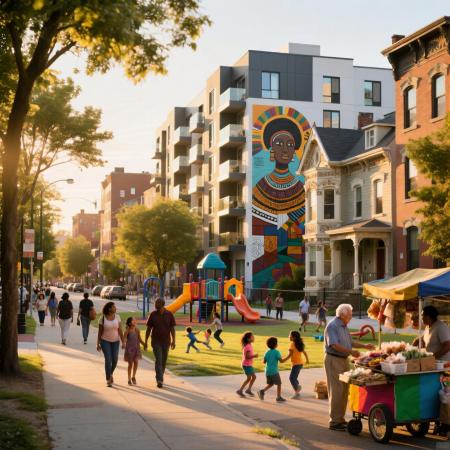
As cities grow denser and housing markets become more competitive, planners, policymakers, and community advocates are turning to housing diversification as a tool to address long-standing issues of segregation, affordability, and access to opportunity. Yet, while the goal is often to create more vibrant, equitable neighborhoods, the actual social implications of housing diversification can be complex and, at times, contradictory. From reshaping neighborhood identities to influencing social mobility, these implications touch every aspect of urban life.
This essay explores the multifaceted social implications of housing diversification in the context of urban renewal, examining its effects on community cohesion, economic equity, cultural preservation, and access to services. By analyzing case studies, policy frameworks, and resident experiences, we aim to understand how housing diversification influences the social fabric of cities and what lessons can be drawn for future urban development.
Redefining Neighborhoods: The Social Implications of Housing Diversification
One of the most immediate social implications of housing diversification is the transformation of neighborhood character. As urban renewal projects replace aging or underutilized buildings with mixed-use developments that include apartments, townhouses, and affordable units, the demographic makeup of communities often shifts. This shift can lead to greater socioeconomic diversity, which in theory fosters richer social interactions and broader networks of support. However, the social implications of housing diversification also include the risk of social fragmentation, particularly when new residents do not integrate with long-term community members.
In many cases, the influx of higher-income households into formerly low-income areas—often facilitated by housing diversification initiatives—can lead to tensions over cultural identity, public space usage, and community norms. For example, in cities like San Francisco and London, the introduction of luxury apartments alongside subsidized housing has created visible divides between residents, with some feeling that their neighborhoods are being “taken over” by outsiders. These dynamics highlight the social implications of housing diversification not just as a policy tool but as a lived experience that affects belonging and social trust.
Moreover, housing diversification can alter the way public spaces are used and perceived. When new developments include private amenities such as gyms, rooftop gardens, or gated entrances, they may inadvertently exclude existing residents from shared spaces. This creates a form of spatial segregation within ostensibly integrated communities, reinforcing the social implications of housing diversification as both a unifier and a divider.
Economic Equity and the Social Implications of Housing Diversification
A central promise of housing diversification is that it promotes economic equity by making urban living accessible to a broader range of income levels. In theory, integrating affordable units into market-rate developments allows lower-income families to benefit from improved infrastructure, safer streets, and better schools—amenities often associated with wealthier neighborhoods. This is particularly important in the context of urban renewal, where public investment can dramatically increase property values and displace existing residents.
However, the social implications of housing diversification in this regard are not always straightforward. While mixed-income housing can reduce economic segregation, it does not automatically lead to economic integration. Studies have shown that even when lower-income residents live in the same buildings as higher-income ones, they often experience limited social interaction and may face stigma or surveillance. This underscores the social implications of housing diversification as a structural intervention that must be accompanied by intentional social programming and inclusive design.
Additionally, the placement and quality of affordable units within diversified developments can reflect deeper inequalities. In some cases, affordable units are located in less desirable parts of a building—such as upper floors without elevators or units facing noisy streets—reinforcing the social implications of housing diversification as a potentially tokenistic gesture rather than a genuine commitment to equity. Without strong regulatory oversight and community input, the economic benefits of housing diversification may be unevenly distributed, benefiting developers and investors more than residents.
Gentrification and Displacement: Unintended Social Implications of Housing Diversification
Perhaps the most controversial aspect of the social implications of housing diversification is its relationship to gentrification. While diversification is often promoted as an antidote to displacement, in practice, it can accelerate it. When urban renewal projects attract private investment and increase property values, existing residents—especially renters—may be priced out, even if new affordable units are added. This phenomenon reveals a critical paradox: the social implications of housing diversification can include both inclusion and exclusion, depending on implementation.
For example, in Brooklyn’s Gowanus neighborhood, a rezoning initiative aimed at housing diversification led to the construction of thousands of new units, including a percentage designated as affordable. Yet, long-term residents reported rising rents, loss of small businesses, and a sense of cultural erasure. The social implications of housing diversification here were not just about housing stock but about the erosion of community memory and identity.
Similarly, in cities like Atlanta and Portland, urban renewal projects that embraced housing diversification have been criticized for prioritizing aesthetic and economic revitalization over resident stability. The social implications of housing diversification, in these cases, include the displacement of marginalized communities—particularly Black, Latino, and Indigenous populations—who have historically faced systemic housing discrimination.
To mitigate these risks, some cities have adopted inclusionary zoning policies, community land trusts, and right-to-stay ordinances. These tools aim to ensure that the social implications of housing diversification are not solely defined by market forces but are shaped by community needs and historical context.
Community Cohesion and the Social Implications of Housing Diversification
A key goal of housing diversification is to foster stronger, more resilient communities by bringing together people from different backgrounds. Proponents argue that diverse neighborhoods promote social tolerance, reduce prejudice, and enhance collective problem-solving. In this sense, the social implications of housing diversification can be profoundly positive, especially in cities marked by racial and economic segregation.
However, achieving true community cohesion requires more than just physical proximity. Research indicates that without shared institutions—such as schools, community centers, and local events—residents in diversified neighborhoods may remain socially isolated. The social implications of housing diversification, therefore, depend heavily on whether urban renewal projects include investments in social infrastructure.
For instance, in Vancouver’s Southeast False Creek development, planners intentionally designed public plazas, childcare centers, and community gardens to encourage interaction among residents of different income levels. This holistic approach helped to realize the social implications of housing diversification as a force for connection rather than division. In contrast, developments that focus solely on architectural diversity without fostering social engagement often fall short of their equity goals.
Language barriers, cultural differences, and unequal access to decision-making power can also hinder integration. The social implications of housing diversification are thus not automatic; they must be nurtured through participatory planning, resident-led initiatives, and sustained public investment in community-building activities.
Cultural Preservation and the Social Implications of Housing Diversification
Urban renewal often targets neighborhoods with rich cultural histories, particularly those inhabited by immigrant or minority communities. When housing diversification is introduced in such areas, the social implications of housing diversification extend beyond economics to questions of identity and heritage. Will the new development honor the existing culture, or will it overwrite it with a
homogenized, market-driven aesthetic?
In cities like New Orleans and Chicago, urban renewal projects have sparked debates about the preservation of cultural landmarks, local businesses, and artistic expression. The social implications of housing diversification in these contexts include the risk of cultural erasure, where long-standing traditions are displaced by chain stores, luxury lofts, and tourism-oriented developments.
To address this, some cities have incorporated cultural impact assessments into their planning processes. For example, in Los Angeles, the Arts District redevelopment included provisions for artist live-work spaces and support for local galleries. These efforts recognize that the social implications of housing diversification must include cultural sustainability, not just physical and economic change.
When done thoughtfully, housing diversification can actually strengthen cultural vitality by providing space for community events, cultural institutions, and intergenerational exchange. But when cultural considerations are ignored, the social implications of housing diversification can include alienation, loss of place-based identity, and the commodification of heritage.
Access to Services and the Social Implications of Housing Diversification
Another critical dimension of the social implications of housing diversification is access to essential services such as healthcare, education, transportation, and recreation. Urban renewal projects often promise improved infrastructure, but the benefits are not always equitably distributed.
For example, a new transit hub may be built to serve a diversified neighborhood, but if fares are high or routes favor wealthier areas, lower-income residents may still face mobility challenges. Similarly, while new schools or clinics may be constructed, they may be under-resourced or inaccessible to certain groups. The social implications of housing diversification, therefore, hinge on whether service improvements are truly inclusive.
Moreover, the concentration of affordable housing in specific zones—sometimes called “poverty clustering”—can undermine the benefits of diversification. If low-income residents are confined to certain buildings or blocks within a mixed-income development, they may still experience limited access to opportunities. The social implications of housing diversification are thus shaped by spatial design, policy enforcement, and ongoing monitoring of equity outcomes.
Cities like Vienna and Singapore have demonstrated that when housing diversification is paired with universal access to public services, the social implications of housing diversification can be overwhelmingly positive. In these models, high-quality healthcare, education, and public transit are available to all residents regardless of income, reinforcing social cohesion and reducing inequality.
Policy and Governance: Shaping the Social Implications of Housing Diversification
The way housing diversification is governed plays a decisive role in determining its social implications. Policies that prioritize developer incentives over community benefits may lead to superficial diversification, where the appearance of inclusion masks deeper inequities. On the other hand, policies that mandate community participation, enforce affordability requirements, and protect tenant rights can help ensure that the social implications of housing diversification are aligned with public interest.
For example, inclusionary zoning laws—which require a percentage of new units to be affordable—have been adopted in over 700 jurisdictions in the United States. While these policies have expanded affordable housing supply, their effectiveness varies based on enforcement and affordability levels. The social implications of housing diversification are therefore closely tied to the strength and equity of regulatory frameworks.
Additionally, the role of community organizations and resident advocacy cannot be overstated. In cities like Barcelona and Medellín, grassroots movements have successfully influenced urban renewal projects to prioritize social equity over profit. These cases illustrate that the social implications of housing diversification are not predetermined but are shaped by power dynamics, civic engagement, and political will.
Long-Term Sustainability and the Social Implications of Housing Diversification
Finally, the social implications of housing diversification must be evaluated over the long term. While initial outcomes may appear promising, the sustainability of social integration, affordability, and community well-being depends on ongoing management and adaptation.
Maintenance of affordable units, for instance, requires dedicated funding and oversight. Without it, units may be converted to market rate or fall into disrepair, undermining the goals of diversification. Similarly, social cohesion can erode over time if new residents do not engage with existing community networks or if economic pressures increase.
The social implications of housing diversification, therefore, extend beyond the construction phase to include long-term stewardship. This includes resident-led governance models, community land trusts, and regular impact assessments to ensure that equity goals are being met.
Conclusion
The social implications of housing diversification in urban renewal are vast, complex, and deeply consequential. While the strategy holds promise for creating more inclusive, dynamic, and resilient cities, its success depends on more than just architectural variety or policy mandates. The social implications of housing diversification are shaped by how equitably benefits are distributed, how inclusive community processes are, and how well cultural and economic diversity are respected.
From redefining neighborhoods to influencing access to services, the social implications of housing diversification touch every aspect of urban life. They reveal both the potential for transformative change and the risks of reinforcing existing inequalities. To harness the positive aspects of housing diversification, cities must move beyond tokenism and embrace a holistic, community-centered approach to urban renewal.
Ultimately, the social implications of housing diversification are not just about where people live, but how they live together. When guided by principles of justice, participation, and long-term sustainability, housing diversification can become a powerful tool for building cities that are not only physically diverse but socially equitable.
In sum, the social implications of housing diversification challenge us to rethink what urban progress means. They remind us that true renewal is not measured by skyline transformations or investment returns, but by the well-being of all residents. As cities continue to evolve, the social implications of housing diversification will remain a vital lens through which we assess the fairness and humanity of our urban futures.
Also read: Housing Policy Options to Tackle Urban Inequalities
