Reviving Our Inner Cities: Social Housing and Urban Regeneration in South Africa
Introduction
Social Housing and Urban Regeneration in South Africa represent a critical intersection of historical redress, economic revitalization, and spatial justice in a nation still reshaping itself after apartheid’s rigid geographies of exclusion. For decades, South African cities were deliberately fragmented—Black, Coloured, and Indian communities forcibly relocated to distant townships, while economic hubs and prime urban land remained concentrated in white-controlled areas.
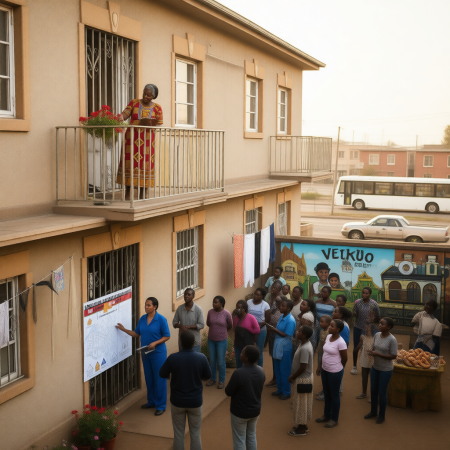
Today, the challenge is not just to build more housing, but to heal the urban fabric: reconnecting people to opportunity, restoring dignity through well-located homes, and transforming neglected inner-city zones into thriving, inclusive neighborhoods. Social Housing and Urban Regeneration in South Africa are thus not merely technical projects but acts of reimagining urban belonging.
This effort is both urgent and complex. South Africa faces a housing backlog estimated at over 2.2 million units, with demand concentrated in cities like Johannesburg, Cape Town, Durban, and Tshwane. Yet the solution cannot be another wave of peripheral settlements on the urban edge—what critics call “apartheid’s afterlife in concrete.”
Instead, Social Housing and Urban Regeneration in South Africa aim to reclaim underutilized or decaying inner-city land, repurpose abandoned buildings, and create mixed-income communities where low- and moderate-income earners can live near jobs, schools, and public transport.
A Legacy of Spatial Injustice
To understand the stakes of Social Housing and Urban Regeneration in South Africa, one must confront the legacy of apartheid planning. Laws like the Group Areas Act of 1950 systematically removed non-white populations from city centers, creating racially segregated townships on the periphery. Even after democracy in 1994, market forces and slow policy implementation reinforced these divides. New housing programs often replicated spatial apartheid by building vast estates far from economic activity—trapping residents in cycles of long commutes, unemployment, and social isolation.
Urban regeneration, therefore, is not just about bricks and mortar; it’s about correcting historical wrongs. Social Housing and Urban Regeneration in South Africa prioritize “inclusionary” development—building affordable rental and ownership units in well-located areas where land values were once prohibitive for the poor. This shift reflects a growing consensus: location is a form of equity.
The Social Housing Model: More Than Just Rental Units
Central to this transformation is the formal Social Housing sector, established through the Social Housing Act of 2004. Unlike informal settlements or backyard shacks, social housing in South Africa refers to professionally managed, government-subsidized rental apartments targeted at households earning between R3,500 and R22,000 per month—a group often excluded from both formal market housing and state-subsidized “free” housing.
These developments are typically high-density, multi-story buildings with basic amenities: secure access, communal laundry, on-site management, and proximity to transit. But what makes them transformative is their location. Projects like Nkomo Village in central Johannesburg or the District Six developments in Cape Town place residents within walking distance of jobs, courts, universities, and cultural institutions—opportunities once denied by design.
Social Housing and Urban Regeneration in South Africa recognize that housing is a platform for mobility. A cleaner, a nurse, or a student living in a centrally located social housing unit saves hours and rands on transport, accesses networks more easily, and participates more fully in urban life. This is housing as infrastructure—not just shelter, but a springboard.
Revitalizing the Inner City: From Decay to Dignity
In cities like Johannesburg, the inner core suffered decades of disinvestment as businesses and middle-class residents fled to suburban malls and gated communities. By the 2000s, entire blocks stood vacant, with crumbling facades, broken windows, and rising crime. Urban regeneration has reversed this trend through strategic public-private partnerships.
The Johannesburg Development Agency (JDA), for example, has spearheaded the rehabilitation of heritage buildings along Gandhi Square and Sauer Street, converting them into mixed-use spaces with ground-floor retail and upper-floor social housing. These projects retain historical character while injecting new life. Similarly, in Cape Town, the N2 Gateway project—though controversial in its early phases—has evolved to include social housing components integrated with community facilities and green space.
Social Housing and Urban Regeneration in South Africa also tackle “brownfield” sites: former industrial zones contaminated or abandoned. Cleaning and redeveloping these areas not only create housing but removes blight, improves environmental health, and unlocks municipal revenue through rates and services.
Community Participation: Co-Creation, Not Imposition
Critically, the most successful initiatives under Social Housing and Urban Regeneration in South Africa now prioritize community voice. Top-down planning has given way to participatory design processes where future residents help shape layouts, choose finishes, and co-manage buildings. In Durban, the Cornubia Integrated Urban Development project included extensive community workshops to ensure housing reflected local needs and cultural practices.
This shift recognizes a hard-learned lesson: regeneration imposed from above often fails. When communities are treated as partners—not problems to be solved—outcomes are more sustainable, maintenance costs fall, and social cohesion grows. Social Housing and Urban Regeneration in South Africa increasingly view residents as co-stewards of urban renewal.
Challenges and Tensions
Despite progress, significant challenges remain. Funding is a persistent constraint. While the national Social Housing Regulatory Authority (SHRA) provides institutional subsidies, demand far outstrips supply. Delays in land acquisition,
rezoning disputes, and contractor inefficiencies further slow delivery.
There are also tensions around gentrification. As inner cities improve, property values rise—risking the displacement of existing informal traders, backyard dwellers, and even social housing tenants if rents are not strictly controlled. Social Housing and Urban Regeneration in South Africa must therefore embed strong anti-displacement measures: rent caps, tenure security, and support for informal livelihoods.
Moreover, maintenance and management remain weak points. Some social housing complexes suffer from poor governance, leading to service breakdowns and tenant dissatisfaction. Strengthening community-based housing associations and professional management training is essential to long-term viability.
Policy Evolution and Institutional Innovation
The policy landscape has matured significantly. The National Urban Policy Framework (2016) and the Human Settlements Development Grant now explicitly prioritize well-located, integrated development. Municipalities are required to develop Spatial Development Frameworks that identify regenerable inner-city nodes.
Innovative financing is also emerging. The Green Fund supports energy-efficient social housing, reducing utility costs for tenants. Public-private partnerships, while complex, have enabled faster delivery in cities like Tshwane, where developers contribute land or infrastructure in exchange for density bonuses.
Social Housing and Urban Regeneration in South Africa are increasingly seen not as isolated housing programs, but as engines of local economic development. Construction creates jobs; revived neighborhoods attract small businesses; improved safety boosts tourism and investment. The multiplier effects are real.
Climate Resilience and Green Design
Newer social housing projects are integrating climate adaptation. In Cape Town, developments include water-saving fixtures and greywater recycling in response to recurring droughts. In Durban, flood-resilient foundations and elevated ground floors address coastal storm risks. Green roofs, solar water heaters, and passive cooling design are becoming standard—reducing both environmental impact and household expenses.
This “greening” of Social Housing and Urban Regeneration in South Africa aligns with national climate commitments while delivering immediate co-benefits: lower bills, healthier homes, and reduced pressure on municipal services.
Success Stories That Point the Way
Several projects exemplify best practices. In Johannesburg, the Maboneng Precinct—though initially criticized as elite—has evolved to include affordable units and community arts spaces, demonstrating how mixed-income models can work if inclusion is intentional. In Cape Town, the Victoria Mxenge Housing Project in Joe Slovo integrates social housing with community halls, childcare, and urban agriculture.
Perhaps most inspiring is the work in smaller cities like Kimberley, where social housing near the central business district has reconnected residents to civic life and reduced spatial marginalization. These examples prove that Social Housing and Urban Regeneration in South Africa can succeed beyond the major metros—with the right local leadership and community trust.
The Role of Data and Technology
Data is increasingly guiding decisions. Municipalities are using GIS mapping to identify underutilized public land, assess infrastructure capacity, and track housing demand in real time. In Cape Town, digital platforms allow tenants to report maintenance issues instantly, improving responsiveness.
Yet technology is only as good as its inclusivity. Social Housing and Urban Regeneration in South Africa emphasize “participatory data”—where communities help collect and interpret information about their neighborhoods. This ensures regeneration responds to real needs, not just administrative convenience.
Looking Ahead: A Vision of Inclusive Cities
The ultimate goal of Social Housing and Urban Regeneration in South Africa is to create cities where apartheid’s spatial logic is finally undone—where a domestic worker can live near her workplace, a student can walk to campus, and a grandmother can access a clinic without a two-hour commute. This is not utopian; it is practical urbanism rooted in justice.
Achieving this requires sustained political will, patient capital, and unwavering community partnership. It also demands redefining success: not just units built, but lives transformed through proximity, safety, dignity, and opportunity.
Social Housing and Urban Regeneration in South Africa are thus more than development strategies—they are acts of urban healing. They acknowledge past harm while constructing a future where cities belong to everyone.
As South Africa navigates economic pressures and demographic shifts, the path forward lies not in expanding the urban fringe, but in deepening the heart of the city. By investing in well-located, well-managed, and community-anchored housing, the country is not just building homes—it is rebuilding the very idea of the South African city.
In this vision, every repurposed warehouse, every rehabilitated street, and every family moving into a secure inner-city apartment becomes a quiet act of resistance against segregation—and a step toward a more just, vibrant, and truly integrated urban future.
Social Housing and Urban Regeneration in South Africa, therefore, stand at the forefront of a broader global conversation about inclusive urbanism—but with a uniquely South African urgency, born of history and driven by hope.
And as lessons from these efforts spread—from policy labs in Pretoria to community meetings in Soweto—they offer a powerful blueprint for other nations grappling with urban inequality: that regeneration begins not with bulldozers, but with belonging.
Also read: The Effects of Low-Cost Houses on Poverty Reduction: A Case Study of Moroke Village within Fetakgomo-Tubatse Municipality in Limpopo, South Africa
