Slum dwellers and their conditions in Indian states
Introduction:
Population of the any cities are increasing very fast rate. Cities are the gravitation center and source of attraction point for the people. Migration toward the cities from the rural areas affects the city life. Resources of the cities are limited in nature but due to the heavy concentration of the people within the city causes some problems like as transportation problems, traffics, energy crisis, water related problems, electricity problems, housing facility etc. Big cities attract the rural people to migrate toward the urban areas. Better job opportunity in the cities, is the one of the important factor responsible for the migration.
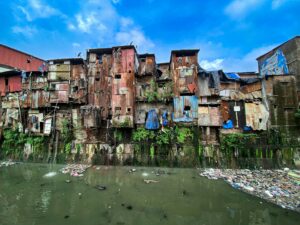
Some people who go to cities for the job opportunity, they choose the slum areas for the living purpose because they cannot afford the room rents within the city. Slum areas are the less rented areas; they have to pay fewer amounts for the room rent so they choose these types of the areas for living purpose. Slum condition in India mega cities is very pathetic in nature. The existence of Slum is a global phenomenon. As described by social scientist, slum is a by-product of modern era. In the rapid spread of slums, resulting not merely from shortage of housing but also from the low earnings of the workers engaged in less productive activities has become an endemic feature of the urbanization process in developing countries.
Objectives of the Study:
-
To study the Conditions of the slum dwellers in Indian states.
-
To examine whether economic conditions of slum dwellers has improved due to their migration from their origin.
-
To identify what are the Probable Reasons for Upcoming Slums.
-
To suggest measures for improvement of socio-economic conditions of slum dwellers.
-
To extent appropriate suggestions for development of slum dwellers.
Meaning of the Slums:
Many governmental agencies have provided the definition of the slums on the basis of the physical and socio cultural conditions. According to United Nation Habitat slums are defined as “a group of individuals living under the same roof that lack one or more (in some cities, two or more) of the following conditions,
i. Security of tenure
ii. Structural quality and
iii. Durability of dwellings
iv. Access to safe water
v. Access to sanitation facilities and
vi. Sufficient living area.
Definition of Slum dwellers According to Census of India:
The Census of India has adopted the definition of slums specified/declared “slums” through State/UT or local government under any act. In additions it also consider the following area as slum : “A compact area of at least 300 population or about 60-70 households of poorly built congested tenements, in unhygienic environment usually with inadequate infrastructure and lacking in proper sanitary and drinking water facilities”.
Slum dwellers: An Urban Phenomenon:
According to the government of India slum dwellers are an urban phenomenon. They are directly related to the level of urbanization. Under Section-3 of the Slum Area Improvement and Clearance Act, 1956, slums have been defined as mainly those residential areas where dwellings are in any respect unfit for human habitation by reasons of dilapidation, overcrowding, faulty arrangements and designs of such buildings, narrowness or faulty arrangement of streets, lack of ventilation, light, sanitation facilities or any combination of these factors which are detrimental to safety, health and morals.
Probable Reasons for Upcoming Slum dwellers:
There are many reasons associated with the development of the slums in urban cities of India. Some important reasons are as following:
- Urbanization
- Industrialization
- Higher productivity in the secondary/tertiary sector against primary sector makes cities and towns centers of economic growth and jobs
- Cities act as beacons for the rural population as they represent a higher standard of living and offer opportunities to people not available in rural areas. This results in large scale migration from rural to urban areas.
- Negative consequences of urban pull results in upcoming of slums characterized by housing shortage and critical inadequacies in public utilities, overcrowding, unhygienic conditions
Definition and Types of Slums According to Census of India 2011:
According to the census of India 2011, slums areas are categorizes in to three major parts. They are as followings:
1. Notified slums
All notified areas in a town or city notified as ‘Slum’ by State, Union territories Administration or Local Government under any Act including a ‘Slum Act’ may be considered as Notified slums.
2. Recognized slums:
All areas recognized as ‘Slum’ by State
, Union territories Administration or Local Government, Housing and Slum Boards, which may have not been formally notified as slum under any act may be considered as Recognized slums.
3. Identified slums:
A compact area of at least 300 populations or about 60-70 households of poorly built congested tenements, in unhygienic environment usually with inadequate infrastructure and lacking in proper sanitary and drinking water facilities. Such areas should be identified personally by the Charge Officer and also inspected by an officer nominated by Directorate of Census Operations.
Conclusion:
Living in the slums is a challenging life, and lack of land tenure and fear of evictions do not make that life easier. Although there is a will to improve people’s lives, many suffer because their opinion is not taken into consideration. As the years have passed, the slums have only gotten bigger. The absence of citizen participation is still a problem in the slum upgrade projects. People are involved in the beginning, but as the implementation phase arrives and as problems arise, they are pushed aside. Corruption and political manipulation are still a problem in the slums.
Also Read:
Factors to Facilitate Private Developers in Financing Affordable Housing for Low-Income Group in Klang Valley
