Redefining Urban Resilience
Introduction
Redefining Urban Resilience has become an urgent imperative as cities worldwide confront compounding pressures—from climate shocks and economic instability to social fragmentation and rapid, often unplanned, urbanization. For decades, “resilience” was narrowly interpreted as the ability of infrastructure to withstand disasters: flood barriers, earthquake-proof buildings, backup power grids.
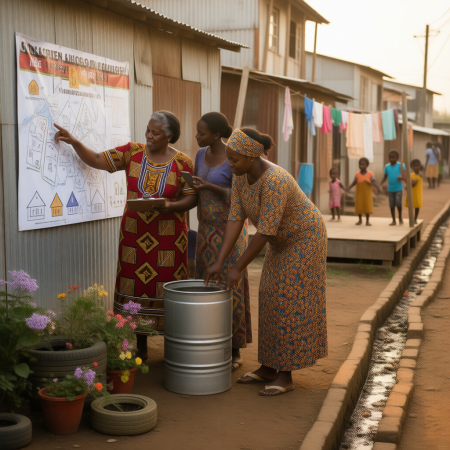
While critical, this engineering-centric view overlooked the human systems that truly sustain cities in crisis. The contemporary shift—evident in policy labs, community movements, and international frameworks alike—is toward a more holistic, equity-driven understanding. Redefining Urban Resilience now means building cities that not only survive disruption but adapt, learn, and thrive through inclusive governance, social cohesion, and locally rooted innovation.
This evolution is not theoretical. In secondary cities across Africa, Asia, and Latin America, where formal systems are often stretched thin, communities have long practiced resilience through mutual aid, incremental housing, informal economies, and adaptive land use. What was once dismissed as “informality” is increasingly recognized as a reservoir of adaptive capacity. Redefining Urban Resilience, therefore, is as much about unlearning outdated assumptions as it is about adopting new tools.
A New Vision: Beyond Bunkers and Backups
The old paradigm treated resilience as a technical problem to be solved by experts. Cities invested in hard infrastructure while ignoring the vulnerabilities created by inequality, exclusion, and environmental degradation. A neighborhood with a seawall but no affordable housing, clean water, or accessible healthcare remains deeply fragile—especially when disaster strikes and marginalized residents are least able to evacuate, recover, or rebuild.
Redefining Urban Resilience flips this logic. It starts with people, not pipes. It asks: Who is most at risk, and why? How do communities already support one another? What local knowledge exists about flood patterns, heat refuges, or food distribution? The answers shape interventions that are not only more effective but more just. In this view, a community savings group that helps families rebuild after a fire is as vital as a fire station. A women’s collective that manages urban farms during supply chain disruptions is as critical as a warehouse of emergency grain.
This human-centered approach is now embedded in global frameworks like the UN’s New Urban Agenda and the Sendai Framework for Disaster Risk Reduction. But it's true test lies in implementation—at the neighborhood level, in cities often overlooked by global capital.
The Social Fabric as Critical Infrastructure
One of the most profound insights in Redefining Urban Resilience is the recognition that social trust is infrastructure. Neighborhoods with strong social ties recover faster from disasters, share resources more equitably, and advocate more effectively for their needs. In Nairobi’s informal settlements, for example, community-based organizations have mapped flood-prone alleys, organized early-warning WhatsApp groups, and negotiated with city officials for drainage upgrades—often with more speed and precision than top-down agencies.
Similarly, in Medellín, Colombia, the transformation of once-violent hillside neighborhoods into vibrant communities was not achieved through policing alone, but through libraries, parks, and cable cars that physically and socially reconnected marginalized barrios to the city. These “
social urbanism” investments-built resilience by restoring dignity and opportunity—a lesson now echoed in Redefining Urban Resilience strategies from Jakarta to Johannesburg.
Crucially, this model treats residents not as victims or beneficiaries, but as co-creators. Redefining Urban Resilience means shifting power: supporting community land trusts that prevent post-disaster displacement, funding participatory budgeting for climate adaptation, and recognizing informal caregivers as essential service providers during crises.
Climate Adaptation Through Local Wisdom
Climate change is accelerating the need to rethink urban systems. But instead of imposing one-size-fits-all “green infrastructure” solutions, Redefining Urban Resilience emphasizes context-specific, locally led adaptation. In Surat, India, where rising temperatures threaten outdoor workers, communities have revived traditional shaded courtyards and installed community cooling centers in mosques and schools—low-cost, culturally resonant responses that complement municipal heat action plans.
In Dakar, Senegal, fishing communities are using indigenous knowledge of tidal patterns to design elevated walkways and flood-resistant housing layouts, blending ancestral wisdom with modern materials. These hybrid approaches are more sustainable, affordable, and accepted than externally designed “resilient” housing blocks that ignore local livelihoods.
Redefining Urban Resilience also means confronting the false choice between development and protection. Rather than relocating entire neighborhoods from floodplains—a traumatic and often ineffective solution—cities like Bangkok and Manila are piloting “living with water” models: amphibious homes, permeable streets, and urban wetlands that absorb floods while supporting daily life. This paradigm accepts uncertainty and builds flexibility into the urban fabric.
The Role of Data—But Not Just Digital Data
Data is central to Redefining Urban Resilience—but not only the kind generated by satellites and sensors. While digital tools like drone mapping and AI-powered risk modeling are valuable, they can miss the lived realities of informal settlements where addresses don’t exist and land tenure is ambiguous.
That’s why the most effective resilience initiatives combine high-tech and “high-touch” data. In Freetown, Sierra Leone, the city’s Chief Heat Officer partnered with schoolchildren to map urban heat islands using simple thermometers, while community enumerators documented which households lacked shade or water access. This grounded intelligence ensured that tree-planting and water kiosk programs reached those most in need.
Redefining Urban Resilience thus champions “participatory data sovereignty”: communities collecting, owning, and using data about their own neighborhoods. This not only improves targeting but builds collective agency—the very essence of long-term resilience.
Finance That Follows Function, Not Form
Perhaps the biggest barrier to Redefining Urban Resilience is finance. Traditional funding mechanisms favor large, visible infrastructure projects with clear ROI—seawalls, dams, smart grids—while underfunding “soft” interventions like community organizing, mental health support, or land tenure regularization.
Yet these “invisible” investments often yield the highest returns in crisis. A family with secure land rights is less likely to flee before a storm and more likely to rebuild afterward. A neighborhood savings group can disburse cash faster than any international aid agency.
To overcome this, cities are innovating. Nairobi’s Urban Climate Resilience Fund channels a portion of property tax revenue into community-led adaptation projects. In Cape Town, a “resilience bond” ties investor returns to reductions in household water stress during droughts. And across Africa, the African Union for Housing Finance is piloting blended finance models that treat incremental housing as climate-resilient infrastructure.
Redefining Urban Resilience demands rethinking not just what we fund, but how we fund it—prioritizing flexibility, local control, and long-term capacity over short-term deliverables.
Gender, Equity, and the Heart of Resilience
True resilience cannot exist without equity. Women, youth, the elderly, people with disabilities, and ethnic minorities often face disproportionate risks during crises—and are frequently excluded from planning processes. Redefining Urban Resilience places gender and social inclusion at its core.
In post-earthquake Nepal, reconstruction programs that trained women as masons not only sped up rebuilding but shifted gender norms and increased household incomes. In Lagos, Nigeria, women’s groups now lead flood early-warning systems in riverside communities, using local knowledge of water behavior that outsiders lack.
Redefining Urban Resilience means designing evacuation routes that accommodate caregivers with children, ensuring disaster shelters have menstrual hygiene facilities, and recognizing that unpaid care work is essential infrastructure during emergencies. When resilience planning centers the most vulnerable, it benefits everyone.
Learning from the Margins
Much of the innovation in Redefining Urban Resilience is emerging not from global capitals, but from secondary cities and informal settlements—places long written off as “problems” rather than laboratories of adaptation. In Khartoum, Sudan, displaced communities have created self-organized neighborhoods with shared water committees and conflict-resolution councils. In Guayaquil, Ecuador, residents built their own drainage channels using recycled materials after years of government neglect.
These grassroots systems are not perfect, but they are agile, low-cost, and deeply embedded in social networks. Redefining Urban Resilience means valuing this ingenuity, not replacing it with top-down “solutions.” It means municipal governments acting as enablers—providing legal recognition, technical support, and access to resources—rather than as directors.
The Danger of “Resilience Washing”
As the term gains popularity, there’s a risk of “resilience washing”—using the language of adaptation to justify business-as-usual development or even displacement. Luxury “resilient” condos marketed as “disaster-proof” while low-income neighbors are evicted is not resilience; it’s exclusion in green disguise.
Redefining Urban Resilience requires guardrails: clear equity metrics, community consent mechanisms, and transparency in decision-making. Resilience must reduce vulnerability, not shift it. It must serve the public good, not private profit.
Policy Shifts Driving Change
National and regional policies are beginning to reflect this deeper understanding. The African Union’s Agenda 2063 now links urban resilience to industrialization and job creation. The European Union’s Urban Resilience Strategy emphasizes social cohesion alongside climate adaptation. And in the United States, the Biden administration’s Justice40 Initiative directs 40% of climate investment to disadvantaged communities.
But policy alone is insufficient. Redefining Urban Resilience thrives where local governments have the capacity, mandate, and political will to experiment. City networks like C40, ICLEI, and the Global Covenant of Mayors are accelerating peer learning—sharing not just technologies, but governance models, financing tools, and community engagement practices.
The Road Ahead
Redefining Urban Resilience is not a finish line but a continuous process of listening, learning, and adapting. It requires humility—to learn from communities long ignored by planners. It demands courage—to challenge inequitable systems and vested interests. And it calls for patience—to invest in relationships and institutions that may not yield visible results for years.
Yet the payoff is immense: cities that don’t just bounce back, but bounce forward—more inclusive, more connected, more alive. In a world of growing uncertainty, that is the only kind of resilience worth building.
As climate extremes intensify and urban populations swell, the question is no longer whether cities can afford to invest in deep resilience—but whether they can afford not to. Redefining Urban Resilience offers a path that is not only technically sound but deeply human: one where every neighborhood, every resident, and every act of collective care becomes part of the city’s living shield.
This is the future of urban resilience—not hardened, but whole. And it begins by redefining what we mean by strength.
Redefining Urban Resilience, therefore, is both a practical necessity and a moral choice. It moves us from a world of fortified enclaves to one of shared fate—and shared hope.
Also read: Urban Resilience - The better the question. The better the answer
