PURSUING THE TARGET OF SLUM FREE CITIES BY CONTRIBUTION TO HOUSING PROJECTS
Introduction
Pursuing the Target of Slum Free Cities has long been a cornerstone of India’s urban development agenda. With over 65 million people living in slums—according to the 2011 Census—and rapid urbanization adding pressure to already strained infrastructure, the vision of slum-free urban landscapes is both aspirational and essential. This goal, however, cannot be achieved through eviction or displacement alone. Instead, it demands inclusive, participatory, and well-funded housing strategies that prioritize dignity, security, and sustainability.
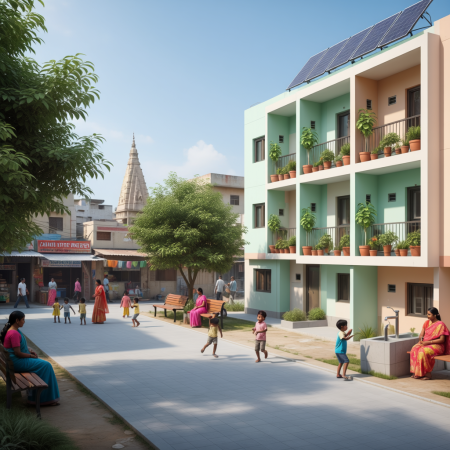
Central to this mission is the active contribution to housing projects by governments, private developers, civil society, and communities themselves. Pursuing the Target of Slum Free Cities is not merely about bricks and mortar—it’s about transforming lives, restoring rights, and building resilient urban futures.
Understanding the Slum Challenge in Urban India
Slums emerge from a complex interplay of rural-urban migration, inadequate affordable housing supply, weak land tenure systems, and exclusionary urban planning. They are not symbols of failure but of resilience—communities that have self-organized in the absence of formal support. Yet, living in slums often means lacking access to clean water, sanitation, electricity, and secure tenure. Children face barriers to education, and families live under constant threat of eviction. Pursuing the Target of Slum Free Cities begins with recognizing slum dwellers not as problems to be removed, but as citizens with legitimate claims to the city.
From Clearance to In-Situ Upgrading: A Paradigm Shift
Historically, India’s approach to slums oscillated between neglect and demolition. Large-scale clearance drives in the 1970s and 1980s displaced thousands without adequate rehabilitation, deepening poverty and social fragmentation. Over time, policy evolved. The National Urban Housing and Habitat Policy (2007) marked a turning point by advocating “in-situ” slum redevelopment—upgrading settlements where they stand, rather than relocating residents to distant peripheries. This approach preserves social networks, livelihoods, and urban integration.
Pursuing the Target of Slum Free Cities now hinges on this humane, rights-based philosophy, where contribution to housing projects includes community participation, tenure security, and basic service delivery.
The Role of Government Schemes and Policy Frameworks
Several flagship initiatives reflect India’s commitment to Pursuing the Target of Slum Free Cities. The Jawaharlal Nehru National Urban Renewal Mission (JNNURM), launched in 2005, introduced the Basic Services to the Urban Poor (BSUP) and Integrated Housing and Slum Development Programme (IHSDP). These schemes funded infrastructure and housing in slums across 65 cities. Building on this, the Pradhan Mantri Awas Yojana – Urban (PMAY-U), launched in 2015, set an ambitious goal: “Housing for All” by 2022 (later extended). Under its “In-Situ Slum Redevelopment” (ISSR) vertical, PMAY-U incentivizes states and cities to redevelop slums with private sector participation, offering central assistance of ₹1 lakh per house.
This model relies heavily on contribution to housing projects from multiple stakeholders—public funds, private investment, and beneficiary co-payments. Pursuing the Target of Slum Free Cities thus becomes a shared responsibility, not a state monopoly.
Public-Private Partnerships: Catalyzing Investment
One of the most innovative aspects of PMAY-U’s ISSR component is its use of
Transfer of Development Rights (TDR). Private developers are granted additional floor space in exchange for constructing free housing for slum dwellers on the same plot. This mechanism leverages market forces to cross-subsidize affordable housing. For example, in Mumbai and Delhi, large-scale slum redevelopment projects like Dharavi and Kathputli Colony have attempted this model—though not without controversy over delays, design flaws, and community consultation gaps.
Nevertheless, when executed transparently and inclusively, such partnerships represent a powerful form of contribution to housing projects. Pursuing the Target of Slum Free Cities requires scaling these models while addressing legitimate concerns about equity, quality, and accountability.
Community Participation: The Heart of Sustainable Redevelopment
Top-down housing projects often fail because they ignore the lived realities of slum residents. Successful slum redevelopment demands active community involvement—from planning and design to implementation and maintenance. Organizations like SPARC, Mahila Housing SEWA Trust, and National Slum Dwellers Federation (NSDF) have pioneered community-led enumeration, mapping, and savings collectives that empower residents to negotiate with authorities.
When slum dwellers co-invest time, labor, or small savings into housing projects, they develop ownership and stewardship. This grassroots contribution to housing projects ensures that solutions are contextually appropriate and socially sustainable. Pursuing the Target of Slum Free Cities must therefore prioritize participatory governance over technocratic delivery.
Financing the Vision: Mobilizing Resources
Achieving slum-free cities requires massive financial resources. PMAY-U has allocated over ₹8 lakh crore, but gaps remain—especially in operations, maintenance, and inclusion of the poorest who cannot afford co-payments. Innovative financing is key. Options include:
- Municipal bonds for housing infrastructure
- Land value capture from redevelopment gains
- Blended finance with impact investors
- Micro-mortgages for incremental housing
Every rupee invested in well-designed housing projects yields returns in health, productivity, and tax revenue. Thus, contribution to housing projects must expand beyond government budgets to include institutional finance, CSR funds, and international development partners. Pursuing the Target of Slum Free Cities is as much a fiscal challenge as a social one.
Designing Dignified and Climate-Resilient Housing
Affordable does not mean substandard. Many past slum rehabilitation projects produced tiny, poorly ventilated flats with no balconies, storage, or community spaces—ignoring how the urban poor actually live and work. Modern housing projects must integrate:
- Minimum 30 sq.m. carpet area (as per PMAY-U)
- Cross-ventilation and natural light
- Space for home-based enterprises
- Green spaces and waste management
- Climate-resilient materials and flood-proofing
Architects like Balkrishna Doshi and NGOs like Urban Design Collective have shown that low-cost can be high-quality. Pursuing the Target of Slum Free Cities means redefining “affordable housing” as dignified, functional, and future-ready. Every act of contribution to housing projects should uphold these standards.
Tenure Security: The Foundation of Urban Citizenship
A house without legal recognition is a house under threat. Many slum dwellers live on public or encroached land, making them ineligible for formal housing schemes. Pursuing the Target of Slum Free Cities requires resolving land ownership issues through:
- Regularization of eligible slums
- Issuance of occupancy certificates
- Community land trusts
- Leasehold arrangements with long-term security
Tenure security unlocks access to credit, utilities, and civic services. It transforms residents from “illegal occupants” into recognized citizens. Without it, even the best-built housing project remains precarious. Hence, legal reform is a critical form of
contribution to housing projects.
Inclusion of the Poorest and Most Vulnerable
Not all slum dwellers are equally positioned to benefit from housing schemes. The homeless, pavement dwellers, single women, disabled persons, and migrant laborers often fall through the cracks. Pursuing the Target of Slum Free Cities must adopt a “leave no one behind” approach, with:
- Special quotas for vulnerable groups
- Simplified documentation requirements
- Rental housing options for the ultra-poor
- Support services like childcare and skills training
True slum-free cities are not just physically upgraded—they are socially inclusive. This demands a compassionate and flexible contribution to housing projects that reaches the margins.
Lessons from Global Cities
Cities like Medellín (Colombia), Bangkok (Thailand), and Cape Town (South Africa) offer valuable lessons. Medellín used cable cars and libraries to integrate hillside slums into the urban fabric. Bangkok’s Baan Mankong program supports community-managed upgrading with city loans. These models emphasize integration over isolation, participation over paternalism. Pursuing the Target of Slum Free Cities in India can learn from such innovations—adapting them to local governance and cultural contexts while scaling contribution to housing projects through decentralized, community-driven action.
Monitoring, Transparency, and Accountability
Without robust monitoring, housing projects risk delays, corruption, and poor quality. Digital platforms like the PMAY-U Beneficiary Portal and Awaas Soft enable real-time tracking of construction progress, fund flow, and beneficiary lists. Social audits, third-party evaluations, and grievance redressal mechanisms further strengthen accountability. Pursuing the Target of Slum Free Cities requires open data and citizen oversight to ensure that every contribution to housing projects delivers real impact.
The Role of Urban Planning and Land Use Policy
Slum formation is often a symptom of exclusionary zoning and land speculation. To prevent new slums, cities must:
- Release public land for affordable housing
- Enforce inclusionary zoning (e.g., 15–25% EWS housing in private projects)
- Streamline approval processes
- Promote mixed-income neighborhoods
Proactive urban planning is a preventive form of contribution to housing projects. Pursuing the Target of Slum Free Cities must therefore go beyond retrofitting existing slums to shaping equitable urban growth from the outset.
Gender-Sensitive Housing Design and Ownership
Women bear the brunt of inadequate housing—fetching water, managing sanitation, and facing safety risks. Yet, they are often excluded from property titles. Pursuing the Target of Slum Free Cities must ensure:
- Joint or female-only titling
- Safe, well-lit common areas
- Proximity to schools and healthcare
- Secure tenure for widows and single mothers
When women own homes, families thrive. This gender lens is a vital dimension of contribution to housing projects.
Technology as an Enabler
From drone mapping of slum boundaries to GIS-based project planning and mobile apps for grievance reporting, technology can enhance efficiency and inclusion. Aadhaar-linked beneficiary verification reduces duplication, while blockchain pilots explore tamper-proof land records. Pursuing the Target of Slum Free Cities in the digital age means harnessing tech not for surveillance, but for service delivery and empowerment—another modern form of contribution to housing projects.
Challenges and the Road Ahead
Despite progress, challenges persist: slow land acquisition, developer reluctance, community resistance due to poor past experiences, and insufficient focus on rental housing. Moreover, the definition of “slum-free” must evolve—it’s not just about eliminating slum structures, but ensuring all urban residents enjoy decent, secure, and affordable housing.
Pursuing the Target of Slum Free Cities will require sustained political will, inter-departmental coordination, and a shift from project-based thinking to systemic urban reform. Every stakeholder—central and state governments, municipalities, private sector, NGOs, and citizens—must deepen their contribution to housing projects.
Conclusion: A Shared Urban Destiny
Pursuing the Target of Slum Free Cities is ultimately about justice. It’s about affirming that every person, regardless of income, has a right to the city. Housing is not a commodity alone—it is a foundation for health, education, dignity, and democracy. Through inclusive policies, innovative financing, participatory design, and unwavering commitment, India can turn this vision into reality.
The journey will be complex, but not impossible. With each well-built home, each secured tenure, and each empowered community, we move closer. And so, Pursuing the Target of Slum Free Cities remains one of the most profound expressions of urban solidarity in our time.
Indeed, Pursuing the Target of Slum Free Cities is not a finish line but a continuous process of inclusion, improvement, and integration. It demands that we see slum dwellers not as liabilities, but as partners in urban transformation.
Therefore, Pursuing the Target of Slum Free Cities must be anchored in empathy, equity, and evidence—guided by the voices of those who know slum life best.
Let us remember: Pursuing the Target of Slum Free Cities is not just about removing slums—it’s about building cities where no one is left behind.
In this spirit, every act of contribution to housing projects becomes a step toward a more just and humane urban India.
And as we scale these efforts, Pursuing the Target of Slum Free Cities will stand as a testament to what’s possible when policy meets compassion.
Ultimately, Pursuing the Target of Slum Free Cities is a promise—to current and future generations—that urban growth will not come at the cost of human dignity.
Through collective action and shared responsibility, Pursuing the Target of Slum Free Cities can become India’s defining urban legacy.
Hence, Pursuing the Target of Slum Free Cities must remain at the heart of national development discourse—not as a slogan, but as a lived reality.
And with every new housing project that rises with community consent and quality standards, we reaffirm our commitment to Pursuing the Target of Slum Free Cities.
Finally, Pursuing the Target of Slum Free Cities is not just a government mission—it is a societal covenant for inclusive urban futures.
Also read: Slum Upgrading Up Close: Experiences of Six Cities
