PROPERTY RIGHTS TO SLUM DWELLERS ACT OF INDIA 2011
Introduction
Property Rights to Slum Dwellers. That phrase alone carries the weight of decades of neglect, struggle, and hope. In 2011, India took a bold legislative step toward recognizing the humanity, dignity, and legal personhood of millions living in informal settlements — slums — by proposing the Property Rights to Slum Dwellers Act. Though it never became law in its original form, the spirit and intent of this proposed legislation continue to influence policy, court rulings, and grassroots movements across the country. This summary explores the origins, objectives, challenges, and enduring legacy of the Property Rights to Slum Dwellers Act of India 2011 — and why, even today, the phrase “Property Rights to Slum Dwellers” remains a rallying cry for urban justice.
I. The Genesis of the Property Rights to Slum Dwellers Act
India’s cities have long been defined by stark contrasts: gleaming skyscrapers next to crumbling shanties; luxury cars navigating narrow lanes lined with open drains and tin-roofed homes. Slums are not anomalies — they are structural features of India’s urbanization. According to the 2011 Census, over 65 million Indians lived in slums. These are not transient populations. Many slum dwellers have lived in the same location for decades, contributing labor, taxes (indirectly), and cultural vibrancy to their cities — yet without legal recognition or security.
The Property Rights to Slum Dwellers Act emerged from a growing realization among policymakers, civil society, and even some within the judiciary that treating slum dwellers as “encroachers” or “illegal occupants” was not only unjust but also counterproductive. Evictions without rehabilitation, demolitions without alternatives, and criminalization without redress had only deepened urban poverty and social fragmentation.
The Act was conceived as a corrective — a legal instrument to grant property rights to slum dwellers who had resided in their settlements prior to a cut-off date (often proposed as January 1, 2010). Property Rights to Slum Dwellers was not about handing out free land or encouraging squatting. It was about regularization — acknowledging that these communities were not problems to be removed, but citizens to be integrated.
II. Core Provisions: What the Act Promised
The draft Property Rights to Slum Dwellers Act contained several groundbreaking provisions:
- Legal Recognition: Slum settlements identified and verified by municipal authorities would be granted in-situ land titles or long-term leases to eligible residents.
- Cut-off Date: Only those who could prove continuous residence before January 1, 2010, would be eligible — preventing opportunistic land grabs while protecting legacy residents.
- Women-Centric Ownership: Titles would be issued jointly in the names of husband and wife, or solely in the name of single women — a radical step toward gender equity in property ownership.
- Infrastructure Guarantee: Once granted property rights, slum areas would be upgraded with basic services — water, sanitation, electricity, roads — by municipal bodies.
- No Eviction Without Rehabilitation: The Act prohibited forced evictions unless alternative accommodation was provided — and even then, only after due process.
- Grievance Redressal: Special tribunals would be established to handle disputes and appeals related to eligibility, boundaries, and ownership.
At its heart, the Property Rights to Slum Dwellers Act was an admission that urban planning in India had failed the poor. It sought to turn slum dwellers from “illegals” into stakeholders — with legal titles, civic responsibilities, and political voice.
III. Why Property Rights to Slum Dwellers Matters
Property Rights to Slum Dwellers is not merely a legal technicality. It is the difference between living in fear and living with dignity.
Without property rights, slum dwellers face constant insecurity. A notice from the municipality, a developer’s interest in the land, or even a change in political leadership can trigger mass evictions. Children are pulled out of schools; small businesses shuttered overnight; community networks shattered.
With property rights, however, everything changes. Families invest in their homes — adding a second floor, installing a toilet, painting the walls. They open bank accounts using their address as proof. They vote in local elections because they know they’ll still be there next year. They pay property taxes — not because they’re forced to, but because they feel they belong.
Studies from around the world — from Brazil’s favela titling programs to Thailand’s Baan Mankong initiative — show that granting Property Rights to Slum Dwellers reduces poverty, improves health outcomes, and increases civic participation. In India, pilot projects in cities like Indore and Ahmedabad have demonstrated similar results.
Property Rights to Slum Dwellers also stimulates the formal economy. Secure residents become consumers, taxpayers, and entrepreneurs. They buy cement, hire masons, enroll children in private tuition, and take out microloans — all activities that feed into the broader economy.
Moreover, Property Rights to Slum Dwellers reduces the burden on the state. Instead of spending crores on demolitions, litigation, and temporary shelters, municipalities can channel resources into upgrading infrastructure — benefiting not just slum dwellers but the entire city.
IV. Political and Legal Hurdles
Despite its merits, the Property Rights to Slum Dwellers Act of 2011 never passed into law. Why?
First, political will was fragmented. While some states — like Odisha, which later implemented its own slum land titling scheme — were enthusiastic, others feared backlash from middle-class voters who viewed slums as eyesores or threats to property values. In cities like Mumbai and Delhi, real estate lobbies exerted enormous pressure against regularization, seeing slum lands as prime real estate waiting to be “liberated.”
Second,
bureaucratic inertia played a role. Municipal officials, trained to “remove encroachments,” struggled to shift to a mindset of “recognize and upgrade.” Land records were outdated or non-existent. Surveying millions of slum plots seemed daunting.
Third, legal ambiguities persisted. Who “owns” the land under slums? Often, it’s central government agencies (railways, defense), state development authorities, or religious trusts. Untangling these claims required inter-departmental coordination — something Indian governance is notoriously bad at.
Fourth, there were genuine concerns about fraud and misuse. Without robust verification, the Act could be exploited by non-residents or politically connected individuals. Designing foolproof eligibility mechanisms was — and remains — a challenge.
Still, the failure to pass the Act did not kill the idea. Property Rights to Slum Dwellers continued to gain traction through court judgments, state initiatives, and civil society campaigns.
V. Judicial Endorsement and Grassroots Pressure
Even without a national law, Indian courts have repeatedly affirmed the principle of Property Rights to Slum Dwellers. In landmark cases — such as Olga Tellis v. Bombay Municipal Corporation (1985) and more recently, Sudama Singh v. Government of Delhi (2010) — the Supreme Court and High Courts have held that the right to shelter is part of the right to life under Article 21 of the Constitution.
Judges have ruled that slum dwellers cannot be evicted without rehabilitation, that in-situ upgrading should be preferred over relocation, and that cut-off dates must be applied fairly. These rulings, while not legislation, have forced state governments to adopt more humane policies — effectively implementing the spirit of the Property Rights to Slum Dwellers Act through judicial activism.
At the grassroots, NGOs like SPARC, Mahila Milan, and the National Slum Dwellers Federation have mobilized communities to demand Property Rights to Slum Dwellers. Through participatory mapping, community savings groups, and negotiations with municipal officials, they’ve shown that slum dwellers are not passive victims but capable agents of their own development.
In cities like Pune and Bhubaneswar, federations of slum women have successfully negotiated land leases and infrastructure upgrades — proving that when given a seat at the table, slum communities can co-create solutions.
VI. State-Level Experiments: Odisha Leads the Way
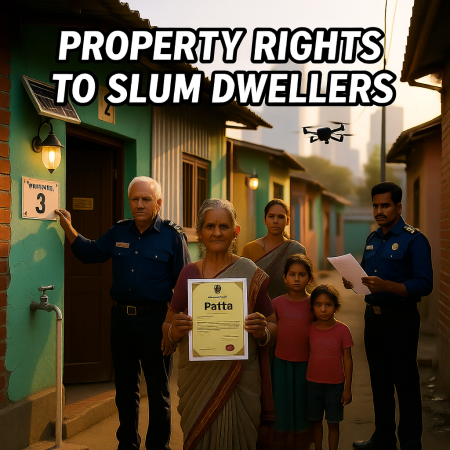
While the national Act stalled, Odisha took the boldest step. In 2017, it launched the “Jaga Mission” — a statewide initiative to grant Property Rights to Slum Dwellers through “patta” (land title) distribution. Using drone technology for mapping and community verification for eligibility, the state has issued over 200,000 land titles as of 2023.
The results? Improved sanitation, increased bank lending, reduced fear of eviction, and greater civic engagement. Women, holding titles in their names, report higher self-esteem and decision-making power within households. Property Rights to Slum Dwellers in Odisha hasn’t solved all problems — corruption, incomplete infrastructure, and boundary disputes remain — but it has shown that large-scale regularization is possible.
Other states are taking note. Tamil Nadu, Madhya Pradesh, and Jharkhand have launched pilot programs. Even Maharashtra — long resistant due to Mumbai’s high land values — is experimenting with transit-oriented development that includes slum rehabilitation with ownership rights.
VII. The Economic Argument for Property Rights to Slum Dwellers
Critics often argue that granting Property Rights to Slum Dwellers is a “handout” or a drain on public resources. Nothing could be further from the truth.
Economists like Hernando de Soto have long argued that the lack of formal property rights traps the poor in “dead capital.” Slum dwellers may live on valuable land, but without titles, they cannot leverage it for credit, investment, or inheritance. Granting Property Rights to Slum Dwellers unlocks this capital — turning informal assets into engines of economic mobility.
In India, slum economies are vibrant. From street food vendors to home-based garment workers, slum dwellers contribute massively to the urban GDP. Secure tenure allows them to scale up — rent additional space, hire employees, obtain licenses. Banks are more willing to lend when borrowers have collateral. Insurance companies offer policies when addresses are verifiable.
Moreover, Property Rights to Slum Dwellers reduces public expenditure on law enforcement, litigation, and emergency shelters. It shifts the paradigm from “managing poverty” to “enabling prosperity.”
A 2019 World Bank study estimated that granting Property Rights to Slum Dwellers in Indian cities could increase household incomes by 25–40% over a decade — a massive boost to domestic demand and tax revenues.
VIII. The Social and Psychological Impact
Beyond economics, Property Rights to Slum Dwellers transforms identity.
For generations, slum dwellers have been stigmatized — called “jhuggi-wallahs,” “encroachers,” “vote banks.” Legal titles confer legitimacy. They say: You are not illegal. You belong here. Your labor built this city. Your children deserve schools, clinics, and parks — not because you’re begging for charity, but because you’re a citizen with rights.
Children in titled slums show higher school attendance and lower dropout rates. Women report less domestic violence — knowing they have a legal stake in the home gives them bargaining power. Elderly residents feel secure, knowing their grandchildren won’t be thrown out after they’re gone.
Property Rights to Slum Dwellers also fosters civic responsibility. Titled residents are more likely to form resident welfare associations, pay municipal taxes, and participate in urban planning meetings. They stop seeing the government as an adversary and start seeing it as a partner.
IX. Challenges That Remain
Even where implemented, Property Rights to Slum Dwellers faces obstacles.
— Exclusion Errors: Cut-off dates can be arbitrary. What about families who moved in just after 2010? Or those who lack documentation due to illiteracy or displacement?
— Infrastructure Lag: Titles without toilets, water, or roads are meaningless. Many cities grant property rights but fail to deliver services — breeding disillusionment.
— Market Pressures: Once slums are titled, they become attractive to developers. Without strict regulations, residents can be coerced into selling at low prices — defeating the purpose.
— Gender Gaps: While laws mandate joint titling, patriarchal norms often result in men controlling the documents. Ensuring women’s actual control over property remains a struggle.
— Political Manipulation: In some cases, titles are distributed selectively — as patronage before elections — rather than as universal rights.
These challenges don’t invalidate the concept. They call for better design, stronger monitoring, and continuous community engagement.
X. The Way Forward: Scaling Up Property Rights to Slum Dwellers
India’s urban population is projected to reach 600 million by 2036. Slums will not disappear — they will grow unless we change our approach.
The central government must revive and pass a national Property Rights to Slum Dwellers Act — not as a one-time scheme, but as a permanent framework integrated with the Smart Cities Mission, AMRUT, and Housing for All.
Technology can help. GIS mapping, blockchain-based land records, and mobile verification apps can reduce fraud and speed up titling.
Civil society must keep pushing. Slum federations, human rights lawyers, and urban researchers must hold governments accountable.
Most importantly, slum dwellers themselves must lead. No policy will succeed unless it is co-designed with the people it affects. Participatory slum upgrading — where residents map their own settlements, prioritize infrastructure needs, and monitor implementation — is the gold standard.
Property Rights to Slum Dwellers is not charity. It’s justice. It’s economics. It’s urban planning 101.
XI. Conclusion: Property Rights to Slum Dwellers — An Idea Whose Time Has Come
The Property Rights to Slum Dwellers Act of 2011 may not have become law, but its soul lives on — in courtrooms, in state capitals, in the quiet pride of a woman holding her first land title, in the laughter of children who no longer fear eviction.
Property Rights to Slum Dwellers is about more than land. It’s about belonging. It’s about turning invisible citizens into visible stakeholders. It’s about building cities that work for everyone — not just the rich.
India cannot claim to be a global power while treating a tenth of its urban population as disposable. Property Rights to Slum Dwellers is the first step toward inclusive, humane, and sustainable urbanization.
Let’s stop seeing slums as problems. Let’s see them as neighborhoods waiting to be recognized. Let’s stop evicting. Let’s start titling.
Also read: Improving the lives of slum dwellers: A home in the city
