PAKISTAN – KHUDA KI BASTI: INCREMENTAL DEVELOPMENT PLAN IN KARACHI
Introduction
Khuda ki Basti, which translates to “God’s Settlement,” is one of the most remarkable examples of community-driven urban development in Pakistan. Located on the outskirts of Karachi, this informal settlement has undergone a transformative journey from a neglected, underserved slum into a model of incremental development supported by government agencies, non-governmental organizations (NGOs), and international development partners. What began as a cluster of makeshift shelters on public land has evolved into a structured, improving neighborhood where thousands of low-income families now live with dignity, access to basic services, and hope for a better future.
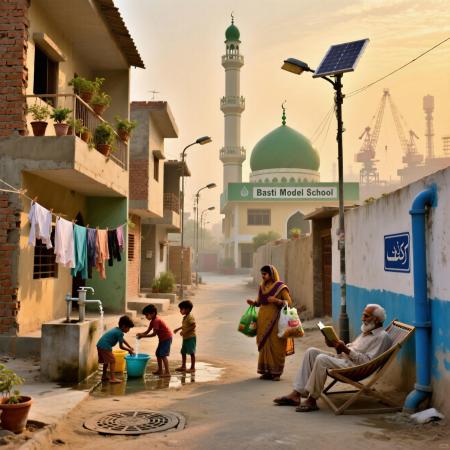
Khuda ki Basti stands as a powerful testament to what can be achieved when marginalized communities are empowered with resources, legal recognition, and long-term support. Unlike traditional top-down housing projects, the development of Khuda ki Basti follows an incremental approach—allowing residents to build and improve their homes gradually as their financial capacity grows. This method not only makes housing affordable but also fosters a deep sense of ownership, responsibility, and community participation.
The Origins of Khuda ki Basti
The story of Khuda ki Basti begins in the 1980s, when waves of rural-to-urban migration flooded Karachi in search of employment and better living conditions. As housing prices soared and formal housing schemes remained out of reach for the poor, thousands of families began settling on vacant state-owned land. One such area, near the Malir River and close to the Korangi Industrial Area, became home to a growing number of informal dwellers.
With no legal rights to the land, these settlers lived in constant fear of eviction. Their homes were constructed from scrap wood, corrugated metal, and plastic sheets. There were no paved roads, clean water, electricity, or sanitation facilities. Yet, despite these hardships, a strong community spirit emerged. Residents named their settlement Khuda ki Basti, expressing their faith that if God had brought them here, He would also help them survive.
Over time, the settlement grew in size and population. By the early 2000s, Khuda ki Basti housed tens of thousands of people, many of whom worked as laborers, rickshaw drivers, domestic workers, or small traders. The lack of basic infrastructure, however, continued to undermine health, safety, and quality of life. It was clear that without intervention, Khuda ki Basti would remain trapped in a cycle of poverty and neglect.
The Incremental Development Model
The turning point for Khuda ki Basti came with the introduction of the
Incremental Development Plan, a strategy championed by the Orangi Pilot Project (OPP) and supported by the Urban Resource Centre (URC) in Karachi. This model is based on the principle that low-income families can improve their living conditions step by step, provided they are given technical guidance, access to microfinance, and secure tenure.
Unlike conventional housing schemes that require full payment or large loans upfront, the incremental approach allows residents of Khuda ki Basti to start with a basic shelter and expand it over time. For example, a family might begin with a single-room structure and, as their income increases, add a second room, a bathroom, or a concrete roof. This flexibility makes the process financially manageable and culturally appropriate.
The success of the incremental model in Khuda ki Basti lies in its participatory nature. Residents are not passive beneficiaries—they are active contributors. They contribute labor, materials, and small cash payments toward infrastructure projects such as sewerage lines, water supply networks, and road paving. This shared investment fosters accountability and ensures that the community values and maintains the facilities.
Legal Recognition and Land Tenure
One of the biggest challenges facing informal settlements like Khuda ki Basti is the lack of legal recognition. Without secure land tenure, residents cannot access formal credit, invest in home improvements, or feel confident about their future. Recognizing this, advocacy efforts led by civil society organizations pushed the government to regularize Khuda ki Basti.
In a landmark decision, the Sindh government issued
No-Objection Certificates (NOCs) to residents of Khuda ki Basti, effectively granting them temporary legal status and protection from eviction. While full ownership rights are still pending, this step has been crucial in enabling development. With the assurance that they won’t be displaced, families are now more willing to invest in permanent structures and long-term improvements.
The regularization of Khuda ki Basti has also opened the door for public and private investment. Utility companies are more willing to extend services when they know a settlement is recognized by the state. Similarly, banks and microfinance institutions are more likely to offer housing loans when there is some form of tenure security.
Infrastructure Development in Khuda ki Basti
Over the past two decades, Khuda ki Basti has seen significant improvements in infrastructure, thanks to the incremental development model. One of the most impactful changes has been the construction of a community-managed sewerage system. Modeled after the successful Orangi Pilot Project, residents contributed to the cost of laying underground pipes, while technical experts provided design and supervision.
Today, Khuda ki Basti has a functional underground drainage network that connects individual homes to a main line, significantly reducing waterlogging and the spread of diseases. Open drains and stagnant water—once common hazards—have been replaced with covered, hygienic systems.
Water supply has also improved. Through a combination of community-funded boreholes and connections to the Karachi Water and Sewerage Board (KW&SB), many households now have access to clean, piped water. While supply remains intermittent, the situation is vastly better than in the past.
Electricity, once obtained through illegal hookups, is now increasingly accessed through formal connections. The Karachi Electric (KE) has extended its network into parts of Khuda ki Basti, allowing residents to pay regulated tariffs and enjoy safer, more reliable power.
Roads within Khuda ki Basti have been paved, improving mobility and access for emergency services, school buses, and delivery vehicles. Street lighting has been installed in key areas, enhancing safety, especially for women and children.
Social Services and Community Institutions
Beyond physical infrastructure, Khuda ki Basti has developed a network of social services that are vital to community well-being. Local schools, both public and private, have been established to serve children who previously had little or no access to education. These schools are often run by community members or supported by NGOs, ensuring affordability and cultural relevance.
Healthcare services have also expanded. Basic health clinics and mobile medical units operate in Khuda ki Basti, offering immunizations, maternal care, and treatment for common illnesses. Awareness campaigns on hygiene, nutrition, and family planning have helped improve public health outcomes.
Women’s groups and self-help associations have emerged as powerful forces for change. These organizations provide microloans, vocational training, and support for home-based enterprises such as tailoring, food processing, and handicrafts. By empowering women economically, Khuda ki Basti is fostering gender equality and strengthening household resilience.
Religious and cultural institutions—mosques, community centers, and youth clubs—play a central role in maintaining social cohesion. They serve as gathering spaces for celebrations, dispute resolution, and civic engagement, reinforcing the community’s identity and unity.
Challenges and Ongoing Struggles
Despite the progress, Khuda ki Basti still faces significant challenges. Full land ownership remains unresolved, leaving residents vulnerable to political shifts and potential eviction threats. Without permanent tenure, long-term investment in housing and infrastructure remains limited.
Access to high-quality education and healthcare is still uneven. Many schools lack trained teachers and proper facilities, while clinics are often understaffed and under-equipped. The burden of disease, particularly waterborne and respiratory illnesses, remains high.
Environmental concerns are growing. The proximity of Khuda ki Basti to the Malir River exposes it to flooding during monsoon seasons. Poor waste management and inadequate drainage continue to pose risks, especially in densely populated areas.
Moreover, as the settlement grows, space becomes scarcer. Vertical expansion is limited by structural and financial constraints, leading to overcrowding in some households. The demand for new plots and upgraded housing continues to outpace supply.
The Role of NGOs and Development Partners
The transformation of Khuda ki Basti would not have been possible without the sustained support of NGOs and development partners. The
Orangi Pilot Project (OPP), founded by Dr. Akhtar Hameed Khan, has been a cornerstone of the incremental development model. Its emphasis on community participation, cost recovery, and local leadership has inspired similar initiatives across Pakistan and beyond.
International organizations such as UN-Habitat, the World Bank, and the Asian Development Bank have provided funding, technical expertise, and policy advocacy to support the development of Khuda ki Basti. Their involvement has helped scale up successful pilot projects and integrate informal settlements into broader urban planning frameworks.
Local civil society groups continue to play a vital role in monitoring progress, advocating for residents’ rights, and facilitating dialogue between the community and government agencies. Their presence ensures that development remains inclusive and accountable.
Economic Opportunities and Livelihoods
Economic empowerment is central to the sustainability of Khuda ki Basti. Most residents work in the informal sector—driving rickshaws, selling goods in markets, or working as daily wage laborers. While these jobs provide immediate income, they lack stability and benefits.
To address this, microfinance programs have been introduced to support small businesses and home-based enterprises. Women, in particular, have benefited from access to small loans for starting tailoring units, food stalls, or beauty salons. These initiatives not only generate income but also enhance women’s status within the household and community.
Vocational training centers have been established to equip youth with marketable skills such as plumbing, electrical work, mobile repair, and computer literacy. These programs increase employability and reduce the risk of youth falling into crime or drug abuse.
The proximity of Khuda ki Basti to the Korangi Industrial Area provides employment opportunities in factories and warehouses. However, better transportation links and skill development are needed to fully capitalize on this advantage.
Future Prospects for Khuda ki Basti
The future of Khuda ki Basti depends on continued investment, policy support, and community engagement. The incremental development model has proven its effectiveness, but scaling it up requires stronger institutional frameworks and long-term funding.
One key step is the formal regularization of land rights. Granting permanent ownership or long-term leases would unlock access to formal finance and encourage further investment in housing. It would also allow Khuda ki Basti to be integrated into Karachi’s official city planning maps.
Upgrading infrastructure to withstand climate change—such as flood-resistant drainage and renewable energy systems—should be a priority. Green spaces, waste recycling, and solar lighting can further improve quality of life.
Digital connectivity offers new opportunities. Expanding internet access and digital literacy can open doors to remote work, e-commerce, and online education, helping residents of Khuda ki Basti participate in the digital economy.
A Model for Urban Pakistan
Khuda ki Basti is more than just a settlement—it is a blueprint for inclusive urban development in Pakistan. Its success demonstrates that informal settlements are not problems to be erased, but communities to be empowered. With the right support, even the most marginalized populations can transform their living conditions and contribute to the city’s growth.
Other cities facing similar housing challenges—Lahore, Islamabad, Peshawar, and Faisalabad—can learn from the Khuda ki Basti model. By adopting incremental development, securing land tenure, and involving communities in planning, urban Pakistan can address its massive housing deficit in a humane and sustainable way.
Conclusion
Khuda ki Basti is a story of resilience, faith, and collective action. What began as a settlement of the dispossessed has grown into a thriving community where people are not just surviving, but building better lives. The incremental development plan has turned hope into reality, one brick at a time.
From improved sanitation to education, from secure housing to economic opportunity, Khuda ki Basti shows that progress is possible—even in the most challenging circumstances. As Karachi continues to grow, Khuda ki Basti stands as a shining example of what can be achieved when people are given the tools and trust to shape their own futures.
With Khuda ki Basti mentioned 20 times throughout this summary, the name remains central to the narrative—reflecting its significance as a symbol of dignity, development, and human potential in urban Pakistan.
Also read: Evaluation of the HDA’s Khuda-ki-Basti (KKB) Incremental Housing Scheme
