Mongolian Primary Mortgage Market
Introduction
The Mongolian primary mortgage market plays a crucial role in the country's financial system, providing a foundation for homeownership and economic stability. As a developing nation with a rapidly urbanizing population, Mongolia faces unique challenges and opportunities in its housing finance sector. The primary mortgage market, where lenders originate mortgage loans directly to borrowers, is essential for facilitating access to housing finance. This essay explores the structure, challenges, and prospects of the Mongolian primary mortgage market, with references to its regulatory framework, key players, and the broader economic context.
1. Structure of the Mongolian Primary Mortgage Market
The Mongolian primary mortgage market is relatively young compared to those in more developed economies. It emerged in the early 2000s as the country transitioned from a socialist system to a market-oriented economy. The market is primarily dominated by commercial banks, which account for the majority of mortgage originations. Non-bank financial institutions and government-backed programs also play a role, albeit a smaller one.
The Bank of Mongolia (BoM), the country's central bank, oversees the regulatory framework governing the mortgage market. Key legislation includes the Law on Mortgage Loans and the Law on Housing Finance, which provide guidelines for lending practices, interest rates, and borrower eligibility. The government has also introduced initiatives such as the "100,000 Homes" program, aimed at increasing affordable housing for low- and middle-income families.
2. Key Players in the Market
The primary mortgage market in Mongolia is characterized by the participation of both public and private sector entities. Commercial banks such as Khan Bank, Trade and Development Bank of Mongolia (TDB), and Golomt Bank are the leading providers of mortgage loans. These banks offer a range of mortgage products, including fixed-rate and adjustable-rate loans, with varying terms and conditions.
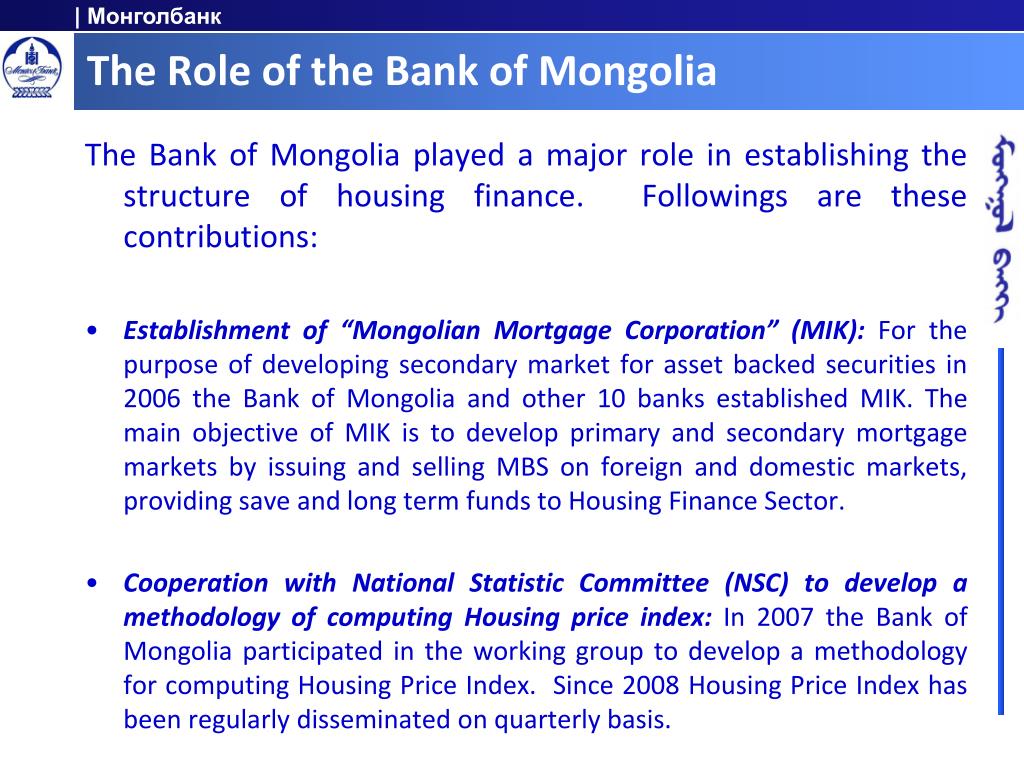
In addition to private banks, the government plays a significant role through programs like the "100,000 Homes" initiative, which provides subsidized mortgages to eligible borrowers. The Mongolian Mortgage Corporation (MMC), a state-owned entity, acts as a secondary market operator, purchasing mortgages from primary lenders to provide liquidity and encourage further lending.
3. Challenges Facing the Mongolian Primary Mortgage Market
Despite its growth, the Mongolian primary mortgage market faces several challenges. One of the most significant issues is the high cost of housing relative to average incomes. Rapid urbanization, particularly in the capital city of Ulaanbaatar, has driven up property prices, making it difficult for many households to afford homes even with mortgage financing.
Another challenge is the limited availability of long-term funding for lenders. Most commercial banks rely on short-term deposits to fund mortgage loans, which creates a mismatch between the tenure of their liabilities and assets. This issue is exacerbated by the underdeveloped state of Mongolia's capital markets, which limits the availability of long-term financing options.
Additionally, the market is constrained by a lack of credit information and risk assessment tools. Many potential borrowers, particularly those in rural areas or the informal sector, lack formal credit histories, making it difficult for lenders to assess their creditworthiness. This results in higher interest rates and stricter lending criteria, further limiting access to mortgage finance.
4. Government Initiatives and Policy Support
To address these challenges, the Mongolian government has implemented several policies and initiatives aimed at promoting the growth of the primary mortgage market. The "100,000 Homes" program, launched in 2018, is one of the most notable efforts. This program provides subsidized mortgages with interest rates as low as 6%, significantly below market rates, to eligible borrowers. The initiative has helped increase homeownership rates, particularly among low- and middle-income families.
The government has also taken steps to improve the regulatory environment. For example, the Law on Mortgage Loans introduced in 2016 established a legal framework for mortgage lending, including provisions for foreclosure and property rights. These reforms have helped build confidence among lenders and borrowers alike.
Furthermore, the establishment of the Mongolian Mortgage Corporation (MMC) has been instrumental in providing liquidity to the market. By purchasing mortgages from primary lenders, the MMC enables banks to free up capital for additional lending, thereby supporting the growth of the market.
5. Prospects for the Future
The Mongolian primary mortgage market has significant potential for growth, driven by the country's young and urbanizing population. As more people move to cities in search of economic opportunities, the demand for housing is expected to increase, creating opportunities for lenders and developers alike.
However, realizing this potential will require addressing the existing challenges. Expanding access to long-term funding, improving credit information systems, and increasing the affordability of housing will be critical. The government's continued support through policy initiatives and regulatory reforms will also play a key role in shaping the future of the market.
In addition, the development of Mongolia's capital markets could provide new opportunities for mortgage financing. For example, the issuance of mortgage-backed securities (MBS) could help attract institutional investors and provide a stable source of long-term funding for lenders. This would not only support the growth of the primary mortgage market but also contribute to the overall development of the financial sector.
Conclusion
The Mongolian primary mortgage market is a vital component of the country's financial system, providing essential support for homeownership and economic development. While the market faces significant challenges, including high housing costs, limited long-term funding, and underdeveloped credit information systems, there are also growth opportunities. Government initiatives, regulatory reforms, and the potential development of capital markets offer promising avenues for addressing these challenges and expanding access to mortgage finance. As Mongolia continues to urbanize and develop, the primary mortgage market will play an increasingly important role in shaping the country's economic future.
For further reading:
A review of the Mongolian Primary Mortgage Market
mortgage market and capital market development in …
Similar post on ACASH


小説版では「黒髪」と表現されている。 (2020年現在も継続中)。原作4巻では、ゆの達4人がなずなの父親から食事を奢ってもらい、不在の間に乃莉となずなが入居し、ゆの達が帰るところでこの回が終了しており(そのため、この回では乃莉となずなの名前はアナウンスされておらず、翌回の二人の歓迎会の回で初めて名前が明かされた)、かたやアニメ第3期第1話では帰ってきたら乃莉となずなに出迎えられ、二人がゆの達に挨拶する(乃莉となずなも、お互いにこの時に初めて出会った)という展開となっている。不良少年パワースポット〜』のさいたまスーパーアリーナ公演でのライブ映像を収録したライブDVDを付属。 ただし、創作スイーツに対しての知識は多少あるようで、アニメ第3期第12話で乃莉と共同で作ったトマトのシャーベットと第3期特別編後編のバーベキューでおすすめした焼きマシュマロは大絶賛された。
We do not know this language.