
ISSUES & CHALLENGES IN NAYA PAKISTAN HOUSING SCHEME
Introduction
Issues and challenges in NAYA PAKISTAN — these six words carry the weight of a national ambition, a political promise, and the lived reality of millions of Pakistanis dreaming of a secure roof over their heads. Issues and challenges in NAYA PAKISTAN aren’t abstract bureaucratic hurdles — they are the daily frustrations of families stuck in waiting lists, construction workers unpaid for months, investors losing faith, and urban planners watching deadlines slip like sand through fingers.
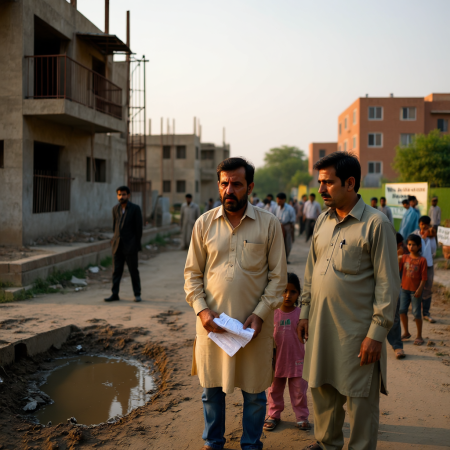
Issues and challenges in NAYA PAKISTAN Housing Scheme (NPHS) were meant to be the cornerstone of Prime Minister Imran Khan’s vision: to build five million homes for low- and middle-income citizens, transform urban landscapes, generate employment, and reduce the yawning housing deficit estimated at 10 million units. But as the years roll by, the gap between vision and execution has widened — revealing structural, financial, administrative, and political fissures. Issues and challenges in NAYA PAKISTAN are not just about bricks and mortar — they are about trust, governance, and the very definition of what “Naya Pakistan” means to its citizens.
Let’s walk through the landscape — not with political rhetoric, but with ground truth.THE PROMISE: A NATION REBUILT FROM THE GROUND UP
Issues and challenges in NAYA PAKISTAN began with a noble, almost revolutionary, premise. Launched in January 2019 under the Pakistan Tehreek-e-Insaf (PTI) government, the Naya Pakistan Housing & Development Authority (NAPHDA) was tasked with executing the largest housing program in Pakistan’s history. The goal? Five million houses — 2.5 million in the first phase — targeting low-cost, middle-income, and even luxury segments, with priority for the economically vulnerable. The scheme promised subsidized financing, public-private partnerships, modern urban planning, green spaces, and digital transparency. It was more than housing — it was nation-building. A chance to formalize the informal, to bring millions into the banking system through mortgage culture, to create jobs for youth, to decongest cities by developing satellite towns, and to break the feudal-urban elite’s monopoly over land and housing. Issues and challenges in NAYA PAKISTAN were supposed to be overcome by political will, technology, and inclusive policy. But reality had other plans.LAND ACQUISITION: THE FIRST STUMBLING BLOCK
Issues and challenges in NAYA PAKISTAN hit their first major roadblock before a single foundation was poured: land. In Pakistan, land is power. It’s political, cultural, and deeply contested. NAPHDA needed thousands of acres — not just anywhere, but near cities, with access to water, roads, and utilities. Provincial governments were supposed to allocate land. But coordination? Almost nonexistent. In Punjab, some plots were identified — but many were disputed, forested, or agriculturally sensitive. In Sindh, resistance from landowners and local elites stalled progress. In Khyber Pakhtunkhwa and Balochistan, security and infrastructure constraints made development nearly impossible. Even where land was “allocated,” ownership records were murky. Pakistan’s land registry system is archaic — riddled with fraud, overlapping claims, and undocumented possession. NAPHDA found itself entangled in court cases, protests, and bureaucratic limbo. Issues and challenges in NAYA PAKISTAN multiplied as deadlines passed with no shovel in the ground. Worse still, accusations flew that prime land was being reserved for “elite plots” or handed to politically connected developers — undermining the scheme’s equity mandate. Issues and challenges in NAYA PAKISTAN began to smell less like reform and more like repackaged patronage.FINANCING: THE BROKEN ENGINE
Issues and challenges in NAYA PAKISTAN became most visible in the financial architecture — or lack thereof. The scheme depended on a three-legged stool: government subsidy, private investment, and bank financing. But each leg wobbled. First, the government’s promised subsidy — interest-free loans, tax breaks, utility discounts — never materialized at scale. The State Bank of Pakistan (SBP) did introduce a Markup Subsidy and Financing Facility for low-cost housing, but disbursement was slow, criteria rigid, and banks reluctant. Why? Because lending to low-income groups is seen as high-risk in a country with weak credit histories and no foreclosure laws. Second, private developers — initially enthusiastic — pulled back. Why invest billions when land titles are uncertain, approvals take years, and demand is suppressed by economic crisis? Many “Naya Pakistan Housing” projects announced with fanfare were rebranded private ventures with no real subsidy or oversight. Third, the average citizen couldn’t access financing. A laborer earning Rs. 25,000/month was expected to qualify for a Rs. 1.5 million home loan? Even with subsidy, monthly installments exceeded half their income. Banks demanded guarantors, CNICs, utility bills — documents many poor Pakistanis don’t have. Issues and challenges in NAYA PAKISTAN turned “affordable housing” into a cruel joke for those it was meant to serve. By 2022, reports showed that less than 1% of the targeted 2.5 million Phase I homes had been completed. Issues and challenges in NAYA PAKISTAN weren’t slowing progress — they were strangling it.INFRASTRUCTURE & UTILITIES: BUILDING ON EMPTY PROMISES
Issues and challenges in NAYA PAKISTAN deepened when construction finally began — only to reveal that houses need more than walls and roofs. Water? Sewerage? Electricity? Gas? Internet? Roads? In most NPHS sites — even the flagship ones like Ravi Urban Development Project or the projects in Sheikhupura, Sukkur, and Haripur — infrastructure lagged far behind housing. Homes were handed over without water connections. Residents had to rely on tankers. Sewage flowed into open drains. Power outages lasted 12 hours a day. The promise of “modern, planned communities” rang hollow. Issues and challenges in NAYA PAKISTAN included a fundamental disconnect: housing was treated as a real estate project, not an urban ecosystem. No integrated planning for schools, clinics, markets, or public transport. No environmental impact assessments. No disaster-resilient design — critical in flood-prone Pakistan. In 2022, the Auditor General of Pakistan’s report slammed NAPHDA for “lack of feasibility studies,” “non-compliance with environmental laws,” and “failure to coordinate with utility providers.” Issues and challenges in NAYA PAKISTAN weren’t just operational — they were systemic failures of governance.POLITICAL VOLATILITY: WHEN VISION MEETS REALITY
Issues and challenges in NAYA PAKISTAN took a sharp turn after the political upheaval of April 2022 — when Imran Khan’s government was ousted through a no-confidence vote. Overnight, NAPHDA went from a “national priority” to a “PTI legacy project.” The new coalition government — led by Shehbaz Sharif — didn’t scrap it outright, but funding dried up. Appointments stalled. Momentum died. Bureaucrats, ever cautious, slowed approvals to avoid “political association.” Provincial governments — now under different parties — withdrew cooperation. Land allocations were frozen. Public-private partnerships collapsed. Issues and challenges in NAYA PAKISTAN became hostage to political score-settling. The housing scheme, meant to transcend politics, became its casualty. Even worse, allegations of corruption surfaced — inflated land valuations, ghost beneficiaries, favoritism in plot allotments. While unproven at scale, the perception stuck. Issues and challenges in NAYA PAKISTAN now included eroded public trust — perhaps the hardest asset to rebuild.BUREAUCRATIC INEFFICIENCY & DIGITAL FAILURES
Issues and challenges in NAYA PAKISTAN were amplified by a bureaucracy ill-equipped for innovation. NAPHDA was meant to be agile, tech-driven, transparent. Instead, it inherited the worst of Pakistan’s administrative culture: red tape, siloed departments, manual processes, and zero accountability. Applications were submitted online — but approvals required 17 physical signatures across 5 departments. Files vanished. Deadlines ignored. The much-touted “digital portal” for beneficiary registration crashed repeatedly. CAPTCHA errors, server timeouts, and vague rejection notices frustrated thousands. Elderly applicants, rural citizens, and the digitally illiterate were locked out. Issues and challenges in NAYA PAKISTAN revealed a cruel irony: a “modern” housing scheme failing its citizens at the most basic technological level. Even when plots were allotted, the process was opaque. No SMS confirmations. No helplines. No grievance redressal. People traveled hundreds of miles only to be told “come back next month.” Issues and challenges in NAYA PAKISTAN weren’t just about resources — they were about respect for citizens’ time and dignity.ECONOMIC CRISIS: THE UNSEEN SABOTEUR
Issues and challenges in NAYA PAKISTAN collided head-on with Pakistan’s macroeconomic meltdown. Soaring inflation — over 30% in 2023 — made construction materials unaffordable. Steel, cement, bricks, glass — prices doubled. Contractors halted work. Projects stalled. The rupee’s collapse made imported fixtures and equipment prohibitively expensive. Meanwhile, interest rates climbed to 22% — killing any hope of affordable mortgages. Even middle-class applicants backed out. Banks stopped lending. Issues and challenges in NAYA PAKISTAN now included a hostile economic environment no policy could easily fix. The IMF’s conditions — cutting subsidies, raising taxes, reducing public spending — directly contradicted NPHS’s model. How do you subsidize housing when you’re slashing the PSDP? Issues and challenges in NAYA PAKISTAN became a microcosm of Pakistan’s larger fiscal tragedy.SOCIAL EQUITY: WHO IS THIS REALLY FOR?
Issues and challenges in NAYA PAKISTAN exposed a painful truth: the poorest were being left behind. The scheme’s “low-cost” category — meant for families earning under Rs. 30,000/month — was the slowest to launch. Most completed units were “middle-income” or “premium” — priced between Rs. 3–10 million — far beyond reach of the target group. In some cities, “low-cost” homes started at Rs. 1.8 million — requiring a down payment of Rs. 360,000. Where does a rickshaw driver or home-based seamstress get that? Worse, eligibility criteria excluded informal workers — the majority of Pakistan’s labor force. No pay slip? No bank account? No home. Issues and challenges in NAYA PAKISTAN revealed a structural bias toward the “documented” poor — leaving the truly vulnerable in the shadows. Women, despite being promised 10% allocation, faced cultural and bureaucratic barriers. Transgender applicants? Nowhere in the policy. Issues and challenges in NAYA PAKISTAN weren’t just logistical — they were deeply exclusionary.ENVIRONMENTAL & CLIMATE RISKS
Issues and challenges in NAYA PAKISTAN ignored the gathering storm — literally. Pakistan is among the top 10 countries most vulnerable to climate change. Floods, heatwaves, water scarcity — all threaten urban development. Yet NPHS projects were launched in floodplains (like parts of Sindh), without drainage planning, without climate-resilient materials, without green building codes. The 2022 super floods submerged thousands of “completed” NPHS homes in Nowshera and Dadu — many built without elevation or flood barriers. Issues and challenges in NAYA PAKISTAN now included rebuilding what was never built right. No environmental impact assessments. No tree preservation. No solar mandates. Issues and challenges in NAYA PAKISTAN sacrificed sustainability for speed — a catastrophic trade-off.REGIONAL IMBALANCE: URBAN ELITES VS. RURAL NEED
Issues and challenges in NAYA PAKISTAN favored big cities — and ignored the provinces. Most projects clustered around Lahore, Islamabad, and Karachi — where land was (relatively) available and demand visible. But what about Quetta, where housing shortages are acute? Or Gilgit-Baltistan, where tourism-driven housing is needed? Or southern Punjab, where poverty is deepest? Balochistan saw almost no activity. Khyber Pakhtunkhwa’s projects stalled after security concerns. Issues and challenges in NAYA PAKISTAN reinforced Pakistan’s centralization — leaving entire regions behind. Even within cities, location mattered. Projects on the urban fringe — far from jobs, schools, hospitals — forced residents into long, expensive commutes. Issues and challenges in NAYA PAKISTAN forgot that housing isn’t just shelter — it’s access.CORRUPTION & TRANSPARENCY FAILURES
Issues and challenges in NAYA PAKISTAN were compounded by opacity and alleged graft. Despite promises of “100% transparency,” NAPHDA’s beneficiary lists were rarely published. Allotments were rumored to go to government employees, party workers, and “influential” applicants. In Lahore’s NPHS Phase I, reports emerged of plots being sold in the black market for triple the official price. No whistleblower protection. No third-party audits. No parliamentary oversight. Issues and challenges in NAYA PAKISTAN created a black box — where hope went in, and silence came out. The media exposed cases of “ghost applicants” — people who never applied receiving plots. Others paid “agents” lakhs of rupees to jump the queue. Issues and challenges in NAYA PAKISTAN weren’t just inefficiency — they were exploitation.IMPACT ON INFORMAL SETTLEMENTS
Issues and challenges in NAYA PAKISTAN failed to address — or even acknowledge — Pakistan’s vast informal housing sector. Over 60% of urban Pakistanis live in katchi abadis — informal settlements without legal title. NPHS offered them nothing. No pathway to regularization. No in-situ upgrading. Instead, some were threatened with eviction to make way for “new” Naya Pakistan towns. The scheme’s rigid formalism — requiring CNICs, income proofs, bank accounts — excluded those who needed help most. Issues and challenges in NAYA PAKISTAN deepened urban apartheid — formal vs. informal, documented vs. invisible.LESSONS FROM OTHER COUNTRIES
Issues and challenges in NAYA PAKISTAN could have been mitigated by learning from global peers. Turkey’s “TOKI” model — massive state-led housing with integrated infrastructure — delivered 1.5 million homes in a decade. India’s “Pradhan Mantri Awas Yojana” used direct benefit transfers and private partnerships to reach 20 million beneficiaries. Egypt’s “New Cities” program relocated millions with full utilities and jobs. Pakistan? Rejected scalable models. Ignored land pooling. Avoided transit-oriented development. Issues and challenges in NAYA PAKISTAN were self-inflicted — born of arrogance, not necessity.WHAT WORKED? GLIMMERS OF HOPE
Issues and challenges in NAYA PAKISTAN weren’t total failure. Some sparks shone through.- In Haripur, KP, a 1,200-unit project was completed — with schools and clinics.
- In Sukkur, women-headed households received priority allotment.
- The SBP’s Markup Subsidy Scheme, though flawed, helped 30,000+ families access loans.
- Digital application — despite glitches — registered over 2 million applicants.
THE HUMAN COST: DREAMS DEFERRED
Issues and challenges in NAYA PAKISTAN aren’t measured in bricks — but in broken promises. Families sold ancestral jewelry to pay application fees — then heard nothing for years. Young couples postponed marriage, waiting for “their Naya Pakistan home.” Retired teachers, promised “priority,” died waiting. Issues and challenges in NAYA PAKISTAN stole time — the one resource the poor can’t afford to lose. One applicant in Multan told Dawn: “They took our hope and gave us a token number. Even that expired.” Issues and challenges in NAYA PAKISTAN became a metaphor for Pakistan itself — grand vision, weak execution, human cost.THE WAY FORWARD: CAN IT BE SAVED?
Issues and challenges in NAYA PAKISTAN don’t have to be the end of the story. Here’s what must change:- Land Reform: Fast-track land titling. Use state-owned land. Adopt land pooling.
- Financing Overhaul: Expand SBP scheme. Introduce rent-to-own. Involve microfinance.
- Infrastructure First: No housing without water, sewer, power, roads.
- Decentralize: Empower provinces. Let cities lead. Include local governments.
- Climate Proof: Mandate EIA, flood resilience, green materials.
- Transparency Portal: Real-time tracking. Public beneficiary lists. Grievance cells.
- Include Informal Sector: Simplify documentation. Accept non-traditional income proof.
- Political Shield: Make NAPHDA bipartisan. Insulate from regime change.
- Private Sector Incentives: Tax holidays. Fast approvals. Risk-sharing.
- Community Participation: Let residents co-design. Include women, youth, minorities.