
INDIA: RURAL HOUSING PROGRAMME
Introduction
Rural Housing Programme lies at the core of India’s commitment to inclusive and equitable development, affirming shelter as a fundamental human right. Launched to bridge the housing gap in rural areas, the Rural Housing Programme provides affordable, weather-resistant, and dignified homes to millions of rural households—particularly those from economically vulnerable and socially marginalized groups.
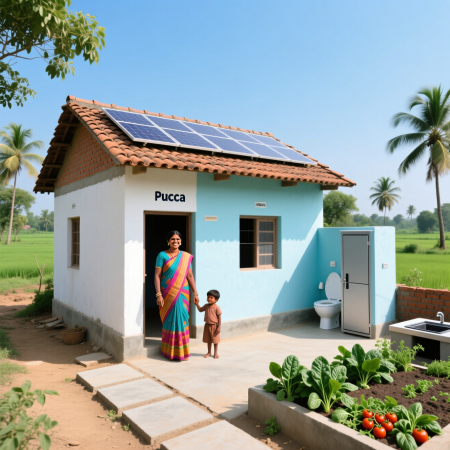
Over the decades, it has evolved from a basic welfare scheme into a transformative national mission, integrating financial assistance, technological innovation, and community participation. More than just constructing houses, the Rural Housing Programme has become a powerful catalyst for improving health, safety, gender equity, and overall quality of life across rural India.
This summary examines its historical roots, policy framework, on-ground impact, persistent challenges, and future potential in building a truly ‘Housing for All’ nation.
Historical Evolution of the Rural Housing Programme
The roots of the Rural Housing Programme can be traced back to the early post-independence era when India’s planners identified housing as a key component of rural development. However, it was in 1985 that the Government of India launched the first structured national initiative—the Indira Awaas Yojana (IAY)—under the Ministry of Rural Development. IAY marked a significant milestone by targeting Below Poverty Line (BPL) families, particularly those belonging to Scheduled Castes (SCs), Scheduled Tribes (STs), and freed bonded laborers. The Rural Housing Programme under IAY provided financial assistance for the construction of new houses and the upgradation of kutcha (temporary) dwellings into pucca (permanent) structures.In 2016, IAY was restructured and subsumed under the ambitious Pradhan Mantri Awaas Yojana–Gramin (PMAY-G), which became the new face of the Rural Housing Programme. PMAY-G aligned with the national goal of “Housing for All by 2022” and significantly expanded the scope, coverage, and technological integration of the scheme. This transition reflected a strategic shift from welfare-based assistance to a rights-based, time-bound mission with clear deliverables.
Objectives of the Rural Housing Programme
The primary aim of the Rural Housing Programme is to eliminate rural homelessness and ensure that every eligible rural household has access to a safe, secure, and weather-resistant home. Beyond mere shelter, the Rural Housing Programme seeks to:- Improve living standards by replacing inadequate housing with pucca structures equipped with basic amenities.
- Promote social equity by prioritizing marginalized groups, including women-headed households, disabled persons, and minorities.
- Enhance financial inclusion through direct benefit transfers (DBT) and convergence with other welfare schemes.
- Foster local employment by encouraging the use of local materials and labor under the Mahatma Gandhi National Rural Employment Guarantee Act (MGNREGA).
- Integrate climate-resilient and disaster-resistant construction techniques to ensure long-term sustainability.
Implementation Framework and Key Features
The success of the Rural Housing Programme hinges on a robust implementation architecture that leverages technology, transparency, and community participation. Under PMAY-G, the Rural Housing Programme operates through a three-tier governance structure involving the central government, state governments, and gram panchayats (village councils). Key features include:- Aadhaar-linked Beneficiary Identification: Ensures accurate targeting and minimizes duplication or leakage.
- Direct Benefit Transfer (DBT): Financial assistance is transferred directly into beneficiaries’ bank accounts, enhancing accountability.
- Geo-tagging and Real-Time Monitoring: Every house constructed under the Rural Housing Programme is geo-tagged and uploaded to a centralized portal, enabling real-time tracking.
- Convergence with MGNREGA: Up to 90–95 days of unskilled labor can be drawn from MGNREGA, reducing out-of-pocket expenses for beneficiaries.
- Women Empowerment: The house is registered in the name of the female head of the household or jointly with her spouse, promoting gender equity.
Financial Assistance and Eligibility Criteria
Under the current Rural Housing Programme (PMAY-G), eligible beneficiaries receive financial assistance of ₹1.20 lakh in plain areas and ₹1.30 lakh in hilly, difficult, or tribal regions. The funds are released in three installments linked to construction milestones: foundation, roof laying, and completion. To qualify, applicants must be identified as homeless or living in zero-, one-, or two-room kutcha houses and belong to the BPL category as per the Socio-Economic and Caste Census (SECC) 2011 data. The Rural Housing Programme also allows for additional support through state contributions, bank loans, or beneficiary contributions, ensuring flexibility based on local needs and capacities. This tiered financial model ensures that the Rural Housing Programme remains both scalable and adaptable across India’s diverse rural landscape.Impact and Achievements
Since its inception, the Rural Housing Programme has transformed millions of lives. As of 2023, over 25 million houses have been sanctioned under PMAY-G, with more than 20 million completed. These numbers represent not just structures but improved health outcomes, enhanced dignity, and greater economic resilience for rural families. Studies have shown that beneficiaries of the Rural Housing Programme report better sanitation, reduced exposure to extreme weather, and improved mental well-being. Children in pucca homes are more likely to attend school regularly, and women experience greater safety and privacy. Moreover, the construction activity spurred by the Rural Housing Programme has generated significant rural employment, particularly for masons, laborers, and material suppliers. The Rural Housing Programme has also played a pivotal role in reducing regional disparities. States like Odisha, Chhattisgarh, and Jharkhand—historically lagging in housing indicators—have recorded remarkable progress due to focused implementation and political will.Challenges and Limitations
Despite its successes, the Rural Housing Programme faces several challenges. Delays in fund disbursement, inadequate technical supervision, and shortages of skilled masons can hinder timely completion. In some regions, beneficiaries struggle to mobilize the required matching contribution, leading to incomplete houses. Additionally, while the Rural Housing Programme mandates basic amenities like toilets and electricity, convergence with Swachh Bharat Mission and Saubhagya schemes is not always seamless. Another concern is the quality of construction. Although guidelines emphasize earthquake-resistant and eco-friendly designs, on-ground adherence varies. Monitoring mechanisms, while improved, still rely heavily on self-reporting, which can compromise data accuracy. Addressing these gaps is essential to ensure that the Rural Housing Programme delivers not just quantity but also quality and durability.Technological Innovations and Digital Governance
A defining strength of the modern Rural Housing Programme is its embrace of digital tools. The PMAY-G Management Information System (MIS) serves as a one-stop dashboard for tracking applications, approvals, fund flows, and physical progress. Mobile apps enable gram panchayat officials and beneficiaries to upload construction photos with GPS coordinates, creating an auditable trail. Blockchain pilots are being explored to further secure land records and prevent fraud. Meanwhile, drone surveys in select districts help verify completion and assess structural integrity. These innovations position the Rural Housing Programme at the forefront of India’s digital governance revolution, setting benchmarks for other social welfare schemes.Social Inclusion and Gender Equity
The Rural Housing Programme has emerged as a powerful instrument for social inclusion. By prioritizing SC/ST households, widows, and persons with disabilities, it actively addresses historical inequities. The mandatory titling in women’s names has had far-reaching implications: it not only secures women’s property rights but also enhances their decision-making power within households. In many villages, women beneficiaries have formed self-help groups to pool resources, share construction knowledge, and advocate for better implementation. This grassroots mobilization has turned the Rural Housing Programme into a catalyst for community-led development and gender transformation.Environmental Sustainability and Climate Resilience
Recognizing the vulnerability of rural communities to climate change, the Rural Housing Programme increasingly promotes green building practices. Guidelines encourage the use of fly ash bricks, bamboo, compressed earth blocks, and solar roofing. Training modules for masons now include modules on thermal insulation and rainwater harvesting. In flood-prone states like Assam and Bihar, elevated plinths and raised foundations are mandated. In drought-affected regions, water-efficient sanitation systems are integrated. These adaptations ensure that the Rural Housing Programme contributes to long-term climate resilience, aligning with India’s Nationally Determined Contributions (NDCs) under the Paris Agreement.Convergence with Other Development Schemes
The true potential of the Rural Housing Programme is unlocked through convergence. Linking housing with sanitation (Swachh Bharat Mission), electricity (Saubhagya), drinking water (Jal Jeevan Mission), and livelihood support (Deendayal Antyodaya Yojana) creates synergistic outcomes. For instance, a pucca house with a toilet, tap water, and electricity becomes a hub of health, dignity, and productivity. State governments have taken the lead in designing integrated packages. Kerala’s “Life Mission” and Tamil Nadu’s “Kalaignar Housing Scheme” complement the national Rural Housing Programme with additional subsidies and infrastructure. Such federal collaboration enhances the reach and relevance of the Rural Housing Programme.Role of Panchayati Raj Institutions
Decentralized governance is central to the Rural Housing Programme. Gram panchayats are responsible for identifying beneficiaries, verifying eligibility, monitoring construction, and resolving grievances. This empowers local institutions and fosters participatory democracy. Capacity-building programs have equipped panchayat members with technical and managerial skills. In many districts, social audits involving villagers ensure transparency and accountability. When implemented effectively, this bottom-up approach makes the Rural Housing Programme more responsive to local needs and contexts.Future Directions and Policy Recommendations
As India moves beyond the “Housing for All by 2022” deadline, the Rural Housing Programme must evolve to address emerging challenges. Key recommendations include:- Expanding coverage to include near poor and economically vulnerable households excluded from SECC 2011.
- Strengthening post-construction support, including maintenance grants and disaster insurance.
- Scaling up skill development for rural masons through partnerships with ITIs and NGOs.
- Enhancing data analytics to predict bottlenecks and optimize resource allocation.
- Promoting rental housing models for seasonal laborers and migrant workers.