INDIA: JANNURM AND CITIES DEVELOPMENT
Introduction
JANNURM and cities development marked a turning point in India’s approach to urbanization. Launched in 2005 by the Government of India, the Jawaharlal Nehru National Urban Renewal Mission—commonly abbreviated as JNNURM but often informally referred to as “JANNURM” in public discourse—was a pioneering initiative aimed at transforming India’s urban centers into engines of economic growth, social equity, and sustainable living. Though technically a misnomer, the term “JANNURM” has gained widespread usage in media, policy discussions, and grassroots conversations.
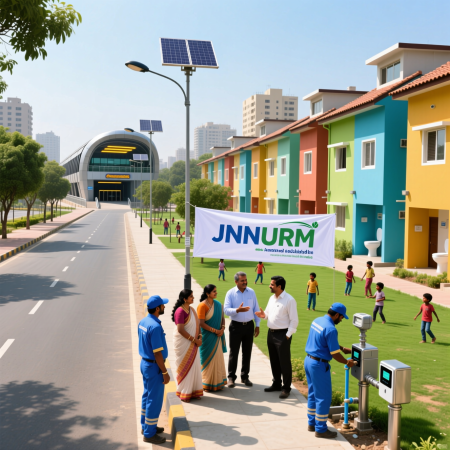
For clarity and alignment with common search behavior, this summary adopts the phrasing “JANNURM and cities development” to reflect both the mission’s intent and its real-world impact. This phrase encapsulates a comprehensive strategy that linked infrastructure investment with institutional reform across 65 mission cities.
Core Objectives of the Mission
At its heart, JANNURM and cities development sought to address two interlinked challenges: crumbling urban infrastructure and weak municipal governance. India’s cities were struggling to cope with rapid population growth, unplanned expansion, and outdated service systems. JANNURM and cities development responded by setting clear goals: modernize urban infrastructure, strengthen urban local bodies (ULBs), improve service delivery, and ensure inclusive growth—especially for the urban poor. The mission recognized that sustainable urbanization required more than just building roads or laying pipes; it demanded systemic change in how cities are governed, financed, and planned.
Structural Framework: Two Pillars of Transformation
JANNURM and cities development operated through two key sub-missions: the Urban Infrastructure and Governance (UIG) component and the Basic Services to the Urban Poor (BSUP). The UIG focused on large infrastructure projects in cities with populations over one million, while BSUP targeted slum upgrading, affordable housing, and access to sanitation and water for marginalized communities. This dual-track approach ensured that JANNURM and cities development balanced economic efficiency with social inclusion. Investments flowed into metro rail systems, water supply networks, sewerage treatment plants, and e-governance platforms—projects that not only improved physical infrastructure but also enhanced the quality of urban life.
Institutional Reforms: Building Capable Cities
One of the most innovative aspects of JANNURM and cities development was its insistence on institutional reform as a precondition for funding. Cities had to adopt seven mandatory reforms, including measures to improve transparency (like the Public Disclosure Law), encourage citizen participation, rationalize property tax systems, and implement user charges for services. These reforms were designed to make ULBs more accountable, financially self-reliant, and responsive to citizens’ needs. In cities like Pune and Surat, JANNURM and cities development catalyzed digital transformation in municipal services, boosting revenue collection and reducing corruption. Thus, the mission was as much about governance as it was about concrete and steel.
Tangible Infrastructure Gains
The outcomes of JANNURM and cities development are visible across India’s urban landscape. Over ₹78,000 crore was invested in mission cities, funding over 1,200 projects. Delhi’s Metro expansion, Chennai’s water supply upgrades, and Indore’s solid waste management system all benefited from JANNURM support. Urban transport received special attention, with bus rapid transit systems (BRTS) introduced in cities like Ahmedabad and Jaipur. These interventions reduced travel times, lowered emissions, and improved accessibility—demonstrating how JANNURM and cities development could deliver measurable improvements in daily urban life.
Focus on the Urban Poor
Equity was central to JANNURM and cities development. The BSUP component funded community toilets, drainage systems in slums, street lighting, and livelihood centers. By integrating informal settlements into the formal urban fabric, the mission challenged exclusionary urban planning models. In Mumbai and Kolkata, JANNURM-funded projects provided secure tenure and basic amenities to thousands of slum dwellers. This emphasis on inclusion ensured that JANNURM and cities development did not just serve the elite but uplifted the most vulnerable urban residents.
Challenges and Limitations
Despite its achievements, JANNURM and cities development faced significant hurdles. Project delays were common due to land acquisition issues, bureaucratic bottlenecks, and weak municipal capacity. Some cities struggled to implement financial reforms, fearing political backlash from increased user fees or property taxes. Moreover, the mission’s focus on only 65 cities left smaller urban centers underserved. Critics also noted that monitoring mechanisms were sometimes inadequate, leading to cost overruns or incomplete projects. Nevertheless, these challenges provided critical lessons for future urban missions.
Technological Integration and Innovation
JANNURM and cities development embraced technology as a tool for transparency and efficiency. Many cities adopted GIS-based master planning, online building permit systems, and digital grievance redressal portals. These innovations reduced processing times, minimized human discretion, and improved citizen trust. In Bhopal and Visakhapatnam, e-governance platforms launched under JANNURM became models for digital municipal services. This tech-enabled approach showed how JANNURM and cities development could modernize not just infrastructure but also administrative culture.
Financing Urban Futures
A key legacy of JANNURM and cities development was its push for diversified urban financing. While the central and state governments provided the bulk of funds, the mission encouraged cities to explore public-private partnerships (PPPs), municipal bonds, and
value-capture mechanisms. Ahmedabad’s successful issuance of municipal bonds in the early 2010s—a first in India—was directly inspired by JANNURM’s financial reform agenda. Though adoption was uneven, these experiments laid the groundwork for more financially autonomous urban governance, proving that JANNURM and cities development thought beyond short-term subsidies.
Citizen Participation and Democratic Governance
JANNURM and cities development mandated community involvement through ward committees and public consultations. The Community Participation Law required ULBs to engage citizens—especially women and marginalized groups—in planning and monitoring. In cities like Thiruvananthapuram, participatory budgeting allowed residents to prioritize local projects. This democratic ethos strengthened accountability and ensured that infrastructure investments aligned with actual community needs. In this way, JANNURM and cities development redefined urban governance as a shared responsibility.
Environmental Sustainability
Recognizing the ecological costs of urban sprawl, JANNURM and cities development promoted green infrastructure. Projects emphasized water recycling, energy-efficient street lighting, non-motorized transport lanes, and urban green spaces. Several cities built sewage treatment plants that reused water for landscaping or industrial use, reducing pressure on freshwater sources. These efforts reflected a growing understanding that JANNURM and cities development must harmonize growth with environmental stewardship—a principle that has only grown more urgent with climate change.
Capacity Building and Knowledge Transfer
Sustainable change requires skilled institutions, and JANNURM and cities development invested heavily in capacity building. Training programs for municipal staff, urban planners, and engineers were rolled out nationwide. Academic institutions and NGOs served as knowledge partners, helping cities design technically sound and socially responsive projects. This focus on human capital ensured that the gains of JANNURM and cities development were institutionalized, not temporary. Many ULBs emerged from the mission with stronger technical teams and better data systems.
Regional Disparities and Lessons in Equity
Implementation of JANNURM and cities development varied widely across states. Southern and western cities—backed by proactive leadership and stronger administrative capacity—often outperformed their northern and eastern counterparts. This uneven progress highlighted the need for context-sensitive strategies and phased support based on city readiness. Later missions like AMRUT and the Smart Cities Mission have since adopted more flexible frameworks, building on the equity lessons of JANNURM and cities development.
Legacy and Policy Evolution
Although JANNURM officially concluded in 2014, its influence endures. It laid the institutional and conceptual groundwork for India’s next-generation urban programs. The Smart Cities Mission adopted its emphasis on technology and citizen engagement, while AMRUT inherited its focus on water, sewerage, and urban transport. Even the Swachh Bharat Mission drew inspiration from JANNURM’s sanitation initiatives. In this sense, JANNURM and cities development served as a national laboratory for urban innovation—testing models that continue to shape policy today.
Conclusion: A Foundation for Future Cities
JANNURM and cities development redefined India’s urban imagination. It moved the national conversation beyond ad-hoc infrastructure fixes toward integrated, inclusive, and institutionally robust urban planning. While not without flaws, the mission demonstrated that cities could be transformed through coordinated investment, reform, and participation. As India’s urban population surges toward 600 million by 2036, the principles embedded in JANNURM and cities development—good governance, equity, sustainability, and innovation—remain more relevant than ever.
JANNURM and cities development showed that building better cities is not just an engineering challenge but a social and political one. It proved that with vision, collaboration, and sustained commitment, Indian cities can become places of opportunity, dignity, and resilience for all.
Also read: Inclusive Urbanization - A Study of Indian Slums
