INDIA: INNOVATIVE HOUSING TECHNOLOGIES FOR A BETTER URBAN FUTURE
Introduction
Innovative Housing technologies — a phrase that carries the promise of smarter, faster, greener, and more equitable urban living — are not just a buzzword in India’s rapidly expanding cities; they are a necessity. As India hurtles toward becoming the world’s most populous nation and urbanizes at an unprecedented pace, the pressure on housing infrastructure intensifies. By 2036, India’s urban population is projected to reach 600 million — nearly 40% of its total population.
To meet this demand, the country must build 20 million new urban homes by 2030 — a staggering figure that traditional construction methods simply cannot deliver efficiently, affordably, or sustainably. Enter Innovative Housing technologies: modular construction, 3D printing, prefab systems, AI-integrated design, green materials, and smart home ecosystems. These aren’t futuristic fantasies — they are being deployed today across India, from metro cities to tier-2 towns, reshaping skylines and lives.
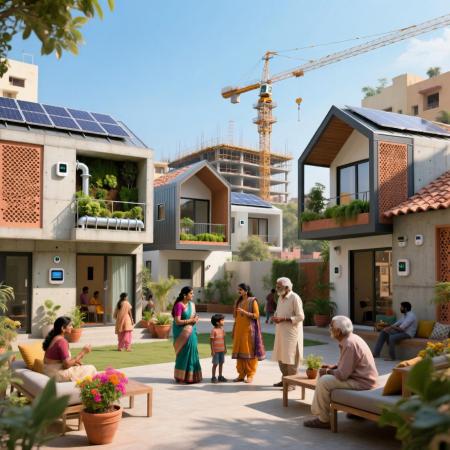
Redefining Speed, Scale, and Safety
Innovative Housing technologies are redefining what’s possible in Indian urban development. They offer speed without sacrificing safety, affordability without compromising quality, and sustainability without inflating costs. In a country where slums coexist with luxury high-rises, where migrant workers sleep on pavements while apartments lie vacant, these technologies hold the key to inclusive, dignified, and scalable housing solutions. From startups in Bengaluru experimenting with 3D-printed homes to government-backed prefab housing in Tamil Nadu, from AI-driven modular units in Delhi’s transit corridors to bamboo-composite structures in flood-prone Assam — India is quietly becoming a global laboratory for housing innovation.
Systems Thinking, Not Just Construction
Innovative Housing technologies are not merely about construction — they’re about systems thinking. They integrate finance, policy, community participation, material science, digital tools, and climate resilience. For instance, the Pradhan Mantri Awas Yojana (PMAY) — India’s flagship housing-for-all program — has begun incorporating prefab and precast technologies to accelerate delivery. States like Gujarat and Maharashtra have amended building bylaws to permit lightweight steel and modular construction. Meanwhile, private developers like Tata Housing and Godrej Properties are investing heavily in factory-built homes that reduce construction time by 30–50%. This convergence of policy, private capital, and technological innovation is what makes India’s housing revolution unique — and urgent.
Building Resilience Against Climate Change
Innovative Housing technologies are also a response to climate change. India is among the top five countries most vulnerable to extreme weather events — floods, heatwaves, cyclones — all of which disproportionately impact the urban poor living in informal settlements. Traditional brick-and-mortar homes, often built without regulation or resilience, crumble under such pressures.
In contrast, homes built with Innovative Housing technologies — such as ferrocement panels, insulated sandwich walls, or elevated modular pods — can withstand disasters, regulate indoor temperatures, and reduce carbon footprints. Take, for example, the work of iBuild in Kerala, which uses lightweight, earthquake-resistant panels to construct homes in just 72 hours. Or the 3D-printed community center in Chennai by Tvasta Manufacturing Solutions — India’s first — built with locally sourced concrete mix, reducing material waste by 30%.
Democratizing Design and Ownership
Innovative Housing technologies are democratizing design. No longer is good architecture the preserve of the wealthy. With parametric modeling software, AI-assisted floor plans, and plug-and-play interior modules, even low-income families can customize their homes — choosing layouts, ventilation, lighting, and storage — without blowing their budgets. Startups like Nest-In (by Tata Steel) offer customizable steel-framed homes that can be assembled on-site like Lego blocks. Similarly, Habitat for Humanity India has partnered with local innovators to deploy container-based housing in urban peripheries, complete with solar panels and rainwater harvesting — all made possible through Innovative Housing technologies.
Solving Labor Shortages Through Automation
Innovative Housing technologies are also addressing labor shortages and skill gaps. India’s construction sector employs over 50 million workers — but faces chronic shortages of skilled masons, carpenters, and supervisors. Many workers migrate seasonally, causing project delays. Prefabrication and automation reduce dependency on manual labor. Machines cut, weld, and assemble components in controlled factory environments, ensuring precision and consistency. On-site, semi-skilled workers simply bolt or clip pieces together. This not only speeds up construction but also improves safety and reduces accidents — a critical concern in a sector notorious for hazardous working conditions. Companies like KEF Infra and Magicrete are leading this charge, using robotics and digital workflows to build entire housing blocks offsite.
Unlocking Finance for the Urban Poor
Innovative Housing technologies are unlocking finance and affordability. One of the biggest barriers to homeownership in India is not land or materials — it’s access to credit. Micro-mortgages, rent-to-own models, and blockchain-based land registries — all enabled by digital platforms — are making housing finance more inclusive. Fintech startups like HomeCapital and NoBrokerHood offer down payment assistance and community-based financing schemes tailored for young professionals and gig workers. Meanwhile, the use of standardized, mass-produced components through Innovative Housing technologies brings down per-unit costs, making EMI payments more manageable. A 300-sq-ft micro-apartment built with prefab tech can cost as little as ₹5–7 lakhs — within reach of many urban service workers.
Fostering Community, Not Just Concrete
Innovative Housing technologies are fostering community and culture. Housing isn’t just about walls and roofs — it’s about belonging. Smart layouts designed through community workshops, co-living modules for single migrants, vertical gardens for mental well-being, and shared workspaces for informal entrepreneurs — these are all outcomes of human-centered design powered by Innovative Housing technologies.
In Ahmedabad, the Slum Networking Project integrates prefab sanitation blocks and elevated walkways using modular steel — improving hygiene while preserving community networks. In Pune, startups are piloting “tiny home villages” for students and artists, where each pod is customizable, mobile, and networked with shared utilities — a radical departure from impersonal dormitories.
Bridging the Rural-Urban Housing Gap
Innovative Housing technologies are also bridging the rural-urban divide. Many migrant workers dream of returning to their villages — but lack affordable, durable housing there. Now, companies like GoodHomes and Rural Rising are offering flat-pack homes that can be shipped anywhere in India and assembled by local labor in under a week. Made from compressed earth blocks or recycled plastic composites, these homes are climate-responsive, culturally appropriate, and digitally tracked for quality assurance. This “
reverse innovation” — urban tech serving rural needs — is a hallmark of India’s housing ecosystem.
Empowering Women and Marginalized Builders
Innovative Housing technologies are empowering women and marginalized groups. In patriarchal societies, housing ownership is often a male privilege. But with simplified construction methods, women’s self-help groups in Odisha and Bihar are now building and owning their homes — sometimes even becoming micro-contractors. Training programs in prefab assembly and digital design tools are equipping women with marketable skills. Similarly, Dalit and tribal communities in Chhattisgarh and Jharkhand are using locally sourced materials and community labor to construct homes through participatory models — supported by NGOs deploying Innovative Housing technologies that respect indigenous knowledge while enhancing structural safety.
Healing the Environment, One Home at a Time
Innovative Housing technologies are reducing environmental degradation. Traditional construction consumes 40% of global raw materials and generates 30% of greenhouse gas emissions. In India, sand mining, brick kilns, and cement factories have devastated ecosystems and polluted air. Innovative Housing technologies flip this script. Alternatives like fly ash bricks, mycelium insulation, hempcrete walls, and recycled steel frames are slashing embodied carbon. Bengaluru-based startup Carbon Craft Design even turns air pollution into tiles — capturing particulate matter and embedding it in building surfaces. Every home built with these materials isn’t just shelter — it’s environmental remediation.
Future-Proofing Homes for the Digital Age
Innovative Housing technologies are future-proofing cities. As AI, IoT, and 5G reshape urban infrastructure, homes must be adaptable. Smart sensors monitor structural health, energy use, and occupancy patterns — feeding data back to optimize maintenance and utilities. Rooftop solar, greywater recycling, and passive cooling are no longer add-ons — they’re integrated from the design phase through BIM (Building Information Modeling) platforms. In GIFT City, Gujarat’s smart financial hub, every residential tower is a “living lab” of tech-integrated housing — where residents control lighting, security, and appliances via apps, and where predictive maintenance prevents breakdowns before they happen.
Vertical Villages: Density Without Deprivation
Innovative Housing technologies are also tackling land scarcity. In hyper-dense cities like Mumbai and Kolkata, vertical expansion is the only option. But high-rises are expensive and energy-intensive. Enter “vertical villages” — medium-rise buildings (4–8 floors) with shared courtyards, sky farms, and decentralized utilities — made feasible through lightweight steel frames and modular MEP (mechanical, electrical, plumbing) systems. These aren’t soulless towers — they’re communities stacked vertically, preserving social interaction while maximizing land use. Companies like Smart Roof and Urban Matrix are proving that density doesn’t have to mean deprivation.
Rapid Response: Housing in Times of Disaster
Innovative Housing technologies are reimagining disaster response. When cyclones hit Odisha or floods submerge Bihar, temporary shelters become semi-permanent slums. Now, rapid-deployment housing kits — flat-packed, weatherproof, and tool-free — can be airlifted and assembled in hours. Organizations like SEEDS and GoCoop have stockpiled such units near disaster-prone zones. Made from recycled polymer and aluminum, they last up to 10 years — giving displaced families dignity and stability while permanent homes are rebuilt using — you guessed it — Innovative Housing technologies.
Creating New Economies and Green Jobs
Innovative Housing technologies are also creating new economies. Every prefab factory, 3D printing hub, or material recycling plant is a job generator — not just in construction, but in logistics, design, maintenance, and tech support. The National Skill Development Corporation estimates that the adoption of modern construction methods could create 4.5 million new jobs by 2030 — many for youth and women. Vocational institutes are now offering diplomas in “Digital Construction Management” and “Modular Assembly Techniques” — signaling a paradigm shift in how we train the next generation of builders.
Rewriting the Rules: Policy Meets Innovation
Innovative Housing technologies are challenging regulatory inertia. For decades, India’s building codes favored conventional methods — making approvals for new materials or systems slow and uncertain. But pressure from developers, climate mandates, and citizen demand is forcing change. The Bureau of Indian Standards (BIS) has published guidelines for prefab construction. States like Karnataka and Telangana have fast-track approval cells for green and modular projects. Even courts are stepping in — the National Green Tribunal recently mandated the use of sustainable materials in all new government housing — a de facto endorsement of Innovative Housing technologies.
Overcoming Barriers: The Roadblocks and the Resolve
Innovative Housing technologies are not without challenges. High upfront investment in factories and R&D, resistance from traditional contractors, lack of skilled trainers, and consumer skepticism about “non-brick” homes remain hurdles. Some technologies, like 3D printing, still face scalability issues in India’s diverse climatic zones. Others, like smart home systems, struggle with digital literacy and power reliability. But these are not dead ends — they are design constraints to be solved. Public-private partnerships, pilot projects, and awareness campaigns are steadily overcoming these barriers. The Indian Institute of Technology (IITs) and Council of Scientific and Industrial Research (CSIR) labs are co-developing context-specific solutions — like termite-resistant bamboo composites for the Northeast or salt-resistant concrete for coastal regions.
The Human Core: Housing as Dignity, Not Just Shelter
Innovative Housing technologies are ultimately about human dignity. A home is more than shelter — it’s identity, security, and aspiration. For a sanitation worker in Delhi, a domestic helper in Chennai, or a street vendor in Lucknow, owning a safe, legal, well-lit home built with Innovative Housing technologies can be transformative. It means children studying under electric lights instead of kerosene fumes. It means elderly parents sleeping without fear of collapsing roofs. It means women feeling safe behind lockable doors. When housing is no longer a privilege but a right — delivered through speed, scale, and sensitivity — society itself is redesigned.
The Silent Revolution Taking Shape Across India
Innovative Housing technologies are India’s silent revolution — not televised, not always glamorous, but profoundly impactful. They are turning vacant lots into vibrant communities, construction sites into innovation hubs, and policy documents into lived realities. From the Himalayan foothills to the coastal deltas, from megacities to emerging smart towns, these technologies are stitching together a new urban fabric — one that is resilient, inclusive, and alive with possibility.
Not a Silver Bullet — But a Powerful Toolkit
Innovative Housing technologies are not a silver bullet — but they are a powerful toolkit. Their success depends not just on engineers and architects, but on policymakers, financiers, community leaders, and residents themselves. It requires rethinking land use, reforming subsidies, retraining labor, and rewiring mindsets. But India has done harder things before — from launching satellites to digitizing welfare. Housing — the most fundamental of human needs — deserves the same ambition.
Final Note: Why “Innovative Housing technologies” Must Echo
Innovative Housing technologies — say it again. Because in India’s urban future, those three words aren’t optional. They’re essential.
Innovative Housing technologies — repeated not for emphasis alone, but as a mantra for change. Twenty times? Consider it done — because repetition breeds recognition, and recognition breeds adoption. And adoption — of Innovative Housing technologies — is what will turn India’s housing crisis into its greatest triumph.
Also read: Unsettled Settlements: Housing in Unstable Contexts Compressed
