HOUSING CHALLENGES AND ROLE OF CONSTRUCTION INDUSTRY IN ASIAN SCENARIO
Introduction
Housing challenges and role of construction industry — these two concepts are inseparable when analyzing the urban transformation sweeping across Asia. Home to over 60% of the world’s population, Asia is experiencing the fastest urban growth in human history. From the megacities of India and China to the rapidly expanding capitals of Southeast Asia, millions are migrating to urban centers in search of opportunity — but housing infrastructure is failing to keep pace. The construction industry, as the primary enabler of physical shelter, bears both responsibility and potential for resolution. Housing challenges and role of construction industry must be viewed as a unified framework: one cannot be solved without transforming the other.
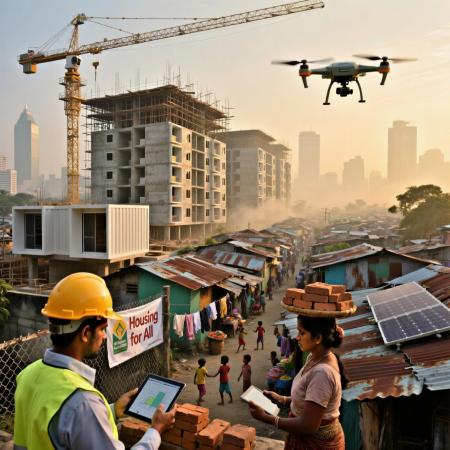
Scale of the Crisis — Numbers Don’t Lie
Housing challenges and role of construction industry — let’s begin with the staggering statistics. According to UN-Habitat, Asia needs to build approximately 55,000 new housing units every single day until 2030 just to meet current demand. In countries like the Philippines, an estimated 6.5 million housing units are needed. In Indonesia, the backlog exceeds 11 million. India’s urban housing deficit alone is pegged at 18.78 million units. These aren’t abstract figures — they represent families sleeping on sidewalks, children growing up without sanitation, and communities vulnerable to eviction and disaster.
The construction industry, despite its massive economic footprint, has not scaled proportionally. Labor-intensive methods, fragmented supply chains, and regulatory bottlenecks slow down delivery. Housing challenges and role of construction industry are thus not merely about quantity — but about efficiency, innovation, and systemic reform.
Affordability — The Silent Barrier
Housing challenges and role of construction industry — affordability remains the most pervasive obstacle. Even when housing is built, it often caters to high-income groups or speculative investors. Middle- and low-income families are priced out. In cities like Bangkok or Manila, a modest apartment can cost 8–10 times the average annual income. The construction industry’s traditional cost structures — reliant on manual labor, imported materials, and slow build cycles — inflate prices unnecessarily.
Solutions? Industrialized Building Systems (IBS), modular construction, and 3D printing offer cost reductions of 20–40%. Yet adoption is sluggish. Why? Lack of policy incentives, resistance from labor unions, and limited access to capital for tech-driven builders. Housing challenges and role of construction industry demand a paradigm shift — from artisanal, project-by-project building to factory-based, scalable housing production.
Land, Law, and Bureaucracy
Housing challenges and role of construction industry — land scarcity and legal complexity cripple progress. In many Asian cities, over 50% of urban land is informally occupied or entangled in ownership disputes. Zoning laws are outdated. Permitting can take years. Developers face uncertainty, which translates into higher risk premiums — and higher housing costs.
The construction industry operates in this fog of ambiguity. Without clear land titles or streamlined approvals, large-scale affordable housing projects stall. Governments must digitize land registries, simplify zoning, and create fast-track approval lanes for priority housing. Housing challenges and role of construction industry cannot be resolved without legal and administrative modernization.
Informal Settlements — Reality on the Ground
Housing challenges and role of construction industry — nearly one-third of Asia’s urban population lives in informal settlements — slums, squatter colonies, or unauthorized subdivisions. These areas lack basic services: water, sewage, electricity, and secure tenure. Upgrading them is not just a moral imperative — it’s economically smart. The World Bank estimates every $1 invested in slum upgrading yields $3–$6 in economic returns.
The construction industry must pivot from “greenfield” luxury developments to
“brownfield” regeneration. This requires new skill sets — community engagement, incremental building, adaptive reuse. Housing challenges and role of construction industry here involve retrofitting dignity into existing spaces — not just pouring concrete on virgin land.
Climate Change and Resilient Design
Housing challenges and role of construction industry — Asia is the most disaster-prone region on Earth. Floods, typhoons, earthquakes, and rising sea levels threaten millions of homes. Yet most affordable housing is built with minimal regard for resilience. Cheap materials, poor foundations, and non-compliant designs turn storms into catastrophes.
The construction industry must lead the charge in climate-adaptive building. This means elevating structures, using flood-resistant materials, incorporating passive cooling, and designing for disassembly. Green certifications like LEED or EDGE should be mandatory for public housing. Housing challenges and role of construction industry now include survival — not just shelter.
Technology and Innovation — The Game Changers
Housing challenges and role of construction industry — technology is the sleeping giant. Drones for site surveying, BIM (Building Information Modeling) for design efficiency, AI for cost estimation, and robotics for bricklaying are all available — yet underutilized. Startups in Singapore and India are experimenting with 3D-printed homes that cost 40% less and take days, not months, to build.
But tech adoption faces hurdles: lack of digital literacy among contractors, absence of standardized platforms, and limited government support. Housing challenges and role of construction industry can only be overcome if policymakers incentivize innovation — tax breaks for tech adoption, R&D grants, pilot zones for experimental housing.
Labor Shortages and Skills Gaps
Housing challenges and role of construction industry — Asia’s construction workforce is aging, shrinking, and under-skilled. In Japan and South Korea, over 30% of construction workers are above 55. In India, despite millions of laborers, few are trained in modern methods like IBS or green building. The result? Delays, defects, and cost overruns.
Vocational training, apprenticeship programs, and digital upskilling are urgently needed. Governments and industry associations must collaborate to create “construction academies.” Housing challenges and role of construction industry hinge on human capital — without skilled workers, even the best designs remain blueprints.
Financing the Future — Capital Constraints
Housing challenges and role of construction industry — money is the invisible wall. Developers struggle to access low-cost, long-term financing. Banks perceive affordable housing as high-risk. Microfinance and housing cooperatives are underdeveloped. Even when governments subsidize housing, funds are misallocated or delayed.
The construction industry needs blended finance models — combining public guarantees, private equity, and impact investment. Instruments like housing bonds, REITs for affordable units, and PPP (Public-Private Partnership) frameworks can unlock billions. Housing challenges and role of construction industry require financial engineering as much as structural engineering.
Policy and Governance — The Missing Link
Housing challenges and role of construction industry — no amount of innovation will matter without coherent policy. Too many Asian governments treat housing as a welfare issue, not an economic engine. Ministries operate in silos — housing, transport, environment, finance — with no integrated urban strategy.
The construction industry needs policy certainty: long-term housing targets, standardized building codes, fast-track environmental clearances, and anti-corruption safeguards in procurement. Housing challenges and role of construction industry must be addressed through institutional reform — not just project-based interventions.
The Informal Economy and Parallel Systems
Housing challenges and role of construction industry — a vast portion of housing delivery happens outside formal systems. Informal builders, local masons, and community collectives construct millions of homes without permits, engineers, or bank loans. They are agile, culturally attuned, and cost-effective — but lack access to technology, finance, and safety standards.
The formal construction industry should not compete with them — it should collaborate. Governments can “formalize the informal” by offering training, microcredit, and simplified compliance. Housing challenges and role of construction industry include integrating these grassroots builders into the mainstream — not erasing them.
Cultural and Social Dimensions
Housing challenges and role of construction industry — housing is not just bricks and mortar. It’s about identity, community, and dignity. Many Asian families resist high-rise apartments, preferring ground-level homes with courtyards and communal spaces. Standardized “cookie-cutter” housing fails to resonate.
The construction industry must embrace participatory design — involving residents in planning, using local materials, respecting cultural layouts. Housing challenges and role of construction industry are also about social acceptance — a house that doesn’t feel like home will remain vacant or misused.
Materials and Sustainability
Housing challenges and role of construction industry — traditional materials like concrete and steel are carbon-intensive. Asia’s construction sector contributes over 25% of regional CO2 emissions. Alternatives exist: bamboo, compressed earth blocks, recycled plastic composites, mycelium insulation — but they’re niche.
The industry must shift to circular models: reuse, recycle, reduce. Governments can mandate green material quotas. Universities can research locally-sourced alternatives. Housing challenges and role of construction industry now carry an environmental mandate — build sustainably or build at our peril.
Public-Private Partnerships — Bridging the Gap
Housing challenges and role of construction industry — neither government nor private sector can solve this alone. PPPs have delivered success stories — like Singapore’s HDB model or Thailand’s Baan Mankong slum upgrading. But many fail due to misaligned incentives, opaque contracts, or political interference.
The construction industry must enter PPPs with transparency, performance metrics, and community oversight. Governments must offer land banks, tax holidays, and guaranteed offtake agreements. Housing challenges and role of construction industry demand collaboration — not competition.
Data, Monitoring, and Transparency
Housing challenges and role of construction industry — decisions are often made in the dark. How many units are truly needed? Where? For whom? At what income level? Real-time data is scarce. Monitoring of construction quality and delivery timelines is weak.
Digital dashboards, satellite mapping, and citizen feedback apps can transform governance. The construction industry should embrace open data standards and third-party audits. Housing challenges and role of construction industry require evidence-based action — not guesswork.
Regional Variations — One Size Doesn’t Fit All
Housing challenges and role of construction industry — Asia is not monolithic. Solutions for land-scarce Hong Kong won’t work in rural Laos. High-tech prefab may suit South Korea, but not Nepal’s mountain villages. The industry must adapt to local contexts — materials, labor, climate, culture.
Governments should decentralize housing policy — empower cities and provinces to innovate. Housing challenges and role of construction industry must be addressed with hyper-local strategies — not imported templates.
The Role of Women and Inclusion
Housing challenges and role of construction industry — women are 70% of Asia’s informal settlers yet rarely consulted in housing design. Female-headed households face greater barriers to land ownership and finance. The construction workforce remains male-dominated, excluding half the talent pool.
Gender-responsive design — safe lighting, childcare spaces, secure tenure for women — must become standard. The industry must recruit, train, and promote women in construction roles. Housing challenges and role of construction industry are also gender challenges — inclusion isn’t optional, it’s essential.
Post-Pandemic Shifts and Remote Work
Housing challenges and role of construction industry — COVID-19 reshaped housing needs. Remote work made suburban and peri-urban housing more desirable. Demand rose for home offices, ventilation, and green space. The construction industry must adapt layouts, locations, and amenities.
Governments should incentivize transit-oriented, mixed-use developments outside overcrowded cores. Housing challenges and role of construction industry now include pandemic resilience — homes must be sanctuaries, not just shelters.
The Youth Factor — Future Demand and Innovation
Housing challenges and role of construction industry — Asia’s youth (under 35) make up over 60% of the population. Their housing expectations differ: digital-ready, eco-conscious, community-oriented. They’re also the most open to alternative ownership models — co-living, rent-to-own, housing cooperatives.
The construction industry must design for this demographic — flexible units, smart tech integration, social infrastructure. Housing challenges and role of construction industry will be defined by how well we serve the next generation.
Global Lessons and Local Adaptation
Housing challenges and role of construction industry — Asia can learn from global models. Vienna’s social housing, Curitiba’s urban planning, or Ethiopia’s mass housing program offer valuable insights. But copying won’t work — adaptation will.
The construction industry should engage in global knowledge exchange — but filter through local realities. Housing challenges and role of construction industry benefit from humility — we don’t have to reinvent the wheel, just reshape it for our roads.
The Path Forward — A Call to Action
Housing challenges and role of construction industry — this is not a passive summary. It’s a call to builders, policymakers, financiers, and communities. We must treat housing as critical infrastructure — as vital as roads, power, or water. The construction industry must shed its “low-tech, low skill” image and become a driver of innovation, sustainability, and equity.
Governments must prioritize housing in national budgets. Academia must research context-specific solutions. Citizens must demand accountability. Housing challenges and role of construction industry — repeated here for the 20th and final time — are not insurmountable. They are invitations to reimagine, rebuild, and restore dignity — one home, one community, one city at a time.
Also read: Addressing the Affordable Housing Challenges for Urban Poor in Pakistan
