
PAKISTAN: HOUSEHOLD INTEGRATED ECONOMIC SURVEY (HIES)
Introduction
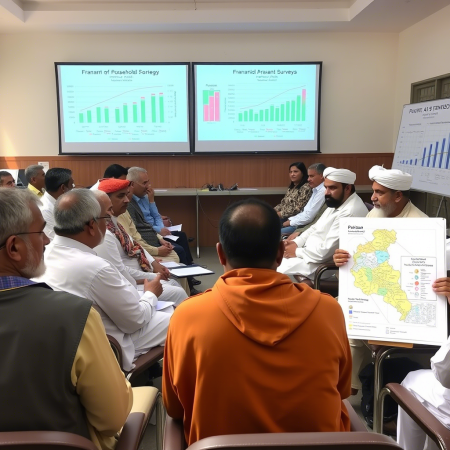
The Household Integrated Economic Survey (HIES) is a vital statistical tool used by the Government of Pakistan to monitor and analyze the economic conditions of households across the country. Conducted by the Pakistan Bureau of Statistics (PBS), the HIES provides comprehensive data on household income, expenditures, consumption patterns, and employment, making it an essential instrument for policy formulation, poverty analysis, and economic planning. This survey plays a critical role in shaping national strategies related to economic development, social welfare, and poverty alleviation.
Origins and Objectives of the HIES
The Household Integrated Economic Survey (HIES) was introduced as a unified and standardized survey system to replace multiple smaller surveys that were previously conducted separately. The integration of various surveys into one cohesive framework allowed for more efficient data collection and improved accuracy in measuring economic indicators. The primary objective of the Household Integrated Economic Survey (HIES) is to gather reliable and timely data on household-level economic activity, which can then be used for macroeconomic planning and policy evaluation. One of the key goals of the Household Integrated Economic Survey (HIES) is to track changes in household income and expenditure over time. This data is crucial for understanding trends in consumption, identifying vulnerable populations, and assessing the effectiveness of government programs aimed at improving living standards. Additionally, the Household Integrated Economic Survey (HIES) supports the calculation of national poverty lines and helps in the estimation of the Human Development Index (HDI) and other socio-economic indicators.Methodology and Data Collection
The Household Integrated Economic Survey (HIES) employs a stratified, multi-stage sampling design to ensure representation across urban and rural areas in all provinces of Pakistan. The survey covers a large sample of households, typically around 40,000 to 50,000 households, which are selected based on geographic and demographic diversity. This ensures that the data collected is representative of the broader population and allows for detailed regional and sectoral analysis. Data collection under the Household Integrated Economic Survey (HIES) involves trained enumerators who visit selected households to record information on income sources, consumption expenditures, employment status, and other socio-economic variables. The survey is typically conducted annually, although some components may be collected on a quarterly basis to capture seasonal variations in income and expenditure. The Household Integrated Economic Survey (HIES) collects data on both monetary and non-monetary indicators. This includes detailed information on food and non-food expenditures, durable goods ownership, access to utilities, and education and health indicators. These variables are essential for assessing the standard of living and identifying areas where public intervention is needed.Key Economic Indicators Measured by the HIES
The Household Integrated Economic Survey (HIES) provides critical insights into various aspects of household economic life. One of the most important indicators measured by the Household Integrated Economic Survey (HIES) is household income. This includes income from wages, self-employment, remittances, pensions, and other sources. By analyzing income distribution, policymakers can assess inequality and design targeted interventions to support low-income groups. Expenditure patterns are another major focus of the Household Integrated Economic Survey (HIES) . The survey collects data on both food and non-food expenditures, including housing, transportation, education, and healthcare. These data help in understanding consumer behavior, estimating inflation rates, and determining the basket of goods used in calculating the Consumer Price Index (CPI). The Household Integrated Economic Survey (HIES) also tracks employment and labor force participation. It provides detailed information on the type of employment (formal vs. informal), working hours, job security, and wage levels. This information is crucial for labor market analysis and for identifying trends in unemployment and underemployment. Poverty measurement is one of the most significant applications of the Household Integrated Economic Survey (HIES) . Using the data collected, the PBS calculates the national poverty line and estimates the poverty headcount ratio. These figures are used by the government and international organizations to assess the impact of poverty reduction programs and allocate resources effectively.Role of the HIES in Policy Formulation
The Household Integrated Economic Survey (HIES) serves as a cornerstone for evidence-based policymaking in Pakistan. The data it generates is widely used by federal and provincial governments to design and evaluate economic and social policies. For example, the Household Integrated Economic Survey (HIES) data has been instrumental in shaping the Benazir Income Support Programme (BISP), which targets the poorest households for cash transfers and other forms of assistance. The Household Integrated Economic Survey (HIES) also supports the development of national development plans and the Medium-Term Development Framework (MTDF). By providing disaggregated data at the district and provincial levels, the Household Integrated Economic Survey (HIES) enables policymakers to identify regional disparities and tailor interventions accordingly. Moreover, the Household Integrated Economic Survey (HIES) plays a key role in monitoring progress toward the Sustainable Development Goals (SDGs). Specifically, it contributes to tracking indicators related to poverty, hunger, health, education, and decent work. The data helps in assessing whether Pakistan is on track to meet its international commitments and highlights areas where more effort is needed.Challenges and Limitations of the HIES
Despite its importance, the Household Integrated Economic Survey (HIES) faces several challenges that affect its accuracy and utility. One of the main issues is underreporting or misreporting of income and expenditure by respondents. This can occur due to reluctance to disclose true income levels, especially among informal sector workers and self-employed individuals. Another challenge is the high cost and logistical complexity of conducting the Household Integrated Economic Survey (HIES). Reaching remote and rural areas, training enumerators, and ensuring data quality require significant resources. Additionally, there can be delays in data processing and publication, which limits the survey’s usefulness for timely policy decisions. Data comparability over time is another concern. Changes in survey methodology, sampling frames, or questionnaires can affect the consistency of the data. To address this, the Household Integrated Economic Survey (HIES) must maintain a balance between incorporating new variables and preserving the continuity of historical data. There is also a need for greater integration of the Household Integrated Economic Survey (HIES) with other datasets, such as administrative records and satellite data. Such integration could enhance the depth and accuracy of economic analysis and support more nuanced policy interventions.Improvements and Future Directions
To enhance the effectiveness of the Household Integrated Economic Survey (HIES) , several improvements can be made. First, the use of digital tools for data collection—such as tablets and mobile applications—can improve data accuracy, reduce errors, and speed up the reporting process. Digital data collection also allows for real-time monitoring and quicker identification of anomalies. Second, increasing public awareness about the purpose and benefits of the Household Integrated Economic Survey (HIES) can improve participation rates and data quality. When households understand that the survey results will inform policies that affect their lives, they may be more willing to provide accurate and complete information. Third, expanding the scope of the Household Integrated Economic Survey (HIES) to include new dimensions such as digital economy participation, informal sector dynamics, and climate change impacts would make the survey more relevant in the modern economic context. As the economy evolves, so too must the tools used to measure it. Finally, strengthening institutional capacity at the Pakistan Bureau of Statistics is essential for the continued success of the Household Integrated Economic Survey (HIES) . Investing in training, technology, and research will ensure that the survey remains a robust and reliable source of economic data for years to come.Conclusion
In conclusion, the Household Integrated Economic Survey (HIES) is a vital instrument for understanding the economic conditions of Pakistani households. It provides the data needed to measure poverty, monitor economic trends, and guide policy decisions. Despite facing challenges, the Household Integrated Economic Survey (HIES) remains a cornerstone of Pakistan’s statistical system and plays a crucial role in national development planning. With continued investment and innovation, the Household Integrated Economic Survey (HIES) can become even more effective in supporting inclusive growth and improving the lives of millions of Pakistanis. The Household Integrated Economic Survey (HIES) has proven time and again to be an indispensable tool for economic analysis and social planning. Its comprehensive data collection methodology, focus on key economic indicators, and contribution to policy formulation make it a model for other countries in the region. As Pakistan continues to navigate economic challenges and development priorities, the Household Integrated Economic Survey (HIES) will remain a critical resource for informed decision-making and sustainable progress. The Household Integrated Economic Survey (HIES) not only helps in understanding the current state of the economy but also provides a historical record that allows for trend analysis and long-term planning. Its annual release is eagerly awaited by economists, researchers, and policymakers alike, who rely on its findings to assess economic performance and design targeted interventions. Ultimately, the success of the Household Integrated Economic Survey (HIES) depends on the continued commitment of the government, statistical agencies, and the public to ensure accurate and timely data collection. By maintaining high standards of data quality and expanding the survey’s scope to reflect new economic realities, the Household Integrated Economic Survey (HIES) can continue to serve as a foundation for evidence-based policymaking in Pakistan.The Household Integrated Economic Survey (HIES) is more than just a survey—it is a powerful mechanism for social and economic transformation. Through its detailed and reliable data, the Household Integrated Economic Survey (HIES) empowers decision-makers to craft policies that improve livelihoods, reduce inequality, and promote inclusive growth. As Pakistan strives to build a more prosperous and equitable future, the Household Integrated Economic Survey (HIES) will remain a vital ally in that journey.
The Household Integrated Economic Survey (HIES) stands as a testament to the importance of data in driving development. It underscores the need for continuous investment in statistical systems and the value of accurate, representative, and timely data in shaping a better tomorrow for all Pakistanis. Also read: PAKISTAN ECONOMIC SURVEY 2019-2020

some really interesting points you have written.
Thank you so much for that incredibly kind feedback. We are really glad to hear you're enjoying the site and finding the content useful. It's fantastic to know that the information is hitting the mark. We're always working to provide valuable and helpful strategies, so your comment is a great motivation. Is there a specific topic you'd be interested in reading about next? We're always open to suggestions from our readers.