GLOBAL: ALTERNATIVE BUILDING TECHNOLOGIES
Introduction
Alternative building technologies — a phrase that once sounded fringe or experimental — are now at the heart of the global response to climate collapse, housing shortages, and resource depletion. As cities swell, forests shrink, and emissions climb, the construction industry — responsible for nearly 40% of global carbon emissions and 30% of raw material consumption — can no longer afford to build the way it always has.
From compressed earth blocks in Senegal to mycelium insulation in the Netherlands, from bamboo skyscrapers in Colombia to 3D-printed refugee shelters in Jordan — the world is quietly rewriting the rules of how we build. Alternative building technologies aren’t just about swapping bricks for bamboo; they’re about reimagining shelter as a regenerative, inclusive, and intelligent act — one that heals rather than harms.
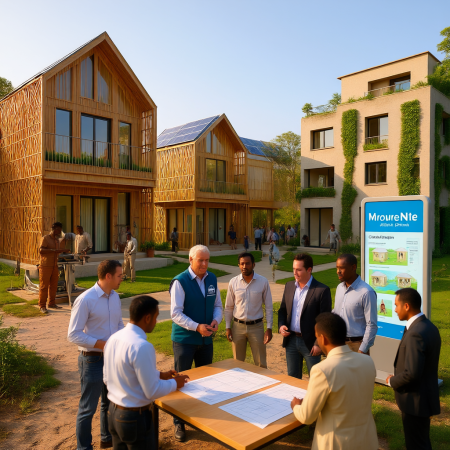
Beyond Concrete and Steel: Materials That Breathe and Give Back
Alternative building technologies start with materials — and not the kind that choke rivers or bake the planet. Globally, innovators are turning agricultural waste, industrial byproducts, and even living organisms into structural solutions. In India, companies like Carbon Craft Design are capturing air pollution — literally — and compressing it into sleek, durable floor tiles. In the Philippines, “Eco Bricks” made from compacted plastic waste are being mortared into school walls.
In Germany, “hempcrete” — a mix of hemp hurd and lime — is insulating homes while sequestering carbon for decades. These aren’t craft projects; they’re code-compliant, scalable, and increasingly cost-competitive. Alternative building technologies recognize that the future of construction lies not in mining deeper, but in harvesting smarter — from what we already have, and what we’ve discarded.
Speed Without Sacrifice: Rapid Assembly for Rapid Response
Alternative building technologies are answering one of humanity’s most urgent questions: How do we house people — fast — without cutting corners? After earthquakes in Türkiye, floods in Pakistan, or wildfires in California, temporary shelters often become permanent slums. But with modular, flat-pack, and tool-free systems, dignified housing can be assembled in hours, not months. Organizations like Better Shelter (backed by IKEA Foundation) deploy refugee housing kits that unfold like origami — weatherproof, lockable, and solar-ready. In Mexico, startup Échale uses “Ecoblock” — a lightweight, interlocking adobe system — to build entire homes in under five days with local labor. Alternative building technologies turn crisis into catalyst — proving that speed and safety, urgency and dignity, can coexist.
The Rise of the Living Building: Structures That Grow and Adapt
Alternative building technologies are blurring the line between biology and architecture. In the Netherlands, companies like Mogu grow acoustic panels and floor tiles from fungal mycelium — a renewable, biodegradable material that thrives on agricultural waste. In Costa Rica, “living root bridges” — trained over decades from banyan trees — are inspiring architects to design buildings that literally grow into place. Even MIT’s Mediated Matter Group has prototyped “Aguahoja” — a pavilion made from chitosan (derived from shrimp shells) that composts gracefully at end-of-life. These aren’t sci-fi fantasies; they’re functional prototypes pointing toward a future where buildings are not inert objects, but dynamic, responsive, even biodegradable systems. Alternative building technologies invite us to build with nature — not against it.
3D Printing: From Prototypes to Communities
Alternative building technologies are scaling up — literally — with 3D printing. What began as small-scale experiments is now producing entire neighborhoods. In Dubai, the “Office of the Future” — a fully 3D-printed building — was completed in 17 days using a 20-foot-tall printer. In rural Kenya, startup 14Trees is printing affordable homes with local materials, cutting costs by 30% and construction time by 70%.
Even NASA is funding research into 3D-printed lunar habitats — using simulated moon dust. The magic isn’t just in the printer; it’s in the material science behind it — geopolymers, stabilized earth, recycled plastic composites — that make these structures durable, thermal-efficient, and locally sourced. Alternative building technologies are turning printers into peacebuilders — one layer at a time.
Bamboo: The Steel of the Global South
Alternative building technologies are resurrecting ancient wisdom with modern engineering — and nowhere is this more visible than in the global embrace of bamboo. Long dismissed as a “poor man’s timber,” bamboo is now being used to build schools in Ecuador, footbridges in Vietnam, and even mid-rise apartments in Bali. With tensile strength rivaling steel and growth rates that humble any tree, bamboo is the ultimate renewable structural material.
Colombian architect Simón Vélez pioneered techniques to treat and join bamboo for seismic resilience — now taught in universities from Tokyo to Texas. The International Bamboo and Rattan Organisation (INBAR) estimates that a global bamboo building boom could sequester 1.7 gigatons of CO2 by 2050. Alternative building technologies don’t always need to invent — sometimes, they just need to remember.
Earth Architecture: Ancient Wisdom, Modern Codes
Alternative building technologies are bringing dirt — yes, dirt — back into the mainstream. Rammed earth, adobe, cob, and compressed earth blocks are no longer relics of the past; they’re front-line solutions for affordable, climate-responsive housing. In Burkina Faso, architect Diébédo Francis Kéré won the Pritzker Prize for schools built with locally sourced clay, passive ventilation, and community labor.
In New Mexico, Earthship Biotecture builds off-grid homes from rammed tires and recycled cans — regulating temperature without AC. Even in frigid Canada, Earthship Ironbank proves that earthen walls can thrive in sub-zero winters. With thermal mass that buffers heat and cold, and zero embodied carbon, earth is the original green material. Alternative building technologies are helping regulators, insurers, and homeowners rediscover its power — one夯土 wall at a time.
Prefab and Modular: Factories as the New Construction Sites
Alternative building technologies are moving construction indoors — into factories. Prefabricated and modular systems allow for precision, waste reduction, and all-weather assembly. In Sweden, 85% of new homes are built offsite — with modules stacked like Lego to create everything from student dorms to luxury apartments. In Japan, Sekisui House mass-produces “smart units” with integrated IoT systems — shipped and assembled in days. Even disaster zones benefit: after Typhoon Haiyan, the Philippines deployed modular classrooms built in Manila factories — erected in remote islands within weeks. Alternative building technologies are turning construction from a chaotic, weather-dependent craft into a streamlined, tech-enabled industry — without losing the human touch.
Waste as Resource: The Circular Construction Economy
Alternative building technologies are closing the loop. Instead of landfills, they see feedstock. In Ghana, “Trashy Bags” turns plastic sachets into waterproof roofing tiles. In Italy, WASP (World’s Advanced Saving Project) prints homes using mud mixed with rice husks and straw — agricultural leftovers that would otherwise burn. In Australia, “The Living” project by architect Andrew Maynard uses salvaged timber, shipping containers, and demolition rubble to build playful, low-cost homes. Circular design isn’t an add-on; it’s the core principle — where every material has a next life, and nothing is “waste.” Alternative building technologies are proving that sustainability isn’t about sacrifice — it’s about smarter sourcing.
Digital Twins and AI: The Brains Behind the Build
Alternative building technologies are getting smarter — literally. Digital twins — virtual replicas of buildings — allow architects to simulate energy flows, structural loads, and occupancy patterns before a single brick is laid. AI algorithms optimize material use, predict maintenance needs, and even generate floor plans based on local climate and cultural preferences. In Singapore, the government mandates BIM (Building Information Modeling) for all public projects — reducing rework by 30%. In Brazil, startups use AI to convert satellite imagery into 3D-printable housing models for favelas. Alternative building technologies are merging silicon and steel — turning construction into a data-driven, predictive, and adaptive science.
Community-Led and Participatory: Building by the People, for the People
Alternative building technologies are democratizing design. No longer is architecture the domain of starchitects and developers. In Nepal, after the 2015 earthquake, villagers trained in “
earthbag construction” rebuilt their homes — stronger, cheaper, and culturally resonant. In Detroit, the “Detroit Cultivator” project empowers residents to build their own tiny homes from salvaged materials — with design support from local architects. In Kenya, “Maji na Ufanisi” teaches women to make stabilized earth blocks — turning them into builders, entrepreneurs, and community leaders. Alternative building technologies are tools of empowerment — putting hammers, trowels, and design software into the hands of those who need shelter most.
Climate Resilience: Building to Withstand the Unthinkable
Alternative building technologies are engineering for extremes. As floods, fires, and hurricanes intensify, homes must be more than comfortable — they must be survivable. In Bangladesh, “amphibious houses” float on buoyant foundations during monsoon floods. In California, “fire-resistant homes” use rammed earth walls and metal roofs to withstand wildfires. In the Caribbean, “hurricane-proof” homes built with ferrocement and aerodynamic shapes have weathered Category 5 storms. These aren’t luxury bunkers; they’re affordable, replicable models for vulnerable communities. Alternative building technologies are turning architecture into armor — without sacrificing beauty or belonging.
Policy and Regulation: Rewriting the Rulebooks
Alternative building technologies face their toughest opponent not in physics or finance — but in bureaucracy. For decades, building codes favored concrete, steel, and standardized methods — sidelining innovation. But pressure is mounting. The EU’s “Level(s)” framework now certifies buildings based on lifecycle carbon — not just safety. California’s “Appendix Chapter S” allows alternative materials like straw bale and earth if performance is proven. Rwanda has adopted national bamboo building codes. India’s Bureau of Indian Standards now includes guidelines for prefab and compressed earth. Alternative building technologies are forcing regulators to ask not “Is this allowed?” but “Does this work?” — and the answer is increasingly yes.
Finance and Investment: Unlocking Capital for Green Builds
Alternative building technologies need more than good ideas — they need money. Traditional lenders balk at “unproven” materials. But new models are emerging. Green bonds now fund earth and bamboo projects in Latin America. Impact investors back startups like Mighty Buildings (3D-printed homes) and BioMason (bio-cement bricks). In Kenya, “build now, pay later” microloans let families finance compressed earth homes through mobile money. Even insurance companies are getting on board — offering lower premiums for fire-resistant or flood-adaptive designs. Alternative building technologies are proving their bankability — one certified, cost-tracked, carbon-negative project at a time.
Education and Training: Building the Next Generation of Builders
Alternative building technologies require new skills — and new teachers. Universities from ETH Zurich to UC Berkeley now offer courses in bio-based materials and digital fabrication. In India, the “Development Alternatives” NGO trains rural youth in earth block making — creating green jobs while building green homes. In Senegal, the “Ecole d’Architecture de Thiès” teaches students to design with laterite stone and thatch — materials their ancestors mastered. Vocational institutes in Germany and Canada offer certifications in modular assembly and BIM coordination. Alternative building technologies aren’t just changing what we build — they’re changing who builds it, and how they learn.
Cultural Sensitivity: Designing with, not for, Communities
Alternative building technologies succeed only when they respect local identity. A thatched roof isn’t “primitive” — it’s perfectly adapted to tropical rains. A courtyard isn’t “old-fashioned” — it’s a social and thermal regulator. In Morocco, the “Earth Architecture Project” revived ancient “pisé” (rammed earth) techniques — now used in luxury eco-resorts and social housing alike. In Peru, “Arariwa” NGO trains Quechua communities to build schools using ancestral stone and earth methods — preserving culture while meeting modern safety standards. Alternative building technologies reject the “one-size-fits-all” global template — instead, they listen, adapt, and elevate local genius.
The Aesthetics of Sustainability: Beauty in the Biobased
Alternative building technologies are proving that green doesn’t mean grim. From the undulating bamboo curves of Bali’s Green School to the sculptural earth walls of Kéré’s Gando Library, sustainable architecture is becoming synonymous with beauty. In Portugal, “Oficina Maravilhas” builds cork-clad homes that glow like honey in the sun. In Japan, “Kengo Kuma & Associates” wraps buildings in woven timber lattices that dance with light and shadow. Sustainability is no longer an afterthought — it’s the source of inspiration. Alternative building technologies are turning environmental responsibility into artistic expression — where every curve, texture, and material tells a story of care.
Scaling the Revolution: From Pilot to Policy, Niche to Norm
Alternative building technologies face a final challenge: scale. A single earth home is inspiring; a million would be transformative. That’s why governments, NGOs, and corporations are moving from pilots to portfolios. The World Bank’s “Low-Carbon Building Program” funds alternative tech across 15 countries. IKEA’s “BoKlok” brand now sells modular, sustainable homes across Scandinavia and the UK. Even global chains like Marriott are piloting 3D-printed hotel rooms. The key? Standardization without sterilization — creating systems that can replicate globally while respecting local context. Alternative building technologies are no longer outliers — they’re the emerging mainstream.
Conclusion: Building a World That Builds Better
Alternative building technologies — say it again. Because repetition breeds recognition. Recognition breeds adoption. And adoption — of earth, bamboo, mycelium, prefab, AI, and community-led design — is what will turn the construction industry from a climate villain into a climate healer. This isn’t about rejecting the old — it’s about expanding the possible. It’s about homes that cool without AC, walls that grow from fungus, roofs that float above floods, and communities that build their own futures.
From the rice fields of Thailand to the tech labs of Boston, from refugee camps to luxury resorts — the materials may differ, but the mission is the same: to shelter humanity without sacrificing the planet. Alternative building technologies aren’t a trend. They’re a tide. And the tide, at last, is turning.
Alternative building technologies — embedded in policy, powered by people, scaled by startups, validated by science. They are the bricks and mortar of a new world — lighter, smarter, kinder. Let’s build it together.
Alternative building technologies — not tomorrow’s dream, but today’s duty. For every child who deserves a window, every elder who deserves a ramp, every planet that deserves a break — we owe them buildings worthy of their future.
Alternative building technologies — India’s quiet revolution, loud in impact. Watch this space. Live in it. Build it. Belong to it.
Alternative building technologies — the foundation of a built environment that doesn’t leave anyone — or anything — behind. That’s not just innovation. That’s justice.
Alternative building technologies — because shelter is sacred. And sacred things deserve better. The world is proving it can deliver — twentyfold.
Also read: Environment Friendly Building Material Technologies for Low-Cost Housing
