The Future of Green Building Materials in Egypt
Introduction
The future of green building materials in Egypt stands at a pivotal crossroads—shaped by urgent environmental challenges, rapid urbanization, government ambition, and a growing awareness of sustainable development. As one of the most populous and fastest-growing nations in the Middle East and North Africa (MENA) region, Egypt faces mounting pressure on its natural resources, energy grid, and urban infrastructure.
In this context, green building materials are no longer a luxury or niche trend; they are becoming a necessity for resilient, affordable, and climate-smart construction. The future of green building materials in Egypt is not just about bricks and insulation—it’s about reimagining how cities grow, how energy is used, and how communities thrive in harmony with a fragile desert ecosystem.
Environmental Pressures and Urban Expansion
Egypt’s environmental reality is stark: over 95% of its 110 million people live on just 5% of the land, concentrated along the Nile Valley and Delta. This extreme population density, combined with desertification, water scarcity, and rising temperatures resulting from climate change, creates an immense strain on housing and infrastructure. Meanwhile, mega-projects like the New Administrative Capital and New Alamein City aim to decongest Cairo and accommodate millions of new residents—demanding massive construction activity. Without sustainable practices, this urban explosion could deepen Egypt’s carbon footprint and resource depletion. The future of green building materials in Egypt must therefore address not only environmental performance but also scalability, affordability, and local adaptability.
Government Policy and Regulatory Momentum
In recent years, the Egyptian government has signaled strong support for sustainability. The National Climate Change Strategy 2050, launched in 2022, explicitly prioritizes green construction as a pillar of low-carbon development. The Building Code for Energy Efficiency, introduced in 2021, mandates improved thermal insulation, energy-efficient lighting, and water-saving fixtures in new public buildings. Additionally, the Green Building Rating System—Egypt’s version of LEED or BREEAM—is being piloted in government projects to incentivize sustainable design. While enforcement remains inconsistent and private developers often lag behind, these policy frameworks lay the groundwork for mainstream adoption. The future of green building materials in Egypt will depend heavily on turning these guidelines into enforceable standards and market incentives.
Local Innovation and Traditional Wisdom
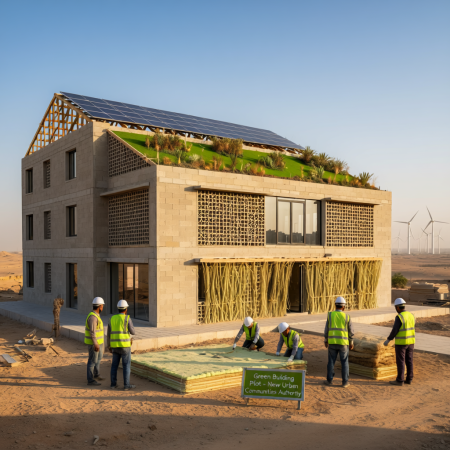
Egypt is not starting from scratch. For centuries, vernacular architecture in Upper Egypt and the desert oases used locally sourced, passive-cooling materials like mudbrick, limestone, and palm fronds—naturally insulating and low-impact. Today, researchers and startups are reviving and modernizing these traditions. Compressed earth blocks (CEBs), stabilized with small amounts of cement or lime, offer high thermal mass and reduce reliance on energy-intensive fired bricks. Similarly, recycled agricultural waste—such as rice husks, sugarcane bagasse, and date palm fibers—is being tested as lightweight aggregate or insulation. These innovations prove that the future of green building materials in Egypt can be both cutting-edge and rooted in cultural heritage.
Waste-to-Resource Opportunities
Egypt generates over 90 million tons of solid waste annually, much of it construction and demolition debris or agricultural residue. Rather than treating this as a disposal problem, forward-thinking firms see it as a raw material stream. Recycled concrete aggregate (RCA) is already used in road bases and non-structural elements. Plastic waste is being incorporated into composite lumber and roofing tiles. Even desert sand—once considered useless for concrete due to its smooth grains—is being engineered into viable building products through new binding technologies. By closing the loop between waste and construction, Egypt can reduce landfill burden, cut import dependence, and lower costs. This circular approach is central to the future of green building materials in Egypt.
Energy Efficiency and Thermal Comfort
In a country where summer temperatures regularly exceed 40°C (104°F), reducing cooling demand is critical. Conventional buildings in Egypt often rely heavily on air conditioning, straining the national grid and increasing household energy bills. Green materials like reflective cool roofs, high-performance insulation (e.g., mineral wool or cellulose), and double-glazed windows can dramatically cut heat gain. Moreover, phase-change materials (PCMs)—which absorb and release thermal energy—can stabilize indoor temperatures without electricity. Integrating these solutions into affordable housing is key. The future of green building materials in Egypt must prioritize passive design strategies that deliver comfort while slashing energy use.
Water Conservation in Building Systems
Water scarcity is another existential challenge. Egypt’s per capita water share is well below the UN’s “water poverty” threshold. Green building materials can contribute to water resilience through permeable pavements that recharge groundwater, greywater recycling systems using non-toxic piping, and low-flow fixtures made from sustainable composites. Even façade materials that harvest dew or reduce evaporation can play a role. As urban water stress intensifies, the future of green building materials in Egypt will increasingly intersect with water-smart urban design.
Affordability and Market Barriers
Despite their long-term benefits, green materials often carry higher upfront costs—a major barrier in a price-sensitive market. Many developers and homeowners perceive sustainability as expensive or elitist. Additionally, limited local production, lack of skilled labor, and fragmented supply chains hinder scalability. To overcome this, Egypt needs targeted subsidies, tax breaks, and public-private partnerships to bring costs down. Pilot projects like the green social housing units in New Borg El Arab show that affordability and sustainability can coexist. The future of green building materials in Egypt hinges on making them accessible—not just to luxury developers, but to the masses.
Role of Education and Capacity Building
Widespread adoption also requires a knowledge shift. Architects, engineers, contractors, and even masons need training in sustainable material selection, installation, and maintenance. Universities like Cairo University and Ain Shams are beginning to integrate green building into curricula, but industry-academia collaboration remains weak. Professional certification programs and hands-on workshops can bridge this gap. Without a skilled workforce, even the best materials will be misused or underutilized. Thus, human capital development is inseparable from the future of green building materials in Egypt.
Private Sector Engagement and Green Startups
Encouragingly, Egypt’s private sector is showing signs of momentum. Companies like
Green Building Egypt,
Eco Consult, and
Sustainable Building Solutions are importing, distributing, and even manufacturing eco-friendly products—from solar tiles to bamboo composites. Meanwhile, green tech startups are emerging with innovations like mycelium-based insulation or algae-integrated façades. International partnerships, such as those with the EU’s Green for Growth Fund or the World Bank’s Sustainable Housing Project, are providing crucial financing and technical support. This entrepreneurial energy is vital to scaling solutions. The future of green building materials in Egypt will be driven as much by market innovation as by policy.
Cultural Perception and Consumer Demand
Public awareness is slowly shifting. Younger Egyptians, influenced by global climate movements and social media, are increasingly demanding sustainable lifestyles—including in housing. Real estate developers now market “eco-friendly” apartments as premium features, even if green elements are minimal. While greenwashing remains a risk, genuine consumer interest can push the market toward authenticity. Community-led initiatives, such as eco-villages in Siwa or sustainable desert lodges in the Red Sea, also demonstrate grassroots demand. As environmental literacy grows, so too will pressure on builders to deliver real sustainability. This cultural shift is a quiet but powerful force shaping the future of green building materials in Egypt.
Integration with Renewable Energy
Green materials don’t operate in isolation—they work best when integrated with renewable energy systems. Solar panels on rooftops made of recycled metal,
building-integrated photovoltaics (BIPV) in façades, or thermal mass walls paired with solar water heaters create synergistic efficiency. Egypt’s abundant sunshine makes this integration especially promising. The New Administrative Capital, for instance, plans to source 35% of its energy from renewables. For this vision to succeed, building envelopes must be designed to maximize energy capture and retention. Thus, the future of green building materials in Egypt is deeply intertwined with the nation’s clean energy transition.
Challenges of Standardization and Certification
One persistent obstacle is the lack of unified standards for what qualifies as “green.” Without clear, locally relevant criteria for material performance, durability, and environmental impact, confusion reigns. Egypt’s Green Building Rating System is a step forward, but it needs wider adoption and third-party verification. International certifications like LEED are costly and not always suited to Egypt’s climate or economy. Developing affordable, Arabic-language labeling and testing protocols will build trust and transparency. Standardization is essential to prevent greenwashing and ensure quality—cornerstones of the future of green building materials in Egypt.
Climate Resilience and Adaptation
Beyond mitigation, green materials must also enhance resilience. As extreme heatwaves, dust storms, and occasional flash floods become more frequent, buildings need to withstand these shocks. Materials with high reflectivity, erosion resistance, and moisture regulation will be critical. For example, lime-based plasters resist mold in humid coastal areas, while rammed earth walls endure desert heat. Designing for resilience means selecting materials that protect occupants and infrastructure under stress. In this sense, the future of green building materials in Egypt is also a strategy for climate adaptation.
International Collaboration and Knowledge Transfer
Egypt is not alone in this journey. Countries like Morocco, Jordan, and Tunisia have made strides in sustainable construction, offering valuable lessons. International organizations—UNDP, UNEP, GIZ, and the Islamic Development Bank—are supporting green building initiatives across the region. Technology transfer, joint research, and regional material databases can accelerate progress. By learning from global best practices while adapting them to local conditions, Egypt can avoid costly mistakes and leapfrog to smarter solutions. This collaborative spirit will enrich the future of green building materials in Egypt.
The Role of Digital Tools and Smart Materials
Emerging technologies are opening new frontiers. Building Information Modeling (BIM) software allows architects to simulate energy performance and material lifecycles before construction begins. Smart materials—such as self-healing concrete or air-purifying paints—are entering the market, though cost remains a barrier. Drones and AI can optimize material delivery and reduce waste on-site. While still nascent in Egypt, these digital tools promise to make green construction more precise, efficient, and data-driven. Embracing innovation will be key to staying competitive. The future of green building materials in Egypt will increasingly blend tradition with technology.
Conclusion: Building a Sustainable Legacy
The future of green building materials in Egypt is not a distant dream—it is an urgent, achievable mission. With the right mix of policy, innovation, education, and public engagement, Egypt can transform its construction sector from a source of emissions into a driver of sustainability. The stakes are high: every new building erected today will shape the country’s environmental and social landscape for decades. By choosing materials that conserve resources, protect health, and respect the desert environment, Egypt can build not just structures, but a legacy of resilience.
Also read: Increase in Urbanization and Consequential Increase in Demand Egypt
