FORECLOSURE EXTERNALITIES IN USA
Introduction
Foreclosure Externalities in USA refer to the indirect costs and spillover effects that occur when a home enters foreclosure—not just for the homeowner, but for neighboring properties, local governments, and entire communities. While foreclosure is often viewed as a private financial failure between a borrower and a lender, its consequences ripple outward, depressing property values, increasing crime, reducing municipal tax revenues, and destabilizing social networks.
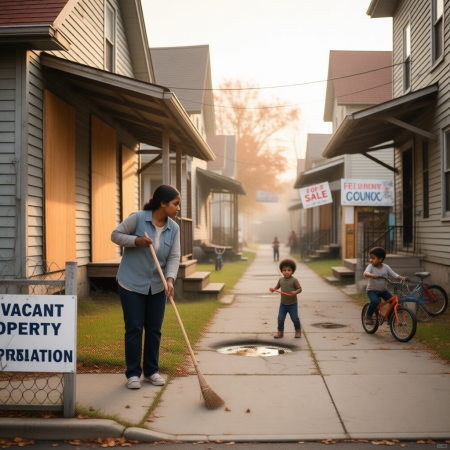
These externalities became especially visible during the 2007–2010 subprime mortgage crisis, when millions of foreclosures triggered cascading economic and social disruptions across cities and suburbs alike. Today, even in periods of relative housing market stability, Foreclosure Externalities in USA remain a critical concern for urban planners, policymakers, economists, and residents striving to build resilient neighborhoods.
Defining Foreclosure Externalities
At its core, a foreclosure externality is a negative effect imposed on third parties who did not participate in the original mortgage agreement. Unlike direct costs—such as the homeowner’s loss of equity or the lender’s write-off—externalities are borne involuntarily by neighbors, local businesses, schools, and public services. For example, a vacant, foreclosed home may attract vandalism or become a site for illegal activity, lowering the quality of life for nearby households.
Similarly, declining property values in a block with multiple foreclosures can erode homeowners’ wealth and reduce their ability to invest in home improvements or local enterprises. These effects are not isolated; they compound over time and space, creating feedback loops that can transform once-stable neighborhoods into areas of concentrated disadvantage.
Property Value Depreciation: The Most Documented Externality
Among all Foreclosure Externalities in USA, the reduction in neighboring home values is the most extensively studied and economically significant. Empirical research consistently shows that homes located within 500 feet of a foreclosed property can lose between 1% and 2% of their value—a figure that rises sharply when multiple foreclosures cluster in the same block. A landmark 2011 study by the Federal Reserve Bank of Cleveland found that a single foreclosure could reduce the sale price of nearby homes by an average of $7,200.
In hard-hit cities like Detroit, Las Vegas, or Cleveland during the housing crisis, entire blocks saw cumulative value losses exceeding 30%. These losses are not merely financial—they translate into reduced household net worth, diminished access to credit (since home equity often serves as collateral), and weakened incentives for homeowners to maintain their properties, further accelerating neighborhood decline.
Neighborhood Blight and Physical Deterioration
Foreclosure Externalities in USA also manifest in the physical decay of the built environment. Once a home is abandoned, routine maintenance stops: lawns overgrow, roofs leak, windows break, and pests move in. Unlike owner-occupied homes, vacant foreclosed properties are often poorly managed by banks or servicers who delay repairs or property preservation. This visible blight signals neglect, discourages investment, and invites further disinvestment.
Neighboring owners may feel demoralized or economically constrained from upgrading their own homes, creating a downward spiral. In extreme cases, municipalities resort to demolishing structurally unsound foreclosed homes—a costly measure that leaves vacant lots, which can become dumping grounds or fire hazards. Thus, one family’s financial distress can degrade the aesthetic and functional integrity of an entire block.
Rise in Crime and Social Disruption
Multiple studies have established a strong correlation between foreclosures and increased crime rates, particularly property crimes like burglary and vandalism, but also violent offenses in some contexts. Vacant homes provide cover for illicit activities, while the social disruption caused by forced displacement weakens informal community surveillance—the “eyes on the street” that deter crime. When long-term residents are replaced by transient renters or absentee owners, neighborhood cohesion erodes, and trust among neighbors declines. This social fragmentation undermines collective efficacy, making it harder for communities to organize around shared concerns like safety or school quality. These social Foreclosure Externalities in USA are harder to quantify than property value losses but are equally damaging to community well-being and long-term recovery prospects.
Fiscal Strain on Local Governments
Local governments bear significant fiscal burdens from Foreclosure Externalities in USA. As property values fall, so do property tax revenues—the primary funding source for schools, police, fire departments, and public infrastructure. At the same time, municipal costs rise code enforcement officers must inspect abandoned homes, police respond more frequently to nuisance calls, and public health departments address hazards like mold or rodent infestations.
In some jurisdictions, cities have had to create “land banks” to manage the inventory of tax-delinquent and foreclosed properties, adding administrative overhead. This double squeeze—less revenue, more expenses—forces difficult trade-offs, often leading to cuts in essential services precisely when communities need them most. The result is a self-reinforcing cycle of disinvestment that can take years or even decades to reverse.
Displacement and Community Fragmentation
Foreclosure is not just an economic event—it is a deeply personal and social rupture. Families are uprooted from homes, schools, support networks, and jobs. Children may change schools multiple times, disrupting their education. Elderly residents may lose access to familiar healthcare providers or community centers. This displacement fragments social ties that are vital for community resilience. Moreover, renters are not immune: nearly 40% of foreclosed homes during the crisis were occupied by tenants who had no role in the mortgage default yet were evicted with little notice. These human dimensions of Foreclosure Externalities in USA highlight how housing instability cascades into broader social inequities, disproportionately affecting low-income, minority, and vulnerable populations.
Racial and Geographic Inequities
The burden of Foreclosure Externalities in USA has not been distributed evenly. Historical patterns of redlining, discriminatory lending, and residential segregation concentrated subprime loans—and subsequent foreclosures—in Black and Latino neighborhoods. Predatory lending practices targeted these communities with high-cost, adjustable-rate mortgages, even when borrowers qualified for prime loans.
As a result, majority-minority neighborhoods experienced foreclosure rates two to three times higher than white neighborhoods with similar income levels. The externalities amplified existing racial wealth gaps: while white families lost wealth during the crisis, Black and Latino families lost a far greater share of their total net worth, much of which was tied to home equity. Thus, Foreclosure Externalities in USA are not only economic phenomena but also mechanisms of systemic inequality.
Impact on Rental Markets and Housing Supply
A lesser-discussed but growing externality involves the post-foreclosure conversion of homes into rental units—often by large
institutional investors. Following the crisis, firms like Blackstone acquired tens of thousands of foreclosed homes at steep discounts, turning them into single-family rentals. While this provided housing options in tight markets, it also shifted ownership from households to corporations, reducing local control and long-term stability. These investor-owned properties are more likely to be managed remotely, with less responsiveness to tenant or neighborhood concerns. Furthermore, the financialization of housing treats homes as assets rather than places to live, potentially inflating rents and reducing affordability—adding another layer to the complex web of Foreclosure Externalities in USA.
Policy Responses and Mitigation Strategies
Recognizing the scale of these spillovers, various policy interventions have been deployed to mitigate Foreclosure Externalities in USA. At the federal level, the Home Affordable Modification Program (HAMP) aimed to prevent avoidable foreclosures through loan modifications, though its reach was limited. Local governments have experimented with “right to counsel” laws (giving tenants legal representation in eviction cases), foreclosure mediation programs, and vacant property registration ordinances that require lenders to maintain abandoned homes.
Some cities incentivize owner-occupancy through tax breaks or grants for rehabilitation. Community land trusts and nonprofit housing organizations have also played a role in acquiring foreclosed properties and preserving them as permanently affordable housing. While no single solution eliminates externalities, a combination of prevention, rapid preoccupancy, and community-centered redevelopment shows promise.
The Role of Data and Early Warning Systems
Modern approaches to managing Foreclosure Externalities in USA increasingly rely on data analytics. Cities like Baltimore and Chicago use predictive models to identify blocks at high risk of foreclosure clusters, enabling proactive interventions such as financial counseling or code enforcement. Public-private partnerships share anonymized mortgage data to flag delinquent loans before they reach foreclosure. Early detection allows for more cost-effective responses, reducing the severity and spread of externalities. Transparent data also empowers community groups to advocate for targeted resources and hold lenders accountable.
Long-Term Urban Planning Implications
The legacy of Foreclosure Externalities in USA continues to shape urban planning priorities. Cities now place greater emphasis on housing stability as a pillar of economic development. Zoning reforms, inclusionary housing mandates, and anti-displacement policies are being integrated into comprehensive plans. There is also growing recognition that housing policy cannot be siloed from transportation, education, and public health—since foreclosures affect all these domains. Planners are increasingly adopting “housing as infrastructure” frameworks, treating stable, affordable housing as essential to community resilience, much like roads or sewers.
Lessons from the Past, Challenges Ahead
While the acute phase of the foreclosure crisis has passed, Foreclosure Externalities in USA remain relevant in an era of rising interest rates, pandemic-era mortgage forbearance expirations, and economic uncertainty. Climate-related disasters—such as floods or wildfires—now also threaten to trigger new waves of mortgage distress, particularly in vulnerable regions. Without robust safeguards, another surge in foreclosures could reignite the same destructive externalities. The key lesson is that housing markets are deeply embedded in social and spatial contexts: a foreclosure is never just one household’s problem. It is a community-wide challenge requiring coordinated, compassionate, and forward-looking solutions.
Conclusion: A Call for Systemic Solutions
Foreclosure Externalities in USA reveal the profound interdependence of households within neighborhoods. What happens to one home affects many others—economically, socially, and psychologically. Addressing these spillovers demands more than temporary bailouts; it requires rethinking housing finance, strengthening tenant and homeowner protections, investing in community capacity, and prioritizing equity in urban policy. By acknowledging and actively mitigating Foreclosure Externalities in USA, policymakers can foster more stable, inclusive, and resilient communities where housing serves people—not just portfolios. In doing so, they honor the fundamental truth that a home is not merely an asset, but the foundation of individual dignity and collective well-being.
Also read: Workforce Housing in Texas, USA
