
A Framework For Facilitating Low-Income Net-Zero Energy Housing Delivery In Developing Countries: Insights From A Practical Case In South Africa
Introduction
South Africa faces a profound dual crisis: a staggering housing backlog of approximately 2.4 million units and a persistent energy emergency characterized by load-shedding and unreliable grid infrastructure. These challenges disproportionately impact low-income households, exacerbating socio-economic disparities while straining the nation's climate commitments. Against this backdrop, researchers Alireza Moghayedi and Bankole Osita Awuzie present a groundbreaking framework for delivering low-income net-zero energy housing (LI-NZEH) using innovative building technologiogies (IBTs) a solution that simultaneously addresses housing insecurity, energy poverty, and carbon reduction targets.
The study emerges at a critical juncture as South Africa commits to the Net-Zero Carbon Buildings Accelerator, targeting net-zero emissions for all new buildings by 2030 and existing structures by 2050. Yet conventional construction methods reliant on energy-intensive materials like cement blocks and bricks dominate the affordable housing sector, with less than 5% of South African housing utilizing IBTs despite their certification by Agrément South Africa. This adoption gap stems largely from the absence of a coherent framework to evaluate the whole life sustainability and affordability performance of IBT-enabled low-income net-zero energy housing.
Methodology: Integrating International Standards for Holistic Assessment
The research adopts a rigorous dual-objective approach. First, it evaluates the environmental sustainability and affordability performance of an IBT-enabled low-income net-zero energy housing prototype against a conventional low-income house using internationally recognized assessment protocols. Second, it synthesizes these findings into a practical ten-step delivery framework grounded in ISO 14040, EN 15978, and RICS whole life carbon assessment (WLCA) principles.
The methodology begins with a comprehensive screening of 66 IBTs accredited in South Africa, evaluating suitability against four critical criteria: climatic appropriateness for South Africa's temperate zones, affordability within constrained low-income budgets, market availability, and performance characteristics including thermal resistance (R-value > 3.5), airtightness (ACH < 0.6), and solar absorbance (α̅s < 0.5). This rigorous selection process identified monolithic prefabricated structural insulated panels (SIPs) as the optimal IBT for low-income net-zero energy housing construction.
The design process then follows a four-stage net-zero housing framework incorporating passive sustainable design, energy-saving techniques, renewable energy integration, and backup systems. Performance evaluation spans the entire 50-year building lifecycle using functional units of one square meter of gross internal area serving a family of four.
Case Study Findings: Dramatic Environmental and Economic Advantages
The comparative assessment reveals transformative benefits of the low-income net-zero energy housing prototype. Whole life carbon assessment demonstrates a remarkable 97% reduction in CO₂ emissions compared to conventional housing dropping from 5,612.87 kgCO₂e/m² to just 160.38 kgCO₂e/m². This dramatic reduction stems from multiple factors. Embodied emissions during the production phase (A1-A3) decreased by 10% through lighter, more efficient SIP materials versus conventional cement blocks. Construction-phase emissions (A4-A5) plummeted by 60% from 15.96 to 6.43 kgCO₂e/m² attributable to the three-day construction timeline enabled by prefabrication, versus twelve days for conventional methods.
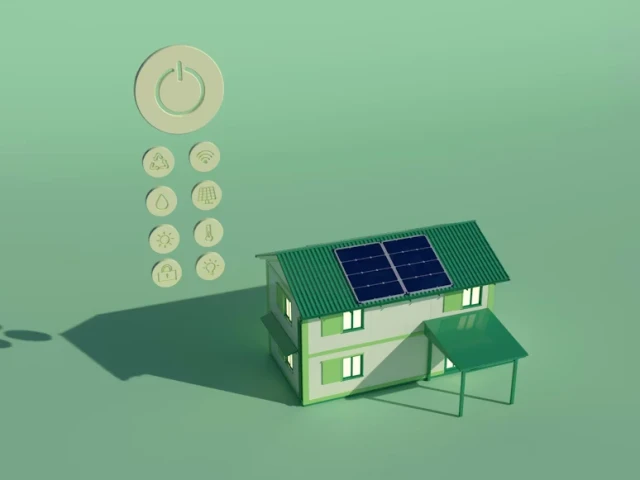
Most significantly, operational emissions registered zero for the LI-NZEH versus 5,434.21 kgCO₂e/m² for the conventional house a 100% reduction achieved through on-site solar photovoltaic generation. The low-income net-zero energy housing's superior thermal performance (R-value of 4.28 m²K/W) and exceptional airtightness (ACH of 0.52) reduced operational energy demand to 4.72 kWh/m²/month versus 8.25 kWh/m²/month for conventional housing. This demand is fully met by a compact 1.56 kW solar PV system with 25-kWh battery storage, eliminating grid dependence entirely.
End-of-life emissions also decreased by 38% due to SIPs' superior recyclability and reusability. Notably, the study identifies reinforced concrete in substructures as contributing approximately half of total embodied emissions in both housing types—a critical insight for future material optimization. The low-income net-zero energy housing's circularity quotient reached 71% reusability, approaching the Royal Institute of British Architects' 2030 target of 80%.
Life cycle cost assessment (LCCA) reveals equally compelling economic advantages. Despite 96% higher upfront material costs for SIPs, solar geysers, and double-glazed windows, the low-income net-zero energy housing achieved an 82% reduction in total lifecycle costs £290.46/m² versus £529.80/m² for conventional housing over 50 years. Construction costs decreased by 400% through prefabrication efficiency, while material wastage plummeted from 20% to just 1%. Crucially, sensitivity analysis demonstrates the low-income net-zero energy housing's resilience to market volatility: conventional housing costs increase up to 40% with energy price inflation, whereas low-income net-zero energy housing remains insulated from such fluctuations through renewable energy self-sufficiency.
The Ten-Step Low-Income Net-Zero Energy Housing Delivery Framework
Translating these findings into actionable guidance, the researchers developed a comprehensive ten-step framework for stakeholders:
Step 1: Define Project Scope and Objectives establishes sustainability goals and affordability requirements using ISO 14040/14044 standards.
Step 2: Passive Design Strategies optimizes building orientation, natural ventilation, and window-to-wall ratios aligned with local climate data and Passivhaus principles.
Step 3: Data Collection & Inventory Analysis documents material selections, IBT specifications, and end-of-life scenarios following ISO 20887 and RICS WLCA guidelines.
Step 4: Energy Performance Modeling utilizes EDGE software to simulate energy demand and on-site generation capacity per ISO 52000/52016 standards.
Step 5: Life Cycle Assessment calculates embodied and operational carbon across all lifecycle stages using EN 15804 and RICS protocols.
Step 6: Life Cycle Cost Assessment evaluates capital, operational, and end-of-life expenses against EN 16627 benchmarks to ensure affordability.
Step 7: Evaluate Circularity & Reusability assesses material recovery potential using ISO 59020 to advance circular economy principles.
Step 8: Comparative Analysis & Impact Assessment benchmarks low-income net-zero energy housing performance against conventional housing using ISO 14042/21930 standards.
Step 9: Interpretation synthesizes findings into actionable policy recommendations following ISO 14043 guidelines.
Step 10: Continuous Improvement establishes feedback loops for ongoing optimization using ISO 19650 information management standards.
This framework uniquely integrates environmental sustainability with affordability imperatives—addressing the critical barrier that has historically limited net-zero energy housing adoption in low-income contexts.
Strategic Recommendations and Future Pathways
The research concludes with actionable recommendations for accelerating low-income net-zero energy housing adoption. National and local governments must collaborate with developers and housing professionals to incentivize mass production, thereby reducing costs through economies of scale. Supporting local manufacturing of SIP components and other IBTs would simultaneously create jobs, reduce transportation emissions, and enhance supply chain resilience.
Public and private investment should prioritize research and development of bio-based materials, recycled content integration, and advanced prefabrication techniques to further reduce embodied carbon. Policy interventions should include updated building codes that recognize IBT performance advantages, streamlined certification processes fornet-zero energy housing projects, and targeted subsidies that offset higher initial material costs while emphasizing long-term lifecycle savings.
Future research directions identified include validating the framework with diverse South African stakeholders, conducting comparative studies across different climatic zones, exploring high-rise low-income net-zero energy housing configurations for dense urban contexts, and developing digital twins to verify actual energy generation versus modeled performance.
Overcoming Implementation Barriers in Developing Contexts
The research candidly addresses systemic barriers hindering LI-NZEH adoption in developing nations. These include fragmented policy frameworks where housing, energy, and climate ministries operate in silos; limited access to green financing mechanisms for upfront technology premiums; skills gaps in sustainable construction practices; and regulatory codes that haven't evolved to accommodate innovative systems. The framework proposes concrete mitigation strategies:
- Policy integration: Advocating for cross-ministerial housing-energy-climate task forces to align subsidies, building codes, and carbon pricing mechanisms
- Blended finance models: Structuring public-private partnerships where carbon credit revenues or green bonds offset initial technology premiums
- Demonstration projects: Scaling from single prototypes to neighborhood-scale implementations to build evidence, refine supply chains, and reduce unit costs through learning curves
- Regulatory modernization: Updating building standards to performance-based requirements rather than prescriptive material specifications, enabling innovation while ensuring safety and performance
Quantifiable Impact Potential
If scaled nationally in South Africa, IBT-enabled low-income net-zero energy housing could transform the country's housing and energy landscape. Assuming delivery of 200,000 subsidized housing units annually (current government targets), adopting the framework could annually avoid approximately 1.2 million tonnes of CO₂ emissions while saving households collectively over R4 billion ($220 million USD) in energy costs. These savings free household income for nutrition, education, and healthcare—amplifying poverty reduction impacts beyond shelter provision alone.
Furthermore, localized manufacturing of IBT components could stimulate green industrial development, creating skilled jobs in sustainable construction supply chains. This aligns with just transition principles ensuring climate action doesn't exacerbate inequality but instead generates inclusive economic opportunities
Conclusion: A Viable Pathway to Sustainable, Affordable Housing
This study demonstrates conclusively that low-income net-zero energy housing is not merely theoretically possible but economically superior and environmentally essential for developing nations confronting housing and energy crises. The South African case study proves that IBT-enabled LI-NZEH delivers dramatic reductions in both carbon emissions and lifecycle costs while improving construction speed, material efficiency, and occupant comfort.
By providing the first comprehensive framework integrating whole life carbon assessment with affordability analysis specifically for low-income contexts, this research fills a critical knowledge gap that has hindered NZEH adoption in the Global South. The ten-step delivery framework offers practical, standards-aligned guidance for policymakers, developers, architects, and contractors seeking to implement sustainable housing at scale.
As climate pressures intensify and urbanization accelerates across developing nations, the LI-NZEH model presents a replicable blueprint for achieving multiple Sustainable Development Goals simultaneously: affordable housing (SDG 11), clean energy access (SDG 7), climate action (SDG 13), and decent work through local manufacturing (SDG 8). The South African prototype proves that sustainability and affordability are not competing priorities but mutually reinforcing objectives when approached through innovative design, appropriate technology selection, and lifecycle thinking.
For nations grappling with similar challenges—from Brazil to India to Nigeria—the lessons from this South African case study offer a compelling pathway toward housing justice, energy sovereignty, and climate resilience. The framework's emphasis on locally adaptable standards rather than prescriptive technologies ensures its relevance across diverse geographical and economic contexts, making it a valuable contribution to global sustainable development discourse.
Read Also: The European Affordable Housing Plan