Cooperative and Islamic Banks: What Can They Learn from Each Other?
Introduction
Cooperative and Islamic Banks represent two distinct yet surprisingly complementary models of ethical finance that have gained traction in an era of growing skepticism toward conventional banking. While Cooperative and Islamic Banks differ in their origins—cooperatives rooted in 19th-century European mutual aid movements, and Islamic banks grounded in Sharia-compliant principles dating back to early Islamic civilization—they share a common vision: placing people and community well-being above pure profit.
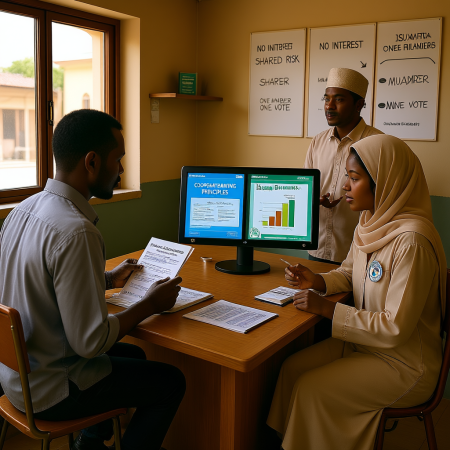
In a global financial landscape often criticized for short-termism, inequality, and moral hazard, both Cooperative and Islamic Banks offer alternative pathways that prioritize inclusion, fairness, and social responsibility. This raises a compelling question: What can they learn from each other? By examining their structures, values, challenges, and innovations, we uncover rich opportunities for cross-pollination that could strengthen both models and inspire a more resilient, equitable financial system. Indeed, the dialogue between Cooperative and Islamic Banks is not just academic—it’s urgently practical.
Shared Ethical Foundations
At their core, Cooperative and Islamic Banks are united by ethical imperatives that reject exploitative finance. Cooperative banks operate on the principle of member ownership: customers are also owners, with voting rights and shared profits. Their motto— “not for profit, not for loss, but for service”—echoes a deep commitment to community welfare. Similarly, Islamic banks prohibit
Riba (interest),
gharar (excessive uncertainty), and
maysir (gambling), emphasizing risk-sharing, asset-backing, and real economic activity.
Both models reject the notion that finance should exist in a moral vacuum. Instead, Cooperative and Islamic Banks embed social purpose into their DNA. This alignment creates fertile ground for mutual learning—especially in designing products that serve low-income households, small businesses, and marginalized communities without compromising ethical integrity.
Divergent Operational Models
Despite shared values, Cooperative and Islamic Banks differ significantly in structure and mechanics. Cooperative banks are typically organized as member-owned institutions—like Germany’s
Volksbanken or India’s cooperative credit societies—where governance is democratic and profits are reinvested or distributed as patronage dividends. Islamic banks, by contrast, may be shareholder-owned (like Dubai Islamic Bank) or state-sponsored (like Malaysia’s Bank Islam), but must adhere to Sharia governance through a supervisory board of scholars.
Their financial instruments—such as
murabaha (cost-plus financing),
mudaraba (profit-sharing), and
ijara (leasing)—are structurally distinct from conventional loans. While cooperatives focus on local empowerment through mutualism, Islamic banks emphasize theological compliance through contract-based finance. These differences mean that Cooperative and Islamic Banks approach risk, capital, and customer relationships in unique ways—offering each other fresh perspectives on sustainable banking.
Risk-Sharing: A Common Language
One of the most powerful areas of convergence lies in risk-sharing. Islamic finance mandates that lenders and borrowers share business risk—unlike conventional debt, where risk falls almost entirely on the borrower. Cooperative banks, though not always structured as equity partners, often exhibit strong risk empathy: they lend based on character and community ties, not just collateral. In practice, both Cooperative and Islamic Banks avoid predatory lending and prioritize long-term relationships over transactional efficiency.
For instance, during economic downturns, cooperative banks in Europe have shown greater forbearance than commercial peers; similarly, Islamic banks in Southeast Asia have restructured contracts to support struggling entrepreneurs. By deepening their focus on genuine risk-sharing—beyond legal form—Cooperative and Islamic Banks can pioneer more humane credit models that build resilience rather than fragility.
Challenges in Governance and Scalability
Both models face structural challenges that limit their reach. Cooperative banks often struggle with weak governance, political interference (especially in developing countries), and difficulty raising capital due to their non-listed, member-funded nature. Islamic banks, meanwhile, grapple with “
Shariah arbitrage”—where products mimic conventional loans in substance while appearing compliant in form—as well as a shortage of qualified scholars and standardized regulatory frameworks.
Moreover, both Cooperative and Islamic Banks find it hard to scale without diluting their mission. Yet here lies a learning opportunity: cooperative banks can adopt Islamic finance’s rigorous ethical auditing (via Sharia boards) to reinforce accountability, while Islamic banks can embrace cooperative principles of democratic governance to enhance transparency and member trust. Strengthening governance is key to ensuring that Cooperative and Islamic Banks remain true to their values as they grow.
Financial Inclusion as a Shared Mission
Perhaps the greatest synergy between Cooperative and Islamic Banks lies in financial inclusion. In regions like South Asia, West Africa, and Southeast Asia, both models serve populations excluded by mainstream banks—farmers, women, micro-entrepreneurs—often in the same communities. In Indonesia, for example, rural cooperatives and Islamic
BMTs (Baitul Maal wa Tamwil) coexist, offering savings, credit, and zakat (charity) services.
Yet they rarely collaborate. Imagine if Cooperative and Islamic Banks partnered to create hybrid institutions: member-owned, Sharia-compliant credit unions that combine democratic control with ethical finance. Such models could dramatically expand access while reducing duplication. By sharing distribution networks, agent training, and digital platforms, Cooperative and Islamic Banks could amplify their collective impact on poverty reduction and economic empowerment.
Innovation in Digital Finance
The digital revolution offers another frontier for mutual learning. Fintech has enabled both Cooperative and Islamic Banks to overcome traditional barriers—geography, cost, scale. Islamic neobanks like
Wahed or
Algbra use AI to offer halal investment portfolios; cooperative fintechs like
Fairbnb or
Mondragon’s digital platforms enable peer-to-peer collaboration. However, many grassroots Cooperative and Islamic Banks still rely on manual processes.
By exchanging best practices—such as Islamic banks’ use of blockchain for transparent
sukuk (bonds), or cooperatives’ community-based digital onboarding—both can leapfrog legacy constraints. Joint innovation labs or regional alliances could help Cooperative and Islamic Banks co-develop inclusive, ethical digital finance solutions that serve the underserved without compromising principles.
Regulatory Recognition and Level Playing Fields
A persistent hurdle for both models is regulatory asymmetry. Conventional banking rules—designed for profit-maximizing, shareholder-driven institutions—often fail to accommodate the unique features of Cooperative and Islamic Banks. Capital adequacy rules, for instance, may penalize profit-sharing instruments or member equity structures. Liquidity frameworks rarely recognize Sharia-compliant short-term instruments like
wakala deposits.
Similarly, cooperative banks are sometimes misclassified as NGOs or mutual societies, limiting their ability to offer full banking services. Advocacy for tailored regulatory sandboxes, proportionate supervision, and international standards (e.g., IFSB for Islamic finance, ICA for cooperatives) is essential. Here, Cooperative and Islamic Banks can form powerful coalitions to lobby for recognition—not as niche alternatives, but as vital pillars of a pluralistic financial ecosystem.
Case Studies of Convergence
Real-world examples already hint at the potential of blending these models. In Malaysia, the
Bank Rakyat—a large cooperative bank—has introduced Sharia-compliant windows to serve Muslim members, effectively operating as a dual-model institution. In Senegal, some
caisses populaires (people’s banks) integrate Islamic savings products alongside cooperative credit. In the UK, the
Islamic Co-operative Finance Society explores member-owned halal finance. These hybrids demonstrate that Cooperative and Islamic Banks can coexist within a single institution, offering customers choice without compromising ethics. Scaling such experiments requires knowledge exchange, shared training, and supportive policy—but the blueprint exists.
Cultural and Educational Exchange
Beyond products and policies, Cooperative and Islamic Banks can learn from each other’s cultures. Cooperative movements emphasize solidarity, education, and self-help—values echoed in Islamic concepts of
ta’awun (mutual assistance) and
amanah (trustworthiness). Joint workshops, scholar-practitioner dialogues, and youth programs could foster deeper understanding. For instance, Islamic finance students could study cooperative governance; cooperative leaders could learn about Sharia-compliant risk management. Building a shared lexicon of ethical finance—where
mudaraba meets mutualism, and
zakat aligns with social dividends—would enrich both traditions and inspire new generations of ethical bankers.
Sustainability and Climate Resilience
In the age of climate crisis, both models offer green advantages. Islamic finance prohibits investment in harmful industries (e.g., tobacco, weapons, fossil fuels) and encourages environmental stewardship (
khalifa—guardianship of Earth). Cooperative banks often fund renewable energy, organic farming, and community resilience projects. By aligning these strengths, Cooperative and Islamic Banks could lead in green and climate-resilient finance—issuing cooperative-Islamic green bonds, financing agroecology through
musharaka partnerships, or creating community-based climate insurance pools. Their shared focus on real economy impact makes them natural allies in the transition to sustainable development.
Overcoming Misconceptions
Both Cooperative and Islamic Banks battle stereotypes: cooperatives are seen as outdated or inefficient; Islamic banks as exotic or restrictive. Yet data tells a different story—cooperative banks showed remarkable stability during the 2008 crisis; Islamic banks have delivered competitive returns with lower volatility. By jointly publishing impact reports, hosting public forums, and showcasing success stories, Cooperative and Islamic Banks can reshape narratives and attract broader support—from policymakers, investors, and customers alike.
The Path Forward: Toward Ethical Finance Ecosystems
The future of finance may not lie in one model dominating, but in diverse, values-driven institutions coexisting and collaborating. Cooperative and Islamic Banks—rooted in community, ethics, and real economy engagement—are uniquely positioned to lead this shift. They can learn from each other’s governance innovations, product designs, inclusion strategies, and resilience mechanisms. More importantly, they can demonstrate that finance can be a force for dignity, not just profit. As global challenges mount—from inequality to climate change—the world needs more, not fewer, ethical finance options. The synergy between Cooperative and Islamic Banks could be a beacon in that direction.
Conclusion
In conclusion, Cooperative and Islamic Banks are far more than financial alternatives—they are expressions of deeply held social and moral visions. While their histories and tools differ, their goals align: inclusive, fair, and sustainable economies. By engaging in honest dialogue, sharing innovations, and building bridges across traditions, Cooperative and Islamic Banks can strengthen each other and offer a compelling counter-narrative to extractive finance. The question is no longer whether they can learn from each other—but how quickly they will.
Also read: ISLAMIC MICROFINANCE: AN IMPORTANT TOOL OF POVERTY ELIVIATION
