The Construction of Affordable Housing in Developing Countries: A Scientific Review
Introduction
The Construction of Affordable Housing in Developing Countries is not a technical challenge alone — it is a systemic one. As cities in Africa, South Asia, and Latin America swell with millions of new residents each year, the demand for safe, dignified, and affordable shelter far outstrips supply. Formal housing markets serve only a fraction of the urban poor. The rest build their own homes, often on land without legal title, using salvaged materials, local labor, and generations of inherited knowledge.
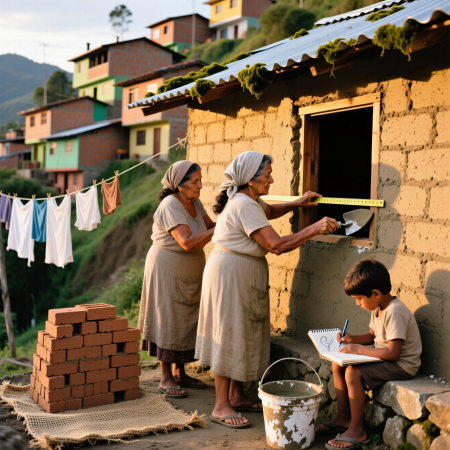
The Construction of Affordable Housing in Developing Countries must move beyond top-down models and outdated standards. It must be rooted in evidence, adapted to local realities, and designed with the people who live in these homes — not for them.
Understanding the Scale of Informal Housing
Most housing in developing cities is not built by developers or governments — it is built by residents themselves. In Lagos, Nairobi, or Dhaka, up to 70% of urban housing exists outside formal systems. These are not “slums” in the derogatory sense — they are dynamic, evolving neighborhoods shaped by necessity, ingenuity, and community. Scientific literature consistently shows that attempts to replace informal housing with large-scale public projects often fail — not because of lack of funding, but because they ignore how people actually live.
The Construction of Affordable Housing in Developing Countries must begin by recognizing informal settlements as legitimate housing systems, not problems to be erased. Upgrading these areas — adding drainage, pathways, water access, and tenure security — is more effective, faster, and cheaper than relocation.
The Role of Local Materials and Techniques
Concrete, fired bricks, and imported steel are expensive, energy-intensive, and often out of reach. Research from institutions like the International Institute for Environment and Development shows that locally sourced materials — compressed earth blocks, stabilized mud, bamboo, recycled plastic bricks, and lime-based plasters — can reduce construction costs by 30–50% while improving thermal performance.
A 2022 meta-analysis in
Habitat International found that homes built with compressed earth blocks in Kenya and Colombia had lower indoor temperatures, higher durability, and greater community acceptance than standard brick-and-mortar units. The Construction of Affordable Housing in Developing Countries thrives when it uses what is already available — not what is imported. When local masons are trained to work with these materials, they become not just builders, but stewards of sustainable urban growth.
Land Access and Tenure Security
No amount of good design matters if people don’t have the right to stay. Studies across 18 countries show that housing projects with secure land tenure have 70% higher long-term occupancy and maintenance rates. In Medellín, legal recognition of hillside barrios led to a 90% drop in forced evictions. In India’s Odisha state, issuing land titles to 150,000 slum households enabled families to access credit, make home improvements, and invest in education.
The Construction of Affordable Housing in Developing Countries cannot be solved by building more houses — it requires building more rights. Land pooling, community land trusts, and regularization of informal settlements are not radical ideas — they are proven strategies documented in peer-reviewed journals and implemented by UN-Habitat and the World Bank.
Community Participation as a Design Principle
Top-down housing projects fail because they assume residents want what planners imagine — not what they need. Scientific reviews, including a 2023 analysis of 67 global housing programs, confirm that when communities are involved in design, construction, and decision-making, outcomes improve dramatically. In Surat, women’s collectives mapped flood risks and redesigned drainage channels — reducing water damage by 60%.
In Kampala, youth used smartphones to document vacant public land, leading to targeted housing allocations. The Construction of Affordable Housing in Developing Countries works best when residents are not passive recipients, but active co-creators. Visual tools — chalk sketches, 3D models, photo-based feedback — make technical planning accessible to non-experts and foster ownership.
Financing That Matches Real Incomes
Most low-income households earn daily wages. They cannot qualify for traditional mortgages. The Construction of Affordable Housing in Developing Countries must match financing to reality. Microfinance for housing, savings groups, pay-as-you-build models, and matching grants have all shown success. In Bangladesh, households receiving small housing loans upgraded their homes at twice the rate of those without.
In Kenya, self-help groups achieved near-perfect repayment rates because of peer accountability. A 2023 study in
World Development found that
blended finance — combining public subsidies, community savings, and private investment — delivered the most sustainable results. The Construction of Affordable Housing in Developing Countries must be financially inclusive, not financially exclusive.
Climate Resilience as a Core Design Requirement
Floods, heatwaves, landslides — these are not future threats. They are daily realities in many informal settlements. Research from the University of Cape Town and the Asian Institute of Technology confirms that simple, low-cost adaptations — elevated foundations, reflective roofing, bioswales, and rainwater harvesting — reduce disaster risk and improve health. In Chennai, homes retrofitted with white-painted metal roofs saw indoor temperatures drop by 4.5°C. In Jakarta, raising homes by just 30 centimeters cut waterborne disease by 35%. The Construction of Affordable Housing in Developing Countries must integrate resilience from day one. These are not add-ons — they are necessities. And they are often cheaper to build in than to repair later.
Medium-Density, Mixed-Use Neighborhoods Over High-Rise Towers
High-rise housing may look modern, but it demands elevators, complex plumbing, and centralized maintenance — systems that break down under strain. In contrast, medium-density housing — four to six stories, with ground-floor shops and shared courtyards — offers affordability, walkability, and social cohesion. Studies in Medellín and Pune show that residents in these neighborhoods walk more, commute less, and report higher satisfaction. The Construction of Affordable Housing in Developing Countries benefits from compact, human-scale environments where housing, work, and services exist in proximity. This is not nostalgia — it is efficiency.
Building Local Capacity, Not Just Buildings
Housing projects collapse when local builders lack the skills to maintain them. Training masons, electricians, and plumbers in resilient, low-cost techniques turns housing into a livelihood. In Uganda, a government program trained 3,000 youth in earth-based construction — reducing defects by 40%. In Nepal, women became certified supervisors after the 2015 earthquake, improving safety and gender equity. The Construction of Affordable Housing in Developing Countries must invest in people as much as in materials. Skills are the most durable infrastructure.
Policy Reform: Removing Barriers to Build
Zoning laws, minimum plot sizes, parking mandates, and height restrictions often prevent affordable housing from being built. Research from Mexico City, Ghana, and Colombia shows that regulatory reform — allowing accessory units, mixed-use zones, and simplified approvals — unlocks housing potential. In Ghana, replacing “minimum size” rules with “minimum safety” standards enabled smaller, smarter homes. The Construction of Affordable Housing in Developing Countries cannot succeed under outdated, Western-derived codes designed for suburbs, not slums.
Data, Mapping, and Community Knowledge
Too many housing decisions are based on assumptions. New tools — satellite imagery, drone surveys, mobile apps for resident feedback — are changing that. In Nairobi, women used photo-based reports to identify flood zones, leading to reallocated drainage funds. In Pune, participatory mapping revealed that 70% of unused public land was already connected to water and sewage. The Construction of Affordable Housing in Developing Countries must be guided by data — not just from experts, but from those who live there.
Gender and Inclusion in Housing Design
Women manage households, care for children, collect water, and cook meals — yet they are rarely consulted in housing design. Studies show that when women lead housing initiatives, homes become safer, healthier, and more functional. In Bangladesh, women-led cooperatives added secure storage, indoor kitchens with smoke-reducing stoves, and private bathing areas — reducing respiratory illness and domestic violence. The Construction of Affordable Housing in Developing Countries is incomplete without gender-inclusive design.
Cultural Fit Over Standardization
A home is not just a structure — it is a cultural space. In West Africa, homes without extended family areas were abandoned. In South Asia, courtyards remain essential for social and religious life. The Construction of Affordable Housing in Developing Countries must respect these norms. Modular, flexible designs that allow for expansion and adaptation outperform rigid, one-size-fits-all units.
The Economic and Moral Case for Investment
Every dollar spent on decent housing returns $2 to $4 in economic and social benefits — through reduced healthcare costs, increased school attendance, and higher productivity. The Construction of Affordable Housing in Developing Countries is not an expense — it is an investment in human capital. Leaving millions in overcrowded, unsafe shelters is not just inhumane — it is economically irrational.
Scaling What Works
We already know what works: incremental development, community land trusts, local materials, participatory planning, and climate-responsive design. The science is clear. The models are proven. What’s missing is political will, coordinated funding, and institutional commitment. The Construction of Affordable Housing in Developing Countries must move from pilot projects to national policy — embedded in urban master plans, climate strategies, and poverty reduction frameworks.
In the quiet corners of Surat, Medellín, and Kampala, people are already building better futures — one brick, one loan, one meeting at a time. They are not waiting for permission. They are not waiting for saviors. They are building with what they have, and what they know.
Also read: Financing Metropolitan Governments in Developing Countries
