
CIRCULAR ECONOMIES AND AFFORDABLE HOUSING IN KENYA
Introduction
Circular Economies and Affordable Housing are no longer theoretical ideals in Kenya—they are lived realities, driven by necessity, ingenuity, and a deep commitment to community resilience. Facing a housing deficit of over 2 million units and drowning in unmanaged waste, Kenyan innovators have turned crisis into opportunity. By reimagining discarded materials as building blocks and designing homes for disassembly, reuse, and regeneration, the country is proving that sustainability and affordability can go hand in hand. At the heart of this transformation lies a powerful synergy: Circular Economies and Affordable Housing are not just compatible—they are interdependent strategies for a more just and livable future.
The Dual Emergency: Waste and Shelter
Kenya’s urban population is booming, yet its housing supply lags dangerously behind. Nairobi alone needs 200,000 new homes each year to keep pace with growth, while over 60% of city dwellers live in informal settlements with insecure tenure and inadequate services. Simultaneously, the country generates more than 22,000 tons of solid waste daily—most of which is dumped in open sites or burned, polluting the air, water, and soil. This dual emergency creates a paradox: scarcity of shelter amid an abundance of “waste.” The solution emerging across cities and villages is clear: integrate Circular Economies and Affordable Housing by treating waste streams as material banks. When plastic, construction debris, and organic matter are diverted into building supply chains, costs drop, emissions fall, and communities gain agency. This is not recycling as an afterthought—it’s design from the start, where every material has a next life.From Trash to Walls: Material Innovation in Action
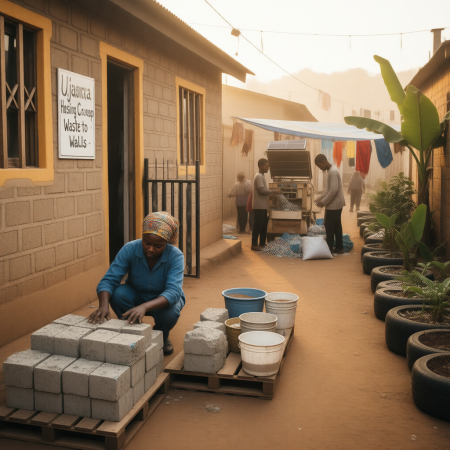
Kenya’s circular building revolution is led by grassroots enterprises turning waste into worth. Gjenge Makers in Nairobi, for instance, collects unrecyclable plastic—chip bags, shampoo sachets, wrappers—shreds it, mixes it with sand, and compresses it into durable, colorful paving stones and bricks. These products are 30–50% cheaper than concrete, water-resistant, and strong enough for load-bearing walls. Each brick embodies the principle of Circular Economies and Affordable Housing: waste becomes value, and value becomes shelter. Elsewhere, earthbag construction uses repurposed grain or cement sacks filled with stabilized soil to create earthquake-resistant, thermally efficient homes for under $2,000. In rural counties, bio-composites from rice husks, banana fibers, or coconut coir are being tested as insulation panels. Even glass bottles and discarded tires find new purpose—as windows or foundation infill in eco-villages. These innovations prove that Circular Economies and Affordable Housing can thrive with local resources and minimal external inputs.Community as the Engine of Change
What distinguishes Kenya’s approach is its deep community ownership. In Kibera, youth groups collect plastic waste and trade it for building materials to construct sanitation blocks. In Nakuru, women’s cooperatives process plastic into pellets sold to brickmakers, creating income while feeding the circular supply chain. These are not top-down projects but bottom-up movements where Circular Economies and Affordable Housing emerge from daily survival strategies. Critically, these models prioritize local labor and materials. Compressed earth blocks (CEBs), bamboo frames, and lime plasters—revived with modern engineering—reduce dependence on expensive, imported cement and steel. This not only lowers costs but also reconnects housing to cultural and ecological context. When communities build with what’s near and known, Circular Economies and Affordable Housing become tools of empowerment, not charity.Policy Momentum and Institutional Support
While grassroots action sparks change, scale requires policy. Kenya’s Affordable Housing Programme (AHP)—targeting 500,000 units by 2027—now includes a dedicated stream for circular construction. Pilot projects in Ruiru and Mavoko are testing homes built with 70% recycled content, with performance monitored by the Ministry of Housing. County governments are also acting. Nairobi’s waste segregation mandate creates cleaner material streams for recyclers. Kisumu’s “Green Building Guidelines” incentivize recycled content in public tenders. The national government has waived import duties on plastic-processing machinery and is developing Kenya Bureau of Standards (KEBS) certifications for circular building products. These steps signal that Circular Economies and Affordable Housing are now central to national development strategy.Climate Resilience Built into Every Wall
In a climate-vulnerable nation, Circular Economies and Affordable Housing offer built-in resilience. Earth walls regulate indoor temperatures, cutting cooling needs in hot regions. Plastic bricks resist flood damage. Green roofs using composted organic waste manage stormwater and reduce urban heat. Moreover, circular construction slashes carbon footprints. Cement production is a major global emitter; replacing it with recycled aggregates or bio-based materials significantly reduces embodied carbon. For Kenya—committed to its Nationally Determined Contributions under the Paris Agreement—this alignment is strategic. Circular Economies and Affordable Housing aren’t just about shelter—they’re climate action in physical form.Jobs, Dignity, and Economic Inclusion
Perhaps the most transformative impact of Circular Economies and Affordable Housing is economic. The value chain—from waste collection to material processing to construction—creates dignified jobs, especially for youth and women in the informal sector. A single eco-brick factory can employ 15 people and serve 100 homes annually while diverting 50+ tons of plastic. Training initiatives like the Circular Construction Academy in Thika teach masons to work with earth blocks and recycled composites. In Mombasa, vocational programs train artisans in upcycled interior finishes. These are not temporary gigs but skilled livelihoods rooted in sustainability. For families, the payoff is direct: homes built with circular materials cost 25–30% less, making Circular Economies and Affordable Housing a pathway out of poverty.Overcoming Barriers to Scale
Despite progress, challenges remain. Quality inconsistency, limited access to finance, and lingering stigma (“recycled = low quality”) hinder adoption. To overcome these, Kenya needs:- National standards for circular materials (KEBS is finalizing these in 2025)
- Demonstration projects in government housing to build trust
- Blended finance—public grants de-risking private investment for SMEs
- Public campaigns reframing waste as “urban ore”