BUILDING LIVABLE & AFFORDABLE COMMUNITIES IN CANADA
Introduction
Creating building livable & affordable communities in Canada has become one of the nation’s most urgent and complex policy challenges. As urban centers swell with new residents and housing prices soar beyond the reach of average earners, policymakers, urban planners, non-profits, and citizens alike are seeking sustainable, inclusive, and forward-thinking solutions.
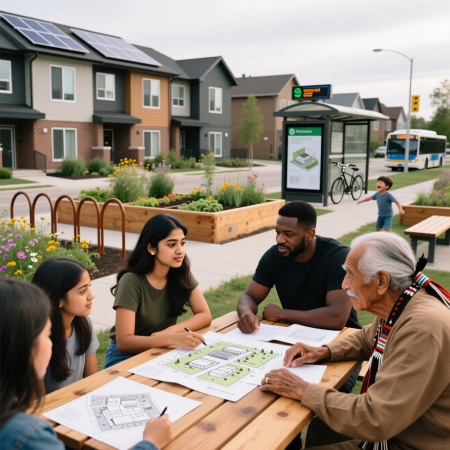
The goal is not simply to construct more homes but to foster entire ecosystems—neighborhoods where people can live with dignity, access essential services, build social connections, and participate meaningfully in civic and economic life. This comprehensive approach to building livable & affordable communities reflects a growing understanding that affordability and quality of life are deeply intertwined.
The Housing Crisis: A Catalyst for Change
Canada is facing a historic housing shortage. According to recent data from Canada Mortgage and Housing Corporation (CMHC), the country needs to build 3.5 million new homes by 2030 to restore affordability. Skyrocketing real estate prices—particularly in cities like Toronto, Vancouver, and Victoria—have priced out not only low-income households but also middle-class families, young professionals, and essential workers like teachers, nurses, and firefighters. This crisis has exposed deep structural issues in land use, zoning, construction practices, and public investment.
In response, governments at all levels have begun to reframe the conversation. Instead of treating housing as a commodity, they are increasingly viewing it as a fundamental human right and a cornerstone of community well-being. The push for building livable & affordable communities demands more than just subsidized units; it requires reimagining how cities grow, how neighborhoods function, and how residents shape their environments.
Defining “Livable” and “Affordable”
While “affordable housing” is often narrowly defined as housing that costs no more than 30% of a household’s pre-tax income, “livability” encompasses a broader set of criteria. A truly livable community provides safe and stable housing alongside access to jobs, public transit, healthcare, education, parks, and social services. Crucially, it fosters inclusion, walkability, environmental sustainability, and a sense of belonging.
Thus, building livable & affordable communities means ensuring that residents are not merely housed but empowered. It means designing neighborhoods where a single parent can walk their child to school, a senior can access a community center, and a young adult can find employment without a two-hour commute. Affordability without livability risks creating isolated, under-resourced enclaves. Conversely, livable neighborhoods that lack affordability become exclusive, perpetuating inequality.
Policy Innovations and Government Action
In recent years, both federal and provincial governments have taken significant steps toward building livable & affordable communities. The National Housing Strategy (NHS), launched in 2017 with a $70+ billion commitment over ten years, marked a turning point. It emphasizes partnership with municipalities, Indigenous organizations, and the private and non-profit sectors. Key initiatives include the Rapid Housing Initiative, the Co-operative Housing Development Program, and the Housing Accelerator Fund, which incentivizes cities to remove regulatory barriers to densification.
Municipalities are also rethinking zoning laws. Many Canadian cities—once dominated by single-family homes—are now permitting “missing middle” housing types like townhouses, duplexes, and small apartment buildings in residential neighborhoods. Edmonton, for instance, eliminated single-family zoning citywide in 2020. Vancouver’s “Housing Vancouver Strategy” aims to add 70,000 new homes by 2027, with a strong emphasis on non-market and co-op housing.
These policy shifts signal a national commitment to building livable & affordable communities that are not only more inclusive but also more resilient to economic and climate shocks.
The Role of Community Land Trusts and Non-Profits
Non-profit housing providers and community land trusts (CLTs) are playing an increasingly vital role in building livable & affordable communities. CLTs acquire and hold land in trust for the community, leasing it to homeowners or developers while ensuring long-term affordability. This model decouples land value from housing cost—a key driver of unaffordability in hot markets.
Organizations like the Co-operative Housing Federation of Canada and the Affordable Housing Society in British Columbia have demonstrated that resident-led, community-focused models can deliver high-quality, sustainable housing. These initiatives often integrate social supports, energy-efficient design, and participatory planning processes, reinforcing both affordability and livability.
Moreover, Indigenous-led housing solutions are gaining prominence. From the Squamish Nation’s Sen̓áḵw development in Vancouver to urban Indigenous housing cooperatives in Winnipeg and Toronto, self-determined models are showing how culturally appropriate, community-controlled housing can be central to building livable & affordable communities that honor identity and sovereignty.
Urban Design and the 15-Minute City Concept
Urban design is another critical pillar in building livable & affordable communities. The “15-minute city” concept—where residents can access most daily needs within a short walk or bike ride—has gained traction in Canadian planning circles. This model reduces car dependency, lowers emissions, enhances public health, and strengthens neighborhood economies.
Cities like Montreal and Ottawa are incorporating 15-minute principles into their official plans, prioritizing mixed-use development, pedestrian infrastructure, and green space. In smaller towns and suburban areas, retrofitting car-centric layouts into walkable, transit-oriented hubs is a growing priority. Thoughtful design that integrates housing diversity, public amenities, and local businesses is essential to creating places where people want—and can afford—to stay long-term.
Transit-Oriented Development: Connecting Affordability and Access
A key strategy in building livable & affordable communities is transit-oriented development (TOD). By concentrating higher-density, mixed-income housing near transit hubs, cities can reduce transportation costs—a major household expense—and expand access to opportunity. TOD also maximizes public investment in infrastructure, making transit systems more efficient and sustainable.
In Toronto, the provincial government’s “More Homes, Built Faster Act” includes provisions to fast-track development near major transit stations. Similarly, Metro Vancouver’s Regional Growth Strategy emphasizes compact urban form and transit integration. However, without strong inclusionary zoning or affordability mandates, TOD can lead to gentrification and displacement. Ensuring that building livable & affordable communities near transit includes protections for existing residents and mandates for affordable units is essential.
Climate Resilience and Sustainable Construction
Canada’s commitment to climate action intersects directly with building livable & affordable communities. The built environment accounts for nearly 20% of the country’s greenhouse gas emissions. Sustainable construction practices—such as using mass timber, passive house design, and renewable energy integration—can reduce emissions while lowering long-term utility costs for residents.
Affordable housing retrofits also present an opportunity to improve energy efficiency and indoor air quality, particularly in older rental stock. Programs like the Canada Green Buildings Strategy and provincial incentives for green retrofits support this dual goal of affordability and sustainability. Moreover, climate-resilient design—accounting for extreme heat, flooding, and wildfires—is becoming non-negotiable in community planning, especially in vulnerable regions.
Equity, Inclusion, and Community Engagement
True building livable & affordable communities cannot happen without centering
equity. Historically marginalized groups—including racialized communities, people with disabilities, LGBTQ2S+ individuals, and newcomers—face disproportionate barriers to safe, stable housing. Discriminatory practices, income gaps, and systemic exclusion have created deep inequities in housing access and neighborhood quality.
Community engagement is therefore not optional—it’s foundational. Participatory planning processes that involve residents in decision-making lead to more responsive, equitable outcomes. When communities co-design solutions, they are more likely to reflect local needs, preserve cultural identity, and build social cohesion. From Vancouver’s Downtown Eastside to Halifax’s North End, grassroots movements are proving that building livable & affordable communities must be led by those who live in them.
The Challenge of Scaling Solutions
Despite promising innovations, scaling these efforts remains a challenge. Construction costs, labor shortages, NIMBY (“Not In My Backyard”) opposition, and fragmented governance all hinder progress. Moreover, the pace of housing production lags far behind population growth, driven in part by record immigration levels.
To truly succeed in building livable & affordable communities, Canada must adopt a coordinated, whole-of-government approach. This includes aligning immigration policy with housing supply, harmonizing building codes across provinces, investing in skilled trades training, and streamlining approval processes without sacrificing environmental or community safeguards.
Financing the Future
Financing is another critical dimension. While public investment is essential, leveraging private capital through public-private partnerships, social impact bonds, and community investment funds can expand resources. At the same time, stronger tenant protections, rent control mechanisms, and anti-speculation measures are needed to stabilize existing housing markets.
Innovative financing models—such as housing bonds, land value capture, and municipal housing corporations—are emerging as tools to fund long-term affordability. For example, the City of Toronto’s Affordable Housing Office has piloted land leasing arrangements that reduce upfront costs for non-profits. Such mechanisms are crucial to sustaining momentum in building livable & affordable communities over decades, not election cycles.
The Role of Technology and Data
Technology also offers new pathways. Geospatial data, AI-driven planning tools, and digital platforms for community consultation can enhance transparency and efficiency. Open data on housing vacancies, land inventory, and development applications empowers researchers, advocates, and residents to hold governments accountable. Meanwhile, modular and prefabricated construction techniques promise to lower costs and speed up delivery—though quality control and labor standards must remain priorities.
Looking Ahead: A Vision for Canada
The vision for building livable & affordable communities in Canada is not just about solving a housing shortage—it’s about redefining what cities and towns can be. It’s about creating places where diversity is celebrated, where sustainability is embedded in daily life, and where economic security is within reach for all.
This vision requires courage, collaboration, and sustained investment. It demands that we move beyond short-term fixes and embrace systemic change—from how we finance housing to how we design streets, from how we govern land use to how we listen to communities. The stakes are high: without bold action, Canada risks deepening inequality, eroding social trust, and undermining its global reputation as an inclusive, forward-looking nation.
Yet the momentum is building. From coast to coast, citizens, leaders, and innovators are coming together to reimagine community life. By centering affordability, equity, sustainability, and human dignity, Canada has a unique opportunity to lead the world in building livable & affordable communities that serve everyone—not just the privileged few.
In the end, building livable & affordable communities is not just a policy goal; it’s a moral imperative and a collective act of hope. It reflects a belief that where we live shapes who we become—and that every Canadian deserves a place to call home, and a community where they can thrive.
Also read: Solutions to Canada’s Housing Crisis
