
Bamboo as a Cost-Effective Building Material for Rural Construction in India
Introduction
Bamboo as a cost-effective material, is emerging as a powerful solution to India’s rural housing challenges—offering affordability, sustainability, and resilience in one naturally abundant resource. In the quest for sustainable, affordable, and resilient rural housing in India, one material stands out for its versatility, abundance, and eco-friendly profile: Bamboo as a cost-effective material. Long used in vernacular architecture across the Indian subcontinent, bamboo is now experiencing a renaissance—not as a symbol of poverty or impermanence, but as a smart, engineered solution for 21st-century rural development.
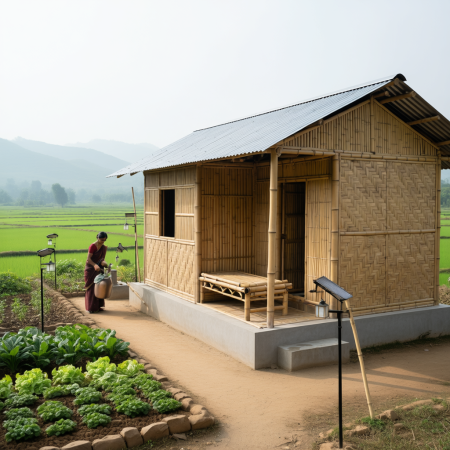
With over 60% of India’s population still residing in rural areas and facing acute housing shortages, the need for low-cost, locally sourced, and climate-responsive building materials has never been greater. Bamboo as a cost-effective material offers a compelling answer, blending cultural heritage with contemporary engineering to deliver safe, dignified, and affordable shelter.
Why Bamboo? The Natural Advantages
Bamboo is not just a plant—it’s a high-performance natural composite. It grows rapidly (some species up to 91 cm per day), reaches maturity in 3–5 years (compared to decades for hardwoods), and sequesters carbon at an exceptional rate. In India, more than 130 species of bamboo thrive across diverse agro-climatic zones—from the Northeast to the Western Ghats—making it widely accessible. Crucially, Bamboo as a cost-effective material requires minimal processing, reducing both energy consumption and transportation costs. For rural communities with limited cash economies but rich in natural resources, this accessibility translates into affordability without compromising structural integrity. Moreover, bamboo’s tensile strength rivals that of steel, and its flexibility makes it ideal for earthquake-prone regions—a significant advantage in the Himalayan foothills and parts of Northeast India. When treated properly against pests and moisture, bamboo structures can last 20–25 years or more. These attributes position Bamboo as a cost-effective material not merely as a stopgap, but as a strategic choice for durable, disaster-resilient rural housing.Historical and Cultural Context
For centuries, rural communities in states like Assam, Meghalaya, Odisha, and Kerala have built homes, granaries, and bridges using bamboo. The “Chang Ghar” of Assam—a stilted bamboo house designed to withstand monsoon floods—is a testament to indigenous engineering wisdom. Yet, during the colonial and post-independence eras, bamboo was often stigmatized as a “poor man’s timber,” leading to its marginalization in formal construction policies. This perception ignored its technical merits and ecological benefits. Today, a paradigm shift is underway. Government initiatives like the National Bamboo Mission (revised in 2018) and the Pradhan Mantri Awas Yojana (PMAY-G) now recognize Bamboo as a cost-effective material for rural housing. NGOs such as the Aga Khan Rural Support Programme and the Centre for Sustainable Agriculture are reviving traditional techniques while integrating modern preservation and joinery methods. This fusion of old and new reaffirms that Bamboo as a cost-effective material is not a regression, but an evolution rooted in local knowledge.Technical Performance and Engineering Potential
Modern research has validated what rural artisans long knew: bamboo is structurally sound. Studies by the Indian Institute of Technology (IIT) and the Forest Research Institute (FRI) confirm that properly treated and engineered bamboo can meet or exceed building code requirements for low-rise structures. Innovations like bamboo-reinforced concrete, bamboo trusses, and prefabricated bamboo panels are expanding its applications beyond walls and roofs to load-bearing frameworks. Crucially, Bamboo as a cost-effective material reduces dependency on energy-intensive materials like cement and steel, which are not only expensive but also contribute significantly to carbon emissions. A typical rural house built with conventional materials may cost ₹2–3 lakh, whereas a well-designed bamboo house can be constructed for ₹1–1.5 lakh—nearly 40–50% less—without sacrificing safety or comfort. This cost advantage is amplified when local labor is employed, keeping money within the community and creating green jobs. Thus, Bamboo as a cost-effective material supports both economic and environmental sustainability.Addressing Common Misconceptions
Despite its benefits, bamboo faces persistent myths: that it’s flammable, prone to insect attack, or inherently temporary. While untreated bamboo is vulnerable, simple, low-cost treatments—such as borax-boric acid immersion or smoke curing—can dramatically enhance durability and fire resistance. Training programs under the National Bamboo Mission now teach rural masons these techniques, turning vulnerability into resilience. Furthermore, engineered bamboo products like bamboo scrimber (densified bamboo) and laminated bamboo beams offer performance comparable to hardwoods. When combined with proper design—elevated foundations, overhanging roofs for rain protection, and cross-ventilation—bamboo structures can thrive even in humid, high-rainfall regions. These advancements prove that Bamboo as a cost-effective material is not a compromise, but a conscious, intelligent choice.Environmental and Climate Benefits
India’s construction sector accounts for nearly 40% of the country’s total carbon footprint. By contrast, bamboo is a carbon-negative material: it absorbs CO₂ during growth and stores it in the built environment. A hectare of bamboo can sequester up to 12 tons of CO₂ annually—more than most tree species. Using Bamboo as a cost-effective material in rural construction thus directly contributes to India’s climate commitments under the Paris Agreement. Additionally, bamboo’s root system prevents soil erosion, stabilizes slopes, and recharges groundwater—critical in drought-prone and flood-affected rural landscapes. Unlike brick kilns, which emit black carbon and deplete topsoil, bamboo harvesting is non-destructive; the plant regenerates from the same rootstock. This regenerative cycle makes Bamboo as a cost-effective material a cornerstone of circular rural economies.Socioeconomic Empowerment Through Bamboo
Beyond construction, bamboo value chains create livelihoods. From cultivation and harvesting to treatment, carpentry, and finishing, a single housing project can engage dozens of local artisans, especially women and tribal communities who have traditional knowledge of bamboo crafts. In states like Nagaland and Tripura, self-help groups are producing bamboo doors, windows, and furniture for rural housing schemes, generating income while preserving cultural identity. When Bamboo as a cost-effective material is sourced locally, it reduces reliance on external supply chains, insulates communities from market volatility, and fosters self-reliance. This localized model aligns perfectly with India’s vision of “Atmanirbhar Bharat” (self-reliant India) in rural development. Hence, Bamboo as a cost-effective material is not just about building houses—it’s about building resilient rural economies.Policy Support and Institutional Frameworks
The Indian government has taken significant steps to mainstream bamboo in construction. The 2018 amendment to the Indian Forest Act declassified bamboo grown on private land as “forest produce,” freeing farmers to harvest and sell it without permits. The National Bamboo Mission allocates funds for nursery development, skill training, and market linkages. Under PMAY-G, states like Assam, Odisha, and Chhattisgarh now include bamboo as an approved material for beneficiary-led construction. Moreover, the Bureau of Indian Standards (BIS) has published guidelines for bamboo construction (IS 16276:2017), providing technical legitimacy. These policy enablers are crucial for scaling Bamboo as a cost-effective material from pilot projects to national programs. With continued support, Bamboo as a cost-effective material can become a standard option in India’s rural housing toolkit.Challenges and the Way Forward
Despite progress, barriers remain. Limited awareness among engineers and officials, inconsistent quality of raw bamboo, and lack of large-scale processing units hinder widespread adoption. There’s also a need for more demonstration projects to build public confidence. The solution lies in integrated approaches:- Strengthening extension services to train rural masons in modern bamboo techniques
- Establishing community bamboo treatment centers
- Promoting hybrid designs that combine bamboo with stabilized earth or compressed stabilized earth blocks (CSEB)
- Encouraging research into fire-retardant and anti-fungal coatings


Wonderful work! That is the kind of info that are meant to be shared across the net. Shame on Google for now not positioning this put up upper! Come on over and consult with my site . Thanks =)
Thank you so much. We are really glad you enjoyed it. Your support means a lot, more fantastic content coming your way soon.