
Bahria Town Karachi: A Case Study in Urban Development
Introduction
Bahria Town Karachi represents one of Pakistan's most ambitious private urban development ventures, spanning approximately 46,000 acres along the M-9 Motorway on Karachi's eastern periphery. As Asia's largest privately developed real estate project, Bahria Town Karachi has emerged as a paradigm-shifting example of master-planned community development in South Asia, simultaneously celebrated for its modern infrastructure and scrutinized for its socio-spatial implications within Pakistan's largest metropolis. This case study examines Bahria Town Karachi's urban development model, infrastructure achievements, amenity offerings, legal controversies, and its complex relationship with Karachi's broader urban realities.
Scale and Vision of a City Within a City
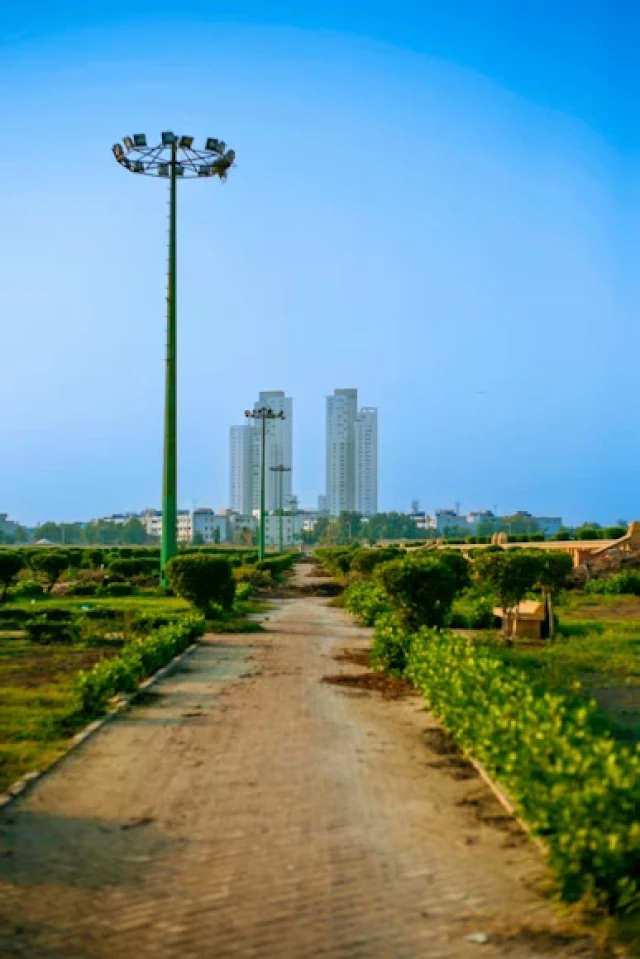
Bahria Town Karachi functions as a self-contained "city within a city," designed to accommodate millions of residents across residential, commercial, recreational, and institutional zones. The development's sheer scale covering nearly 19,000 hectares positions it as Pakistan's largest private urban development project, dwarfing earlier Bahria Town ventures in Rawalpindi and Lahore. The master plan envisions a comprehensively planned community featuring wide, landscaped boulevards, segregated zoning for residential and commercial activities, extensive green belts, and integrated utility networks including underground electricity and sewerage systems. This meticulous planning approach distinguishes Bahria Town Karachi from Karachi's predominantly organic, unplanned urban expansion patterns that have characterized the city's growth over decades.
The development's architectural identity incorporates globally recognizable landmarks, including replicas of the Eiffel Tower, Trafalgar Square, and Taj Mahal alongside functional infrastructure like the 27-hole PGA-standard golf course, Rafi Cricket Stadium, Grand Jamia Mosque, and dancing fountains. These amenities collectively construct an aspirational lifestyle narrative targeting Pakistan's upper-middle and high-income demographics seeking security, modernity, and exclusivity within an increasingly congested and insecure metropolitan context.
Infrastructure Development and Engineering Achievements
Bahria Town Karachi's infrastructure represents significant engineering investment aimed at addressing chronic urban development service deficiencies plaguing Karachi. The development features a sophisticated underground utility network concealing electrical cables, fiber optics, and telecommunications infrastructure eliminating the chaotic overhead wiring typical of Karachi's established neighborhoods. An advanced drainage system with mini dams strategically positioned throughout the community manages monsoon rainfall, a critical consideration given Karachi's vulnerability to seasonal flooding.
Water security receives particular attention through multiple mini dams constructed within the development's boundaries, supplemented by dedicated water treatment facilities ensuring consistent supply independent of Karachi's strained municipal systems. The road network comprises wide, multi-lane avenues with dedicated cycling pathways, jogging tracks, and pedestrian sidewalks elements largely absent from Karachi's existing urban fabric. Twenty-four-hour security infrastructure including perimeter walls, controlled entry points, surveillance systems, and private security patrols creates a gated environment promoting exceptionally low crime rates compared to Karachi's metropolitan average.
Educational and healthcare infrastructure forms another pillar of Bahria Town Karachi's urban development strategy, with purpose-built schools, colleges, and hospitals integrated into residential zones to minimize commute times and create self-sufficient neighborhood clusters. This proximity-based planning philosophy reflects contemporary urban development design principles emphasizing walkability and mixed-use development—though implemented within an exclusive private framework rather than Karachi's public urban development realm.
The Gated Community Model and Socio-Spatial Implications
Critical academic analysis of Bahria Town Karachi, particularly research published in the Journal of Research in Architecture and Planning by NED University, concludes that despite its infrastructural sophistication, the development fundamentally operates as a gated housing scheme catering primarily to middle-to-upper-income residents rather than addressing Karachi's complex urban development challenges. This critique highlights a central tension in contemporary urban development: while Bahria Town Karachi delivers world-class amenities and services to its residents, it simultaneously reinforces spatial segregation by creating an exclusive enclave physically and socially separated from Karachi's broader urban population.
Karachi faces profound urban realities including severe housing shortages, informal settlement proliferation (katchi abadis housing millions), inadequate public transportation, water scarcity, and waste management crises affecting the majority of its 16+ million residents. Bahria Town Karachi's urban development model requiring substantial capital investment for property acquisition and maintenance fees effectively excludes lower and working-class populations from accessing its amenities. Rather than integrating solutions for Karachi's pressing urban challenges, the project essentially "opts out" of the city's public infrastructure systems, creating a parallel urban environment for those who can afford entry.
This spatial segregation raises important questions about equitable urban development. While residents enjoy security, cleanliness, and modern services within Bahria Town Karachi's boundaries, these benefits remain inaccessible to the vast majority of Karachi's population. The development's success thus reflects private-sector capacity to deliver high-quality urban environments but only for select demographics potentially exacerbating rather than alleviating Karachi's socio-spatial inequalities.
Legal Controversies and Land Acquisition Disputes
Bahria Town Karachi's urban development trajectory has been shadowed by significant legal controversies regarding land acquisition practices. In 2018, Pakistan's Supreme Court declared portions of Bahria Town Karachi's land occupation "illegal," ordering investigations into acquisition methods that allegedly displaced indigenous communities and violated land rights. These disputes center on allegations that agricultural land and territories traditionally inhabited by local communities were appropriated through questionable legal mechanisms, with affected residents claiming forcible displacement without adequate compensation or consent.
The Supreme Court's intervention triggered ongoing investigations by Pakistan's National Accountability Bureau (NAB) into potential fraud and deception cases involving Bahria Town's ownership structure and land procurement processes. These legal challenges have created uncertainty regarding property titles within urban development, affecting investor confidence and complicating resale markets. Despite these controversies, construction and sales activities have continued, reflecting the complex interplay between judicial oversight, regulatory enforcement, and powerful private development interests in Pakistan's real estate sector.
These legal disputes underscore a critical dimension of urban development in rapidly urbanizing contexts: the tension between accelerated private-sector development and transparent, equitable land governance. Bahria Town Karachi's case demonstrates how large-scale urban development projects can proceed amid unresolved legal questions a pattern with implications for property rights, community displacement, and the rule of law in urban development expansion processes.
Economic Impact and Real Estate Dynamics
From an economic perspective, Bahria Town Karachi has stimulated significant construction activity, employment generation, and real estate investment flows into Karachi's eastern periphery. The development has attracted capital from domestic investors, overseas Pakistanis, and institutional buyers seeking exposure to Pakistan's real estate market. Property values within Bahria Town Karachi have demonstrated appreciation patterns distinct from Karachi's broader real estate market, partly attributable to perceived security advantages and infrastructure quality.
However, this economic activity primarily benefits construction firms, real estate agencies, and property owners within the development's ecosystem. Limited evidence suggests meaningful spillover effects benefiting adjacent informal settlements or lower-income communities surrounding the project boundaries. The economic model thus reinforces enclave development patterns where prosperity concentrates within gated boundaries rather than diffusing through broader urban economic networks.
Urban Planning Lessons and Policy Implications
Bahria Town Karachi offers valuable lessons for urban development planners and policymakers navigating Karachi's development challenges. Positively, the project demonstrates that comprehensive infrastructure planning including underground utilities, drainage systems, and green space integration, is achievable in the Pakistani context when sufficient capital and planning authority concentrate within a single development entity. These technical achievements provide reference models potentially adaptable to public-sector urban upgrading initiatives.
Conversely, the project's exclusionary character highlights limitations of purely market-driven urban development in addressing equitable city growth. Karachi's urgent needs including affordable housing, public transportation expansion, and service delivery to informal settlements, remain largely unaddressed by Bahria Town Karachi's urban development model. This reality suggests that while private developers can deliver high-quality enclaves for affluent residents, comprehensive urban transformation requires robust public-sector leadership, inclusive planning frameworks, and regulatory mechanisms ensuring development benefits distribute across socioeconomic strata.
Urban Realities vs. Development Fantasies
The fundamental critique emerging from academic analysis is that Bahria Town Karachi fails to engage with Karachi's actual urban challenges. Instead of proposing innovative solutions for affordable housing, transportation efficiency, waste management, or inclusive economic development issues affecting millions of Karachiites, BTK offers an escape hatch for the privileged few. It doesn't integrate with Karachi's public transport networks, contribute meaningfully to municipal tax bases supporting city-wide services, or demonstrate scalable models applicable to broader urban contexts. Its gated nature actively discourages interaction with surrounding communities, reinforcing spatial segregation rather than fostering urban cohesion.
Furthermore, by displacing rural populations without adequate resettlement or compensation, BTK has arguably worsened Karachi's housing crisis rather than alleviating it, creating new cohorts of internally displaced persons while simultaneously removing agricultural land from productive use. This dynamic exemplifies what urban scholars term "accumulation by dispossession," where private profit derives from public or communal resource extraction without equitable benefit distribution.
Conclusion: Reconciling Excellence with Equity in Urban Development
Bahria Town Karachi stands as a paradoxical urban development achievement: technically sophisticated yet socially exclusive, infrastructurally advanced yet spatially segregated. The project successfully delivers a secure, amenity-rich living environment for its residents fulfilling aspirations for modern urban living within Pakistan's challenging metropolitan context. Yet simultaneously, it exemplifies how private-sector urban development can exacerbate spatial inequalities by creating privileged enclaves detached from cities' broader social fabrics.
As Karachi continues grappling with rapid urbanization, population growth, and infrastructure deficits, Bahria Town Karachi's case study invites critical reflection on development models balancing excellence with equity. Future urban interventions might draw technical lessons from Bahria Town Karachi's infrastructure planning while rejecting its exclusionary spatial logic o9pursuing instead inclusive development frameworks where quality urban environments become universal entitlements rather than private commodities. Only through such recalibration can Karachi's urban development truly serve its entire population rather than fragmenting into fortified islands of prosperity amidst seas of deprivation.
The Bahria Town Karachi experience ultimately underscores a fundamental truth about twenty-first century urbanism: technical capacity to build sophisticated urban environments exists, but political will to distribute these environments equitably remains the paramount challenge facing rapidly urbanizing cities across the Global South. How Karachi navigates this tension between exclusive enclaves and inclusive urbanism will profoundly shape its trajectory as a metropolis—and offer lessons resonating far beyond Pakistan's shores.
Also Read: Sustainable And Affordable Housing