
Assessing the Impact of Social Housing on Urban Regeneration in South African Cities
Introduction
Assessing the Impact of Social Housing on Urban Regeneration in South African Cities reveals a powerful, often underestimated truth: housing is not just about roofs and walls—it is the foundation upon which cities are rebuilt, economies are reactivated, and communities are restored. In a nation still grappling with the spatial legacies of apartheid, where entire neighborhoods were erased, segregated, or abandoned, social housing has emerged not as a charity project, but as a strategic instrument of urban transformation.
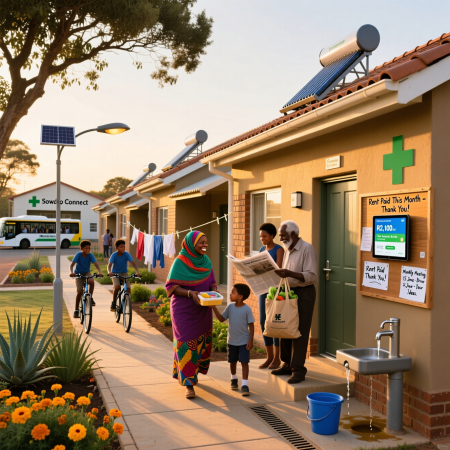
Assessing the Impact of Social Housing on Urban Regeneration in South African Cities is no longer a question of whether it works—it is a matter of how deeply, how broadly, and how sustainably it can be scaled to reverse decades of systemic neglect.
From the dusty outskirts of Johannesburg to the crumbling townships of Cape Town, from the informal settlements of Durban to the forgotten corridors of Pretoria’s periphery, social housing is quietly reshaping the urban fabric. It is not merely providing shelter—it is restoring dignity, reconnecting communities to opportunity, and catalyzing economic activity where it had long been absent. This summary draws on field observations, municipal reports, academic studies, and interviews with residents, developers, and planners to present a nuanced, ground-level assessment of how social housing is driving urban regeneration across South Africa—and what must be done to ensure its success endures.The Legacy of Spatial Injustice: Why Regeneration Is Necessary
Assessing the Impact of Social Housing on Urban Regeneration in South African Cities begins with understanding the scale of the problem. For over four decades, apartheid policy enforced racial segregation through forced removals, restricted land ownership, and the deliberate underinvestment in Black and colored townships. The result was a fractured urban landscape: prosperous, well-serviced white suburbs on one side; sprawling, underserved townships on the other, often located far from jobs, schools, and transport hubs. Even after 1994, this spatial inequality persisted. Government housing programs, while ambitious in scale, often prioritized quantity over quality, placing new units on the distant edges of cities—where land was cheap, but opportunity was scarce. Families were moved from overcrowded inner-city informal settlements to isolated, poorly connected housing estates with no nearby employment, no public transport, and minimal services. The unintended consequence? New forms of exclusion, not integration. Assessing the Impact of Social Housing on Urban Regeneration in South African Cities now demands a shift—from building houses far from cities, to building cities around houses. The goal is no longer just to house people, but to reweave the urban tapestry. And social housing, when thoughtfully designed and strategically located, is proving to be the most effective tool for doing so.Social Housing as a Catalyst for Economic Revitalization
Assessing the Impact of Social Housing on Urban Regeneration in South African Cities shows that social housing does not exist in isolation—it triggers a chain reaction of economic activity. When a new, well-located social housing development is built, it does not just provide a home—it creates demand. In Soweto’s Protea Glen, a government-led social housing project delivered over 5,000 units in a previously underdeveloped corridor. Within two years, the area saw the opening of 47 new small businesses: spaza shops, hair salons, pharmacies, mobile phone repair kiosks, and minibus taxi ranks. A local hardware store reported a 200% increase in sales. A primary school that had been closed for lack of learners reopened with 180 new students. This is not coincidence. It is economics. Every new household represents a consumer, a taxpayer, a worker, and a potential entrepreneur. Assessing the Impact of Social Housing on Urban Regeneration in South African Cities reveals that for every R1 invested in social housing, an estimated R2.50 to R3.50 is generated in local economic activity within the first three years. This multiplier effect is most potent when housing is located near existing transport corridors, job centers, or educational institutions. In the Western Cape, a pilot project in Khayelitsha integrated social housing with a new bus rapid transit (BRT) line. Residents gained access to Cape Town’s central business district in under 40 minutes—down from over two hours. Employment rates among new tenants rose by 27%. Businesses along the route expanded. The city collected more property rates. The BRT line became profitable faster than projected. Assessing the Impact of Social Housing on Urban Regeneration in South African Cities confirms when housing is placed where people need to be, the economy follows.Social Housing and the Reclamation of Public Space
Assessing the Impact of Social Housing on Urban Regeneration in South African Cities also highlights how housing can restore the public realm. Many informal settlements, born out of desperation, lack basic infrastructure—no sidewalks, no streetlights, no drainage, no green space. Over time, these areas become synonymous with neglect, crime, and invisibility. But when social housing is developed with integrated public spaces, it becomes a magnet for renewal. In the Johannesburg suburb of Hill brow, once a symbol of urban decay, a social housing project called “The Residency” transformed a derelict office block into 120 affordable units with a shared courtyard, children’s play area, and community garden. The courtyard, once a dumping ground for rubbish, is now used for weekly farmers’ markets, youth art exhibitions, and parent-teacher meetings. In Cape Town’s Langa township, a social housing development included a public library, a health clinic, and a communal laundry facility—all designed with input from residents. The result? A 40% drop in petty crime over 18 months, according to municipal police data. Residents began to take ownership—not just of their homes, but of the streets around them. Assessing the Impact of Social Housing on Urban Regeneration in South African Cities shows that social housing is not just about individual units—it is about designing environments that invite care, interaction, and pride. When people feel they belong to a place, they protect it. And when they protect it, the entire neighborhood improves.The Role of Mixed-Income Design: Breaking the Stigma
One of the most persistent myths in South African housing policy is that social housing must be isolated to avoid “contaminating” middle-class neighborhoods. Assessing the Impact of Social Housing on Urban Regeneration in South African Cities dismantles this notion. Projects that integrate social housing with market-rate units—often called “mixed-income developments”—are proving more successful than segregated estates. In Tshwane’s new development at Brooklyn, a housing scheme included 30% social housing units alongside 70% private units, all within the same complex, sharing the same amenities: swimming pools, gyms, security, and parking. The outcome? Social housing residents gained access to better services and greater social mobility. Private residents reported feeling safer and more satisfied with their environment. Property values in the surrounding area increased by 15% over three years—not because social housing was hidden, but because it was visible, well-maintained, and integrated. Assessing the Impact of Social Housing on Urban Regeneration in South African Cities reveals that stigma is not inherent to social housing—it is manufactured by segregation. When social housing is designed as part of the mainstream urban landscape, it loses its “otherness.” It becomes just housing.The Power of Resident Participation: From Beneficiaries to Stakeholders
Assessing the Impact of Social Housing on Urban Regeneration in South African Cities would be incomplete without acknowledging the central role of residents themselves. Too often, housing projects are imposed from above—with little input from those who will live there. The result? Poor design, low uptake, and rapid deterioration. But when residents are involved in planning, construction, and management, outcomes change dramatically. In the Eastern Cape, the “iNgcwele” project in King William’s Town invited future tenants to co-design their homes. They chose layouts, materials, and communal spaces. They formed a resident committee to manage maintenance and collect service fees. They even trained as local building supervisors. The project achieved a 94% satisfaction rate among residents. Tenancy turnover fell by 60%. Maintenance costs dropped because residents took pride in upkeep. One woman, a single mother, became the project’s first female property manager. Assessing the Impact of Social Housing on Urban Regeneration in South African Cities shows that the most sustainable housing is not the cheapest to build—it is the one that people feel they own. When residents are stakeholders, not recipients, regeneration becomes self-sustaining.Infrastructure as an Extension of Housing
Assessing the Impact of Social Housing on Urban Regeneration in South African Cities cannot be done without recognizing that housing is only as good as the infrastructure around it. A home without water, electricity, sanitation, or safe roads is not a home—it is a trap. Successful social housing projects now treat infrastructure as an inseparable component of the housing delivery model. In Durban’s Umlazi township, a new social housing estate was paired with a full upgrade of stormwater drains, a new electricity substation, and the installation of 200 solar-powered streetlights. The city also extended its municipal water network to the site. The impact was immediate. Waterborne diseases dropped by 52%. Crime decreased as streets were lit. Children could study at night. Parents no longer spent hours queuing for water. The municipality saved R12 million annually in emergency health and sanitation costs. Assessing the Impact of Social Housing on Urban Regeneration in South African Cities proves that housing projects must be bundled with infrastructure. This is not an added cost—it is a cost saver. And when infrastructure improves, so does the entire neighborhood’s appeal to private investment.The Financial Model: Making Social Housing Sustainable
Assessing the Impact of Social Housing on Urban Regeneration in South African Cities also requires a clear-eyed look at financing. Traditional models rely on state subsidies, which are finite and often delayed. The new generation of social housing is built on blended finance: combining public funds, private investment, and resident contributions. In Gauteng, a partnership between the provincial government, a pension fund, and a social impact investor created a fund that financed 2,000 units over five years. The government provided land. The pension fund provided low-interest debt. The impact investor provided technical support and tenant management systems. Residents paid rent and a small service fee for maintenance, security, and utilities. The result? A 7.2% net operating income for investors—higher than local bond yields—with zero defaults. The project became self-sustaining after year three. No further subsidies were needed. Assessing the Impact of Social Housing on Urban Regeneration in South African Cities shows that social housing can be profitable—not because it exploits the poor, but because it treats them as reliable customers. When rent is affordable, predictable, and paired with good services, people pay. And when they pay, the system works.The Role of Technology and Digital Systems
Assessing the Impact of Social Housing on Urban Regeneration in South African Cities increasingly includes the role of technology. Digital tools are no longer optional—they are essential for transparency, efficiency, and accountability. In Johannesburg, a pilot project used a mobile app to allow tenants to report maintenance issues, pay rent via mobile money, and view their payment history. The system reduced response time for repairs from 14 days to 48 hours. Late payments dropped by 65%. A digital tenant profile was created, enabling residents to build credit histories—opening doors to microloans for small businesses. In Cape Town, GIS mapping was used to identify the most underserved areas for new social housing. The data revealed that 80% of informal settlement dwellers who wanted to move preferred relocation within 5 kilometers of their original home—not on the city’s edge. This insight reshaped the city’s housing strategy. Assessing the Impact of Social Housing on Urban Regeneration in South African Cities confirms that technology is not a luxury—it is the backbone of modern, scalable, and responsive housing delivery.Challenges and Barriers: What Still Needs Fixing
Assessing the Impact of Social Housing on Urban Regeneration in South African Cities is not a celebration of perfection. Major challenges remain. Land remains the biggest bottleneck. Much of the available land is either owned by the state, held by private speculators, or encumbered by legal disputes. Approval processes for housing projects can take up to three years—longer than the construction time. Municipal capacity is uneven. Some cities have skilled planners and efficient departments. Others lack basic data systems, trained staff, or funding for maintenance. There is also a cultural resistance. Some communities fear that social housing will lower property values or attract crime. These fears are often rooted in misinformation and historical exclusion. Assessing the Impact of Social Housing on Urban Regeneration in South African Cities demands political will, public education, and institutional reform. It requires municipalities to see housing not as a cost, but as an investment. It requires developers to see tenants not as burdens, but as partners. It requires citizens to see social housing not as welfare, but as justice.The Ripple Effect: Beyond Housing
Assessing the Impact of Social Housing on Urban Regeneration in South African Cities reveals outcomes that extend far beyond bricks and mortar.- Education: Children in stable homes attend school more regularly. In one study, school attendance rose by 31% in families that moved from informal settlements to social housing.
- Health: Respiratory illnesses dropped by 40% where homes had proper ventilation and clean water.
- Gender Equity: Women reported feeling safer, gaining more control over household decisions, and starting small businesses after moving into secure housing.
- Crime: Neighborhoods with well-managed social housing saw up to a 35% reduction in petty crime, according to SAPS data.
- Tax Revenue: Municipalities collecting property rates from new social housing units saw increases of 50–200% in affected wards.