AFFORDABLE HOUSING TECHNIQUES BY AR. LAURIE BAKER IN INDIA
Introduction
Affordable housing techniques are not about stripping away beauty to cut costs — they’re about rediscovering abundance in simplicity. No one embodied this truth more fully than Laurie Baker — the gentle revolutionary who turned mud, brick, and discarded bottles into dignified homes for India’s poorest. Over six decades, Baker didn’t just design houses — he rewrote the rules of architecture, proving that affordability, sustainability, and soul could coexist. His methods weren’t imported from textbooks — they were born from listening to villagers, watching monsoons, and kneeling beside masons. Affordable housing techniques, in Baker’s world, were acts of love.
The Man Who Unlearned Architecture
Laurie Baker didn’t arrive in India as a savior — he came as a student. Trained in Britain’s Beaux-Arts tradition, he landed in Bihar in 1945 to work with leprosy patients. There, he watched villagers build homes with earth, bamboo, and thatch — methods dismissed by colonial architects as “primitive.” But Baker saw genius: natural cooling, local sourcing, zero waste. He unlearned everything he’d been taught. Affordable housing techniques, he realized, weren’t missing — they were being ignored.
When Bricks Learned to Breathe
Forget glass and steel — Baker’s signature was the humble brick, transformed. He pioneered
jali walls — intricate lattices of brick that filtered light, caught breezes, and turned walls into living screens. No AC needed. No blinds required. Just geometry and gravity. He’d stack bricks in spirals, waves, or honeycombs — turning structure into sculpture. These weren’t decorative gimmicks — they were climate-responsive, cost-saving, soul-lifting innovations. Affordable housing techniques don’t shout — they whisper through perforated walls.
The Wall That Holds Air Inside
One of Baker’s quietest revolutions was the
rat-trap bond — a way of laying bricks vertically to create a hollow cavity within the wall. This cavity acted as insulation — cool in summer, warm in winter. It used 25% fewer bricks. Less mortar. Less labor. And when finished, the exposed cavity became a design feature — sometimes filled with colored glass or local pumice. Structural? Yes. Economical? Absolutely. Affordable housing techniques can be this clever — if you stop copying the West and start listening to the earth.
Salvage as Strategy
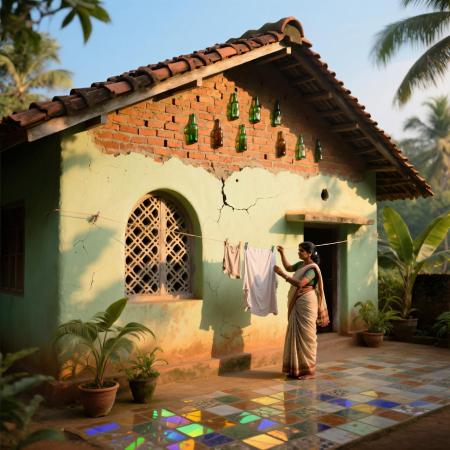
Baker treated construction sites like treasure hunts. Broken tiles? Mosaic floors. Discarded bottles? Stained-glass skylights. Old doors? Reborn as cupboards. He called it “designing with leftovers.” In a country drowning in construction waste, Baker’s approach was radical sustainability before the term existed. His homes glittered with embedded glass, patchwork tiles, and mismatched windows — each piece telling a story. Affordable housing techniques begin not with new materials — but with new eyes.
Roofs That Sing in the Rain
Flat concrete slabs? Baker hated them — hot, leaky, expensive. He revived the
sloping tiled roof, modeled after Kerala’s traditional homes. Deep overhangs shaded walls. High vents let hot air escape. Rainwater gushed cleanly into tanks or gardens. He’d often top roofs with gardens or solar heaters — turning dead space into life-giving systems. You could hear the rain drumming on Mangalore tiles — a lullaby, not a leak. Affordable housing techniques include the sound of monsoon on a well-designed roof.
No Room for Wasted Space
Western floor plans baffled Baker. Why build corridors when you can walk through the kitchen? Why box rooms when life flows? He designed
fluid, multi-use spaces — verandahs that became dining rooms, staircases that doubled as seating, courtyards that hosted weddings and laundry. Internal walls? Minimized. Ceilings? Sloped to follow rooflines and save material. Every inch earned its keep. Affordable housing techniques mean designing for how people
actually live — not how architects think they should.
The Architect Who Published His Receipts
Baker didn’t hide behind jargon or mystique. He published
itemized cost sheets for every project — brick by brick, hour by hour. Clients could choose: “Skip the arch, add a window.” He trained masons and homeowners in his methods, turning construction into community education. His Centre for Development Studies campus? A live textbook. Affordable housing techniques only work when they’re transparent, teachable, and owned by the people who use them.
Sitting on the Floor With the Client
Baker never designed from a high-rise office. He sat cross-legged in courtyards, sketched in the dust, adjusted plans as families spoke. He built homes for rickshaw pullers, weavers, priests — often charging nothing, sometimes paid in rice or eggs. He refused starchitect awards, insisting his work belonged to the users. His architecture had no ego — only empathy. Affordable housing techniques die without humility. Baker kept them alive with it.
Dancing With the Climate, Not Against It
Long before “passive design” was trendy, Baker was orienting homes to catch monsoon breezes, shading windows with deep chajjas, using lime plaster that “breathes,” and planting trees as thermal shields. He avoided cement where possible — it traps heat and moisture. His homes didn’t need AC — they used wind, shadow, and mass to stay cool. Affordable housing techniques must begin with sun angles and wind maps — not HVAC catalogs.
Where the Servant’s Room Had a View
Baker hated architecture that reinforced caste or class. In his homes, “servants’ quarters” had windows, light, and dignity. Toilets were clean, accessible, and never hidden. Courtyards welcomed neighbors. He designed schools, clinics, and community halls with the same care as private villas. For him, every threshold was sacred. Affordable housing techniques are meaningless if they don’t dismantle hierarchy — brick by brick.
The School That Teaches with Its Walls
The Laurie Baker Centre for Habitat Studies in Pabal, Maharashtra, isn’t just an institute — it’s a manifesto in mortar. Every technique Baker championed is visible: rat-trap walls, filler slab roofs, bottle windows, lime finishes. Students don’t just read about affordable housing — they touch it, build it, live in it. Baker’s son Tilak and daughter-in-law Heidi continue his mission — training grassroots builders across India. Affordable housing techniques thrive when they’re passed hand to hand, not just file to file.
Not Anti-Modern — Anti-Waste
Critics called him a rustic. Baker laughed. He used
ferrocement tanks,
precast lintels, even
limited RCC were structurally essential. He wasn’t rejecting technology — he was auditing it. If a machine saved labor without killing craftsmanship, he’d use it. If a new material outperformed mud, he’d test it. His rule? “Use the cheapest material that does the job — and do the job well.” Affordable housing techniques aren’t about nostalgia — they’re about intelligent, ethical selection.
Beauty Measured in Shadows and Silence
Baker’s homes don’t shout. They glow. Light filters through bottle-glass skylights. Shadows ripple across jali walls at noon. Rain whispers on tiled roofs. Floors, made from broken tile chips, glitter like mosaics. He proved that low-cost doesn’t mean low-soul. In fact, his homes — termite-proof, earthquake-resilient, thermally superior — often outlasted luxury builds. Affordable housing techniques, he showed, can be the most durable — and the most beautiful.
The Hamlet: A Home That Grew Like a Tree
Baker’s own home — “The Hamlet” in Thiruvananthapuram — is his final poem in brick and lime. Built over 40 years, it curves, climbs, surprises. No straight lines. No wasted corners. Bottle windows cast rainbows. Trees grow through roofs. It needs no AC — just cross-ventilation and thermal mass. Visitors don’t take photos — they sit in silence. Affordable housing techniques, here, become a meditation — on light, space, and time.
Padma Shri for Social Work — Not Architecture
When India honored Baker with the Padma Shri in 2007, it was tellingly awarded under “Social Work.” He wasn’t an architect in the elite sense — he was a healer, a teacher, a friend of the forgotten. He passed away weeks later, but his legacy didn’t. From Tamil Nadu villages to Delhi policy labs, his methods are being revived. NGOs train masons in rat-trap bonds. Governments mandate jali walls in low-cost housing. Affordable housing techniques he pioneered are now national policy — quietly, powerfully.
Why Baker Matters More Than Ever
India’s cities are choking — on concrete, congestion, and inequality. Gated towers consume energy and isolate souls. Slums swell as families are priced out. Climate change makes glass boxes unbearable. Baker’s answer? Go small. Go local. Go circular. Trust the hands of the mason. Plant a tree before laying a brick. Design for the grandmother, the child, the monsoon. Affordable housing techniques aren’t relics — they’re rescue plans.
Curves Over Corners, People Over Plans
Baker rarely used right angles. His walls curved — to follow land, to save material, to surprise the eye. His plans followed lives, not grids. He measured success not in square feet, but in smiles per rupee. He proved architecture could be joyful, even on a shoestring. In a world of rigid boxes and rigid thinking, Baker’s curves were acts of rebellion. Affordable housing techniques can — and should — bend.
The Quiet Global Influence
Baker’s ideas didn’t stay in India. Architects in Sri Lanka, Nepal, Bangladesh, and even Africa now use his methods. The “Baker bond,” “filler slab,” and “bottle wall” appear in eco-villages from Bali to Brazil. UNESCO studied his work. Harvard invited him to lecture (he declined — too expensive to fly). His manuals are translated into 8 languages. Affordable housing techniques he refined are now global vernacular — proof that local wisdom can travel far.
Building the Future with Yesterday’s Wisdom
Baker never called himself an “eco-architect” or “social designer.” He just built homes — honestly, frugally, beautifully. Today, as we face climate collapse and housing crises, his work feels prophetic. Not because it’s old — but because it’s wise. He teaches us: the best solutions aren’t invented — they’re remembered. Affordable housing techniques are already here — in the earth, in the hands of craftspeople, in the logic of the land.
Final Lesson: Architecture Is a Verb
Laurie Baker didn’t “do” architecture — he lived it. He knelt in mud. He argued with masons. He sketched on napkins. He slept in half-built homes to test comfort. He believed architecture wasn’t about monuments — it was about mornings: the smell of chai in a sunlit courtyard, the sound of rain on a tiled roof, the cool touch of a lime-plastered wall. Affordable housing techniques, in the end, are not about buildings — they’re about belonging.
Also read: Sustainable Wall Construction Techniques with Bricks for New Housing
