

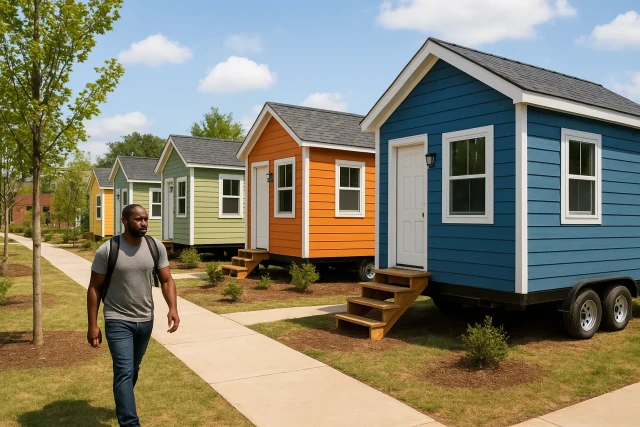
The Return of Tiny Homes: A Solution to Homelessness and Affordability
Housing has emerged as one of the key social dilemmas regarding the modern societies in the recent years. The spiraling rents, exploding home prices, flat wages and exploding homelessness have brought depression to millions once expecting to live in a secure home they could afford. With this crisis, the simple solution is returning back, the tiny home.

These tiny homes which were usually no more than 100 to 400 square feet were initially considered to be novelty architecture and off-grid minimalist living. However, nowadays, they are redesigned as the true answer to homelessness and housing shortage. Backyard accessory dwelling units (ADUs) and formalized, tiny home villages where the unhoused can live are just some of the ways that the tiny home movement has re-emerged with a new message and goal; that is, to restore dignity, shelter and affordability. Although the small houses still cannot help the housing crisis, the current popularity of the houses heralds a change in the minds with regard to space, housing, and the community.
The following blog examines the re-emergence of the so-called tiny houses, why increasing numbers of people are turning to these homes, how tiny houses are being adopted to accommodate the recently homeless or soon-to-be homeless, the drawbacks associated with tiny houses, and what their possible future within housing policy might be.
The Rise, Fall, and Return of Tiny Homes in America
The idea to live in small homes is not new at all. Small living quarters had been the norm in America, particularly in outlying communities and the suburbs following World War II long before what some people have been calling the housing crisis today. In the initial areas, early settlers constructed cabins, which majorly consisted of one room.
The housing shortage was high and people dwelled in tiny shacks in the times of Great Depression. But with growing prosperity in the post-World War II era, came pushing on space and consumption. The optimum American house became bigger over the generations and the square area a new house occupied was overshooting. At the end of the 20 th century, houses larger than 2,500 square feet became the norm. The American culture embraced the mentality of size and the larger one was a better one.
It is against that setting that the tiny home movement came about in the early 2000s as promoted by the minimalist architects and the sustainability movement that sought to rebel against the consumer society. Books, blogs and even television shows were cheering on the independence of small living forever debt-free, nearer to nature, more responsible to the environment.
Though to most city planners and zoning boards, tiny homes were still out in the realm of conventional housing codes. They were termed as recreational vehicles or momentary structures, as opposed to permanent houses. This legal uncertainty restricted the expansion of this movement. It was never a mass-market housing way of life, but instead it was kept on the fringe as a voluntary downsizing choice.
By the 2010s and early 2020s, a new economic reality had been established: wages had stagnated, rents were soaring and urban and rural homelessness were on the rise. Suddenly, the previously perceived as pertaining to the world of the quirky and the alternative started to be spoken of as a viable and human solution to a very serious issue.
Micro dwellings have returned to the discussion not out of idealistic frugality, but necessity. Social workers, non-profits, and city councils started to investigate tiny homes as a means of transitional housing to help homeless ones. Certain areas approved or simplified zoning on small home communities. The revival of the little homes nowadays is not a trend it is a remedy to a housing regime that fails to satisfy millions anymore. This has become a newfound fascination which is a significant cultural change, as the smaller living is not about compromises, but nothing less than a claim to exercise the basic human right to shelter.
Why Tiny Homes Are Gaining Attention in the Housing Crisis
Small homes are becoming a subject since they are flexible, easier to construct, and much cheaper than standard single-family homes or even the average apartment buildings. A tiny home can be constructed with materials and labor cost of about 50,000 to 80,000 dollars or even cheaper depending on the place of construction, in factory environments or in volunteer programs, in cities where the average rent ranges between 1,500 dollars or above per month on a small one bed room apartment.
It was a dramatic cost reduction such that a small house can be more readily financed, donated, or subsidized. Also, the rapidity of construction is an important positive point. A tiny home village can be built within months whereas a traditional housing development may take years to be set up after planning. This urgency is imminent when cities start experiencing insane levels of homelessness and homeless shelters are overflowing with people and winter months create limitations of life.
The other factor that is driving the rise in the popularity of tiny houses is that they will provide individuals with space and independence. Homeless shelters are usually controlled and regulated, have their own restrictions in terms of personal space, communal toilets, and are some of the reasons why there are curfews.
Trauma survivors, singles, couples, pet owners, and mentally ill people are among the many who feel uncomfortable or unsafe in shelters. Tiny homes may provide them with a secure lock door, a place to store their possessions and some dignity. In most of the tiny home communities, members pay a little rent or volunteer in the community to enable them develop a sense of purpose and personal accountability.
Furthermore, the concept of tiny houses is in line with the rest of the societal value on sustainability. They consume less energy, use lesser quantities of materials and occupy small expanse of land. Particularly, Millennials and Gen Z are able to embrace the concept of smaller living accommodation in exchange of affordability, reduced carbon footprint, and more financial freedom. Even the older adults (i.e. with fixed incomes such as retirees) find tiny homes as a viable means of downsizing without losing their independence.
Zoning changes in progressive cities enabling accessory dwelling units or so-called granny flats in backyards have also given the movement a boost. This gives opportunity to home owners to construct small house in their property to generate rent plus increasing the house stock without large-scale land purchases. Such infill development is more immediate means to increase housing stock in well-established neighborhoods.
Tiny houses are turning into an icon. They symbolize creativity in the time of crisis and the desire to reconsider what a home must look like. Nevertheless, it is not just enthusiasm. Tiny homes potentially have significant impact on both affordability and homelessness, but only when introduced in a supportive legal, social and financial environment. This is what leads us to the next conversation, the use of tiny homes as a support mechanism to the homeless and housing insecure.
How Tiny Homes Offer a Lifeline for the Homeless and Housing-Insecure
Tiny home is the new caring intervention that is being embraced across the United States and other states facing the challenge of homelessness. Partnerships between local governments and nonprofits in cities such as Seattle, Los Angeles, Austin, Detroit, and Portland have created tiny home villages devoted to people who lack homes. Such communities usually offer small houses of individual units with electricity, heating which in some cases include plumbing. In some villages, bathrooms and kitchens are communal, whereas, in others, micro-utilities are put into each unit. The essence is to provide a residents with constant, permanent personal space to get sleep, keep their things, have a lockable door, and begin restoring their lives.
Incorporation of supportive services is one of the most successful things with these villages. They can regularly be found near residents of case managers, mental health workers, employment training, and recovery services. This integrative view acknowledges there is more to the issue of homelessness than the lack of a home, rather, a combination of poverty, trauma, health problems associated with homelessness, and structural barriers further complicate the issue. Small houses offer the basis where one can develop trust and stability. Thereafter, the inhabitants are able to receive the assistance they require to move on to permanent housing or jobs.
Unhoused tiny home communities also help create community within the housed persons. People in the streets have various struggles such as loneliness and social fragmentation. The life in a small village home is characterized by knowing the neighbours, the joint use of gardens or working rooms, the decision making collectively. Accountability and pride are promoted with the help of community rules and the support of peers. Such micro-neighborhoods tend to be safer and cleaner as compared to the traditional encampments or shelters.
Tiny home villages are also economically viable to the governments and non-profits. It might be much cheaper to construct and maintain little houses as compared to housing people in shelters, hotels, or even large apartment complexes. Once people are settled in tiny homes, police and emergency services are visited less, which saves the taxpayers money. Also, success observed in these villages can also be used to minimize the population of chronically homeless thus reducing long-term expenditures on social services.
Nonetheless, discerning investors are not seriously though, small houses are not a magic bullet. Others would rather live in apartment-based supportive housing particularly the ones that require heavy health care treatment requirements or supervision.
Tiny houses are most effective with people who can pay, in general, but have either been locked out of housing or need a little push to get back on the right track. Nonetheless, the initial findings of small home communities are a reduced number of relapses, increased employment levels, and the increased success of transitioning to permanent housing compared to shelter-only programs. It is indicative that a small home with an appropriate facility can be a critical part of the larger housing spectrum- affordability, independence, and hope.
Challenges and Limitations of the Tiny Home Movement
Such possible problems as tiny homes have a number of disadvantages that restrict their opportunities to eliminate homelessness or housing affordability entirely. Locally, there is sometimes opposition to tiny home villages by local residents based on concerns about falling property prices or higher crime rates even when local leaders endorse the solution; this is referred to as Not In My Backyard (NIMBYism). Such social and legal obstacles are capable of preventing or terminating projects despite their sources of finance.
Another problem is financing. Since tiny homes are unconventional, lending institutions might deny the mortgage of the house, and insurance providers may find it difficult to provide the proper insurance coverage. Tiny homes do not fit current classifications and therefore municipal governments may not provide the traditional housing subsidies. Charity and nonprofits can provide some of the financial means to help, but unless there is a reliable source of funding, more villages of tiny homes will be temporary or experimental. The question of land also exists: cities might not propose free land lots to construct villages, and villages located in the country might make the residents feel secluded with services, workplaces, and transportation.
Scalability is another restriction. 30-50 units make a small village might significantly impact a small number of people who need it, but when a city has thousands of people on the streets tiny homes roads are just not enough. Moreover, tiny homes are not necessarily long term worthy homes. In some villages, the houses are not plumbed or have not got a complete kitchen which is uncomfortable in bad weather or inappropriate with families that have children. Maintenance can also become a factor: an ill-insulated small house can wear away after a period of time, especially when made of low price resources.
The question of lifestyle preference is also involved. This does not mean that everybody is eager to have a small home to live in. Such small spaces may prove non-practical to families with children, people with disabilities or people with mobility challenges. Shared bathroom situations may come along with privacy concerns. Also, it is possible that tiny homes do not solve far more systemic problems, e.g., the absence of healthcare, psychological services, or jobs, which are the reasons behind homelessness in the first place.
That said, these obstacles do not discredit the worth of the tiny homes they just emphasize that tiny homes cannot be the only solution but just one of the components of a bigger housing plan. When and where they work, tiny homes can provide the instant respite, dignity, and affordable shelter, but to stabilize housing on a universal scale a reform in policy and larger structural change is still warranted.
Community Models and Government Support: The Future of Tiny Living
With the development of the tiny home movement, there has been a lot of clamor among its supporters to ensure that more of these endeavors are supported by government policies to make them more economically viable. To make tiny homes legal, some cities are exempting zoning codes to convert residential lots into accessory dwelling units (ADUs). Other authorities are issuing permits to tiny home communities directly in the new affordable housing programs. Governments in some areas have started deploying public land to build tiny home villages, which can be run by a nonprofit or stocking housing consignment.
New models are also taking place in community. The creation of tiny homes is done at a reduced budget when organizations collaborate with volunteers, faith-based organizations, or vocation schools. There are cases where corporate sponsors donate materials or money to the infrastructures such as bathrooms, kitchens and common spaces. Such alliances generate a shared ownership and social participation, which lowers the local resistance. People would not mind a tiny home village when they do not perceive it as a form of encroachment but see it as a community resource.
There are places where towns and cities are selecting small houses as belonging to workforce, not only homeless. High-rent areas create housing crunch in markets with seasonal workers, teachers and young professionals facing the problem of affordable housing close to places of employment. Tiny home developments create a feasible choice in them in favor of local business practices, as well as promoting less commuter traffic. This dual purpose, of serving the homeless in addition to workforce, attracts more people to investing in the project and proves the industry of the idea.
Conclusion
The revival of tiny homes as a solution to homelessness and cost of housing demonstrates both the seriousness of the problem and how creative the proposed solutions are. Tiny homes are by no means the solution to every problem, but they are a feasible, ethical, and widely spreading means of resolving a dire housing situation. They make the homeless people safe and have a sense of dignity, the low-income workers have options and are affordable and subvert social assumptions about space and consumption.
Governments, nonprofits, and communities need to provide supportive infrastructure, services, and zoning changes to make this housing mode sustainable as they start adopting such developments of tiny homes. To many of them, a small house is not a roof on their head: it is a new beginning, an opportunity to start again and a message of belonging. When connected with greater policy change, the proliferation of tiny homes has the potential to contribute to actually reversing the tide of homelessness and render such homes affordable to everyone.
Also Read: Homelessness Survey of Canada





-3dkuLgKhRD.jpg)
-49HupTvwDD.jpg)






LEAVE A REPLY