

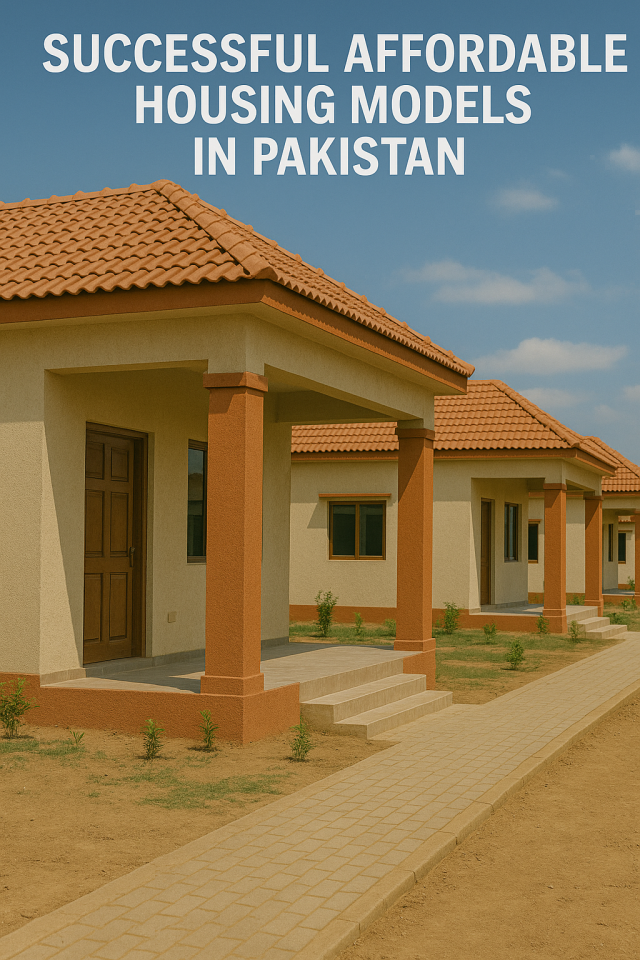
Successful Affordable Housing Models in Pakistan
The shortage of reasonably priced secure living accommodations remains a big problem for Pakistan because its rapid population growth and economic challenges and urban migration patterns have created this housing deficit. The housing deficit impacts numerous populations across Pakistan but it’s most severe impacts affect people from low-income backgrounds. As a solution various affordable housing models and programs have spread throughout Pakistan by implementing government backing with private investment alongside neighborhood participation and ecological responsibility. The simultaneous goals of these initiatives consist of offering decent housing model and maintaining lasting social and environmental sustainability. This evaluation examines major affordable housing models and solutions that have positively transformed Pakistani neighborhoods for disadvantaged household communities.

Government-Initiated Housing Programs
Several government-led housing models /programs have been implemented by Pakistan to address both housing deficit problems and establish affordable residential opportunities for families with low incomes. The Naya Pakistan Housing Program (NPHP) remains one of the most important government initiatives because it plans to construct millions of homes for disadvantaged groups. The program executes this major project to activate economic growth and maintain construction industry work while encouraging national material usage. Through this scheme the government provides affordable loans to low-income applicants via different financial institutions and banks.
The Roshan Gharana program demonstrates the federal government's dedication to enhance accessibility of housing by delivering power through solar resources. This program provides both economic advantages and strategic alliances which help incorporate solar energy systems into low-cost housing construction projects serving communities without access to power networks. Net metering policies locking households into additional profit streams by granting them the chance to feed surplus electric power into the national grid enhances the economic case for solar integration.
The Pakistan Housing Authority conducts residential building projects that aim to provide accommodations for government workers and select target groups in metropolitan areas. The residential units provide important facilities including educational institutions and healthcare facilities as well as shopping areas to foster well-being in communities. The significant housing initiatives continue advancing the development of standardized housing solutions which encounter barriers related to implementation delays and administrative complications.
Local government authorities in Karachi, Lahore and Islamabad have started carrying out urban planning reforms while building upward projects for housing. These high rise structures promote efficient land management and help decrease metropolitan urban growth and create housing solutions in overcrowded cities. This combination with public transport links creates sustainable lifestyles for populace with limited income through integrated urban housing models.
Non-Governmental and Social Enterprise Contributions
Groups like Akhuwat Foundation together with Ansaar Management Company use creative low-cost methods to redefine what affordable housing models can be. The organizations go beyond building structures because their work focuses on developing sustainable communities which extend beyond construction deadlines. These development projects establish sustainable living environments through integrated priorities focused on social equity and economic development and environmental sustainability which support resident success. Public and community-focused organizations demonstrate through their housing models that working together delivers housing solutions for vulnerable populations while showing how affordable housing models creates pathways for social and economic advancement throughout Pakistan.
Akhuwat Foundation offers interest-free loans as the guiding principle for its housing models / program. The organization enables low-income families to get microloans which they can use for home construction or improvement projects. Through this housing model people gain the ability to self-manage their residential needs while avoiding permanent debt. Through its efforts to involve communities Akhuwat achieves higher loan repayment rates that generate better social results.
The Ansaar Management Company partners with both public and private entities through its operation model. Through a public-private-philanthropic partnership model the organization builds viable residential areas with financial support from charitable donors alongside business investments while partnering with government authorities. People who live in community-built housing projects enjoy easy access to employment hubs as well as industrial areas because these projects are strategically positioned near these zones. Architects design homes with feature set-up that ensures fresh air circulation and natural sunlight access as well as common community facilities to create better living conditions.
The Heritage Foundation of Pakistan directs its impactful work toward house construction through traditional methods with local building materials for sustainable requirements. Zero-carbon housing projects built by the Heritage Foundation of Pakistan benefit both environmental protection and community advancement through their habitat-establishment in disaster-prone and distant areas. Through its recovery of indigenous architectural approaches the foundation creates regional heritage protection for local heritage as well as provides professional development for artisans working locally. The approach enables a revival of traditional skills by creating employment opportunities that fosters both communal identity preserved with new job skills
Social enterprises working with microfinance institutions provide adaptive payment structures and support the incorporation of energy-efficient technologies in the residential sector. Donor agencies together with local communities work through these organizations to bring solar kits and water filtration units and sanitation systems which enhance both sustainability and holistic features of low-income housing models. Organizations who integrate social services with education and health services in their models create conditions that improve residents' quality of life.
Community-Led Cooperative Housing Models
Community housing model initiatives from the ground up provide efficient solutions to the current housing crisis. Sustainable affordable communities require joint efforts based on shared ownership along with mutual support through these models. Collective housing offers participants who usually share backgrounds such as village location or profession or family ties a chance to unite their resources and purchase land and materials together which decreases individual financial strain.
The Khuda Ki Basti project stands as a well-known community-led housing initiative that started in Karachi. The initiative guides residents to develop homes at their own pace by providing basic plot infrastructure which they utilize to build according to their financial ability. The incremental housing method lets citizens structure their homes using their income progression which grants them dignity and flexibility. The project includes educational institutions together with medical centers and vocational training centers to create sustained community development.
The Orangi Pilot Project (OPP) located in Karachi functions as one of the most celebrated examples. The project began with the focus on sanitation development but enlarged its scope to include housing development and infrastructure construction and educational services. Through its participatory housing model OPP helped communities develop their own development projects which received technical support and small financial assistance. After its initial triumph this design motivated Pakistan along with various other nations to create different versions of it. Through its initiatives OPP removed the need for external contractors as well as bureaucratic procedures which enabled local people to take control of their developmental needs.
Through housing cooperative initiatives families in rural along with peri-urban regions construct houses from local building materials by working together as a group. Sustainability is achieved through traditional building methods alongside responsible utilization of accessible natural resources by these models. The construction of a building occurs in phases through communal savings groups within communities as a means to avoid taking out high-interest loans. Financial literacy improvement and increased group responsibility follow from these savings groups.
Strategic community housing model efforts demonstrate that permanent social transformation occurs through people-powered empowerment and cooperative collaboration. The methods demonstrate that group effort allows people to claim responsibility for their housing models needs using combined resources together with community assistance systems. When accessed alongside community-directed guidance and suitable support resources people from marginalized groups can construct lasting safe homes that maintain their dignity. The initiatives create housing solutions that produce shelter alongside strengthened relationships between community members who develop their ability to sustain themselves while building prospects for lasting neighborhood growth. The achievements from such initiatives demonstrate that inclusive planning combined with people-driven empowerment produces superior outcomes for building communities.
Eco-Friendly Affordable Housing model Innovations
Modern development in Pakistan needs sustainable methods that blend affordability with sustainability because the country deals with both environmental damage and its lack of energy resources. Modern architecture has adopted innovative green housing designs with three key features that include energy-efficient design practices together with water-conservation techniques alongside renewable resource utilization. These housing developments cut down environmental impact while reducing utility expenses that create lasting affordability benefits for residents.
People have started to choose solar-powered residences due to unreliable electric power availability throughout many regions. Solar panel projects in Tharparkar and Layyah along with other parts of interior Sindh have established off-grid electricity systems that provide power to entire residential areas. Solar water pumping systems combined with lighting systems enhance agricultural development while supporting educational initiatives in these specific geographic areas. The funding originates from NGO partnerships with community groups and donor support and microfinance schemes.
The innovative use of Bamboo along with mud bricks and recycled materials makes sustainable home construction possible. The traditional mud houses in South Punjab and interior Sindh received enhanced insulation and stronger structures to create houses that carry more durability and better withstand the elements. The cooler summer climate reduces dependency on energy-consuming air conditioning systems. The use of recycled steel and reclaimed wood as construction materials in urban low-cost housing developments succeeds both in reducing overall costs and minimizing environmental impacts.
The Green Shelter Program together with the Eco-Housing Initiative in peri-urban zones implement rainwater collection systems and composting toilet facilities and graywater treatment methods to their residential units. These innovations enable the effective management of limited resources and provide education to residents about sustainable life habits. Various sustainable features in eco-housing developments such as community gardens with rooftop green space and shared solar power systems work together to decrease expenses while fostering social connections within communities.
Prefab construction technology has transformed the industry as a result of its innovative adoption. Technical advances enable faster and economical home construction procedures that disturb the environment to a minimum extent. These prefabricated homes need minimal workforce to put together so they can be built into habitable houses within a few days and serve both emergency situations as well as urban growth needs.
The increasing housing demand makes eco-friendly affordable housing an attractive and viable choice which Pakistan adapts through adoption. These modern housing solutions resolve both housing affordability and implement enduring sustainability practices to manage environmental conditions. New developments combine budget-friendly features with eco-building techniques including efficient energy architecture and renewable energy supplies and sustainable materials to create stable living spaces.
This approach delivers shelter beyond basic needs by establishing inclusive environmentally friendly communities which stand ready to address climate change. Eco-friendly affordable housing creates a sustainable future by accommodating population growth while improving energy requirements within urban environments. The decision of Pakistan to adopt eco-friendly residential housing models demonstrates the national recognition that smart housing design delivers both improved living conditions and environmental conservation results with national development objectives.
Role of Microfinance in Housing Accessibility
The financial capability of low-income families who wish to own homes finds important support from microfinance institutions which serve as fundamental access bridges. The housing loans provided by Khushhali Bank together with First MicroFinance Bank and Kashf Foundation specifically accommodate the financial circumstances of borrowers from the low- and middle-income groups. The loan programs from these financial institutions offer small repayable housing loans that come with adaptable terms for family members to construct homes at their own pace.
Microfinance models deliver financial education and technical support in addition to credit so they provide permanent economic strength as well as housing facilities. The provided services create substantial impact in places where conventional banks tend to avoid operating including rural and peri-urban communities. Affordable housing development receives support from microfinance through its innovative trust models coupled with repayment systems operated at the community level.
Women-Centric Housing Empowerment Initiatives
The establishment of women-centric affordable housing solutions represents the latest trend in Pakistan’s national housing development agenda. Housing programs establish mandatory female ownership policies and enable women to obtain housing benefits by serving as main applicants or qualified participants. That initiative supports family security and creates social equity while empowering women. The Kashf Foundation together with Baanhn Beli support programs that teach women construction abilities and let them participate in home improvement decisions. The ownership of property gives women more power to participate actively in their family and community as well as education and healthcare and income-generating activities. Building housing which promotes gender equity enables complete communities to evolve through supportive development that is inclusive and resilient.
Digital Technologies and Smart Planning in Affordable Housing
Modern technology stands behind a total reshaping process of the development concept and operation methods for affordable housing construction. The combination of Geographic Information Systems and digital mapping with satellite data helps identify perfect sites for building new residences in areas that currently lack adequate housing. Digital tools contribute to more visible beneficiary selection systems which combats fraud and guarantees affordable housing access for most-needy groups.
BIM in combination with modular construction methods helps speed up building processes while minimizing waste and reducing costs. The integration of low-income housing with schools along with health facilities and public transportation networks is possible through smart city planning tools within urban areas. Digital technology availability enables its integration into affordable housing policies and practices that will lead to efficiency along with scalability as well as sustainability.
Conclusion
The development of affordable housing in Pakistan exceeds house construction as it stands as the foundation for economic well-being alongside social equilibrium and environmental sustainability. Through inventive residential solutions Pakistan is overcoming its challenges of increasing urbanization and economic inequality and climate issues. The nation's housing shortage gets different types of attention through governmental action and communal cooperative setups which go alongside social enterprising solutions alongside environmentally conscious developments in the housing sector.
Multiple innovative strategies demonstrate affordability can exist alongside dignity preservation and both sustainability and high-quality living standards. The path to successful housing solutions consists of designing solutions which integrate strategic planning along with local resource adoption and affordability and community-wide involvement. Microfinance allows households that fail to access traditional banking systems to obtain vital credit services simultaneously with women-specific housing initiatives that deliver basic security and equality throughout local communities. Both urban and rural locations benefit from technological equipment and sustainable innovations that create expandable housing structures resilient to climate changes.
The fundamental principle shared by these development models stems from the understanding that house ownership stands as a basic right for every human being which creates the foundation for achieving wider development targets. A secure living space enables people to access quality education and healthcare and helps them achieve better job opportunities for successful social advancement. When organizations and communities unite for collaboration the goal of affordable housing which includes inclusivity and environmental sustainability moves from being possible to inevitable.
Housing initiatives can successfully target vulnerable citizens through well-implemented policy measures which draw their funding from transparent governance practices. Developing community engagement in housing projects becomes possible by simultaneously spreading knowledge about sustainable housing solutions and increasing awareness of citizen rights to the public. Continued dedication and joint efforts between sectors give Pakistan the potential to reshape its housing environment. The forthcoming transformation of housing infrastructure will create secure affordable shelters which will raise the quality of life in a way that allows citizens to maintain dignity with resilience toward optimistic futures
Also Read: Integrated-Model-of-Affordable-Housing-Delivery-for-the-City………..










LEAVE A REPLY