

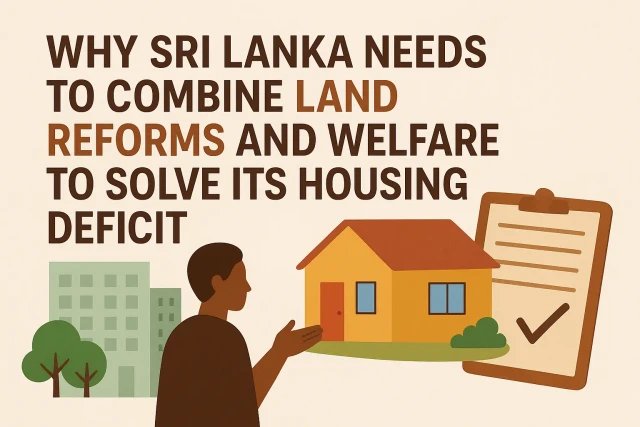
Why Sri Lanka Needs to Combine Land Reforms and Welfare to Solve Its Housing Deficit
The housing crisis is not all about concrete and roofs but it is the history of access, inequality and lost opportunities in Sri Lanka. By 2025 the country is experiencing an expanding housing shortage which has impacted both urban and rural areas. Their need to accommodate the increasing population and also meet the rising demand at the same time with increased rate of urbanization coupled with economic changes has on the one hand produced the demand of homes whilst on the other hand, the systemic problems of ineffective land management, tenure insecurity as well as the poor integration of the social welfare has made millions of people to be in a limbo.

Several housing schemes have over the decades been initiated with different success rates. But little has been said about the underlying structural cause: ambiguous land ownership and a lack of a common welfare-friendly housing policy. The state of land ownership is still marred with technicalities, duplication of ownership, poor bureaucracy and loopholes in the system. At the same time, housing support is undermined by absence of co-ordination, low funding and restricted eligibility.
The direst need of Sri Lanka is a dual method combing land reforms in ensuring tenure, and providing freedom of legal possession, and also welfare policies in making housing universally accessible and affordable by low and medium income families. This blog can discuss why these two approaches need to merge with another and how the two can be the most sustainable away in the solution of the housing deficit in Sri Lanka.
The Genesis of the Issues: Land Insecurity of Tenure and Inefficiencies within the System
The way land is managed in Sri Lanka is very much tied to its colonial past where expanses of land was held by the government. Up to this day, land cannot be privately owned since almost 80 percent of it is classified as state land which makes it legally cumbersome to have the land to the common citizen because of low-income status. Millions of the residents of these lands; estate workers, urban squatters, rural farmers have unregistered plots. It is one of the most influential structural impediments to house-investing and also ownership that are characterized by this tenure insecurity.
In addition to ambiguity of tenure, the legal setup is too complicated. There are several laws, which overlap in the land allocation, ownership and use, which results in ineffectiveness, bottlenecks and legal conflicts. Registry of the informal land occupation to legitimizing occupation is not only bureaucratic, slow but also costly. As an example, it can take several years to get a deed to an occupied piece of land through an informal settlement because one has to go through various government departments.
The implications are long term. Lack of legal ownership does not allow families to have bank financing to upgrade or construct dwellings. They have been left out of government sponsored housing subsidies or social programs which usually demand house ownership proof. This has led to extensive informal settlements at which individuals tend to live extremely vulnerable lives without basic amenities such as drinking water, sanitation or even electricity.
Further, this tenure misadventure discourages developers and public private partnerships in the housing industry. Investors fear working with unregistered land or a legal grey area, not to mention in places that see a high value and a high competition of buildings, such as the city.
However, to find a solution to this issue, one will need to completely restructure the system of land management. Automatizing the flow of land titles, computerizing land records, ways to ease the process of registration, and standardizing the issues of informal tenure should become the focal point. The affordable housing journey can only be set in motion through visible ownership.
The Isolated Housing Assistance: Welfare without Ground the Highs and Lows of Helping Out
Whereas, Sri Lanka has always considered housing as a social need, most of the welfare programs have failed because of lack of planning and they were not linked with land policy. It is not uncommon that vulnerable groups of people have been the recipients of housing subsidies, interest-free loans and public housing schemes. But, these initiatives tend to ignore the fact that land is an essential condition to success.
As an example, a family may be eligible to house loan under some government scheme, but since they do not have access to land, either they are denied the loan, or they resort to informal construction- again locking them into the chain of vulnerable existence. Other benefits establishments never consider the cost of construction and land availability in cities, and therefore the assistance would be either irrelevant or just not enough.
Besides, several housing projects are bureaucratic and way centralized, with minimal localisation. Practically, what this implies is that villages that are far located in the country-side or plantation towns, or urban under-served slums, may not enjoy the programs that correspond to their demands. Consequently, there exists housing inequality even in cases where welfare policies are available on paper.
The other problem is the implementation. Welfare housing is commonly provided through uncoordinated silos of policy and independent of any wider urban planning and utility provision or employment programs. A housing project can provide cover but no roads, water or even schools. Such a disintegrated process reduces the effectiveness of government expenditure and does not develop cohesive societies.
To eliminate these gaps, the welfare housing should be developed based on a broad-based and encompassing format. It ought to be linked to legal tenure, domestic demand and community infrastructure. The policy of welfare cannot be independent of the land policy, but must be based on it. This interrelatedness is necessary to make social spending into a long-term housing security and economic empowerment and social cohesion.
The Case for Integration: Land Reform + Welfare as a Single Strategy
The housing crisis is not an isolated phenomenon and it is representative of more fundamental governance and social equality problems. Therefore, the single solution will not address it. We have no choice but to come up with a legal land reform integrated with a focused welfare, which will be one comprehensive national strategy.
The base is land reform. It includes surveying of all the existing informal and never-registered property with issuance of legal title to the long-term occupants as well as generation of a clear and accessible land title. Electronic filing of land records will play an important role in reducing fraud, settling disputes and in accelerating transactions. Formalization of land gives the households an appreciable asset, also increases credit worthiness and makes them entitled to receive state support.
Land is not sufficient, though. Formal ownership needs to be accompanied by cheap credit, housing subsidy, and physical infrastructure. This is where welfare makes an entry. Government should provide subsidy or grant to the low-income house builders, provide easy credit through non-banking financial companies (microfinance) and give more infrastructure facilities in housing areas.
These two components are also likely to minimize the cases of urban sprawl and overcrowding. By having land regularization within regular soil regions in peri-urban locations and within the rural belts, as well as in giving attention to welfare housing, the weights on the urban households such as Colombo can be reduced.
This establishes more harmonised development and improved living standards in general. Besides, the community led development is also possible with this integration model. They can be involved at the level of defining the needs, neighborhood planning as well as co-running the housing funds. When individuals are managed as stakeholders, rather than as recipients, the results are much better. The Sri Lanka land and housing challenges can become one of the success stories of the country, assuming it no longer treats it as distinct ones.
Advantages of Integrated Process: Human Decency, Financial Prosperity and Social Stability
The positive aspects of the merging of the land reform and welfare housing are many and far-reaching. To begin with, it creates stability in society. Families become attached to something belonging, safe and dignified with measurable security and permanent address. Children get to visit school without interference. These people feel enabled to fix whatever is wrong in their environment, establish companies, or participate more in society. Informal rough settlements transform into successful communities.
Secondly, it opens up the economic growth. Access to finance is gained through assigning formal property rights through which families are able to invest in improved housing and livelihood properties. Housing construction, by itself, creates a big number of jobs, as when connected to surrounding local small businesses, contractors, and materials suppliers. Under a vibrant housing market, more families at the middle income range will have a better mobility where they can buy, sell or rent houses.
Third, the urban/environmental/urban planning is enhanced. Controlling the nation by regulating the housing will allow governments to implement zoning, eco-friendly constructions, and prevent the risk of the uncontrollable spread. Expanding settlements and creating maps to identify the settlements also brings convenience in the infrastructure planning process since the residents are officially identified.
Finally, the housing reform supports human dignity. A home is a place of existence beyond shelter, since a home is the basis of health, safety, family, and identity. Due to legal and financial obstacles, this basic right has been withheld on too many members of the population of Sri Lanka, over a long period of time. The unified approach to the reform confirms that housing is not only a commodity, still a basic human need.
The reward is not only humanitarian, but financial as well. Secure long-term housing lowers the expenditure of the government on health emergencies, disaster control, and slums management. It also converts a passive recipient to an active participant in the national economy.
Urban-Rural Divide: Why Both Ends of the Spectrum Need Targeted Housing Solutions
The housing crisis in Sri Lanka is not homogeneous it is far sharper in the urban setting than in the rural. The main issue in such cities as Colombo, Kandy, and Galle is the lack of land as well as access to high real estate prices and informal settlements. On the other hand, the countryside tends to lack maintenance of values, low-value constructing practice and access to finances or social services. This is an important divide to deal with in order to make a mixed land and welfare approach succeed at a national level.
Cities experience economic stress because of the large number of people who migrate to the city to work and to study. Families with low incomes in urban areas end up occupying informal settlements such as slums, squatter settlements or overcrowded tenements where they have no security of tenure and as such are usually vulnerable to eviction. Having a formal job is not even a guarantee of the affordability of property as land values have increased as well as the commodification of the urban space. Unless there is the adequate reform of zoning and vertical housing policies which the legal tenure can back, the city will still marginalize the poorest of the citizens.
Contrarily, the countryside of Sri Lanka is rich with large amounts of land, but a lot of the villages are missing proper roads, drains, or utility supply. Rural housing plans are usually quantity oriented rather than quality oriented, and are seldom backed with job creation or welfare intending plans. The immigrants in these regions prefer to go to the urban places because of lack of opportunity thus leading to a situation of stagnation in the rural setting, resulting in overcrowding in the urban setting.
A land and welfare approach should address these variations and work with them. Cities should have formalised settlements, higher density, low rent housing and increased tenant rights. In the meantime, rural housing programs should entail development of infrastructure, agricultural programs, and safe holding of titles in order to eliminate the needless migration.
The sustainable closure of housing deficit in Sri Lanka can only be done by looking down to both extremes of the spectrum.
Women and Housing: Why Land Reform Need to be about Gender Equity
As elsewhere in the world, the proportion of females who own land, formally in Sri Lanka, is also biased. This exclusion has far reaching implications on their housing, credit and long term stability. An effective land reform should also address the gender-sensitive policies that place women on an equal footing with men by providing them with legal hold and special housing benefit.
Customarily, the land has been dominated by the male gender as ownership and continuity of property titles are frequently succeeded through male family members. Women often get no legal status as co-owners, even when they invested financially in a house. This exposes them to danger where they are evicted or left homeless in cases of domestic violence, divorce or widowhood.
Furthermore, in the lists of welfare housing programs, men are ranked first since in most cases the responsibility was in terms of maintaining the house, taking care of children and elder people. Lack of a wealth of secure housing under their names it is no wonder women are still subject to dependency and helplessness particularly in the low-income society.
By formally involving women on the land titling procedures, Sri Lanka can be in a position that it does not shut off half of its population in the formal housing sector. Community titling among the married couples, giving the first precedence to the households headed by women and awareness programmes on rights of women regarding land ownership are all much-needed changes. Senior women, single mothers, and victims of gender-based violence should also get safe housing through such welfare housing schemes and schemes.
Giving women equal rights to land and housing is no longer a question of fairness; it also makes families more stable, children do better at school, and a community can develop over the long term. The housing reforms in Sri Lanka shall become productive, fair, and forward-looking through gender-inclusive land and welfare policies.
Conclusion
Sri Lanka is at the cross-roads. Its lack of housing is no statistic, but a symptom of bigger, structural problems in land management and social relief. The path ahead has to be ambitious, comprehensive, and holistic. Integrating land reforms with the housing policies based on welfare is not only rational, but also indispensable. The bridge is welfare programs and the base is legal hold. The two, combined, have the ability to open the gates to millions of Americans who can then enjoy sustainable, affordable housing.
Improved homes are not the only things that this dual approach offers. It guarantees a fairer society, resilient urban environment, and more capable future. With Sri Lanka on a path towards economic stability and growth there should be no stopping in eradicating the housing crisis as policy makers must approach it not as an extraneous interest but an issue of national priority- supported with reformation, compassion and political determination. The country cannot, and must not, tackle the causes of its housing shortage by promoting access to high-quality welfare unless this is combined with the promotion of access to land.
Also Read: LARA-Land-Reforms-in-Afghanistan-System-Design-Documents-M-DRACS-SDD-61690




-3dkuLgKhRD.jpg)
-49HupTvwDD.jpg)









LEAVE A REPLY